


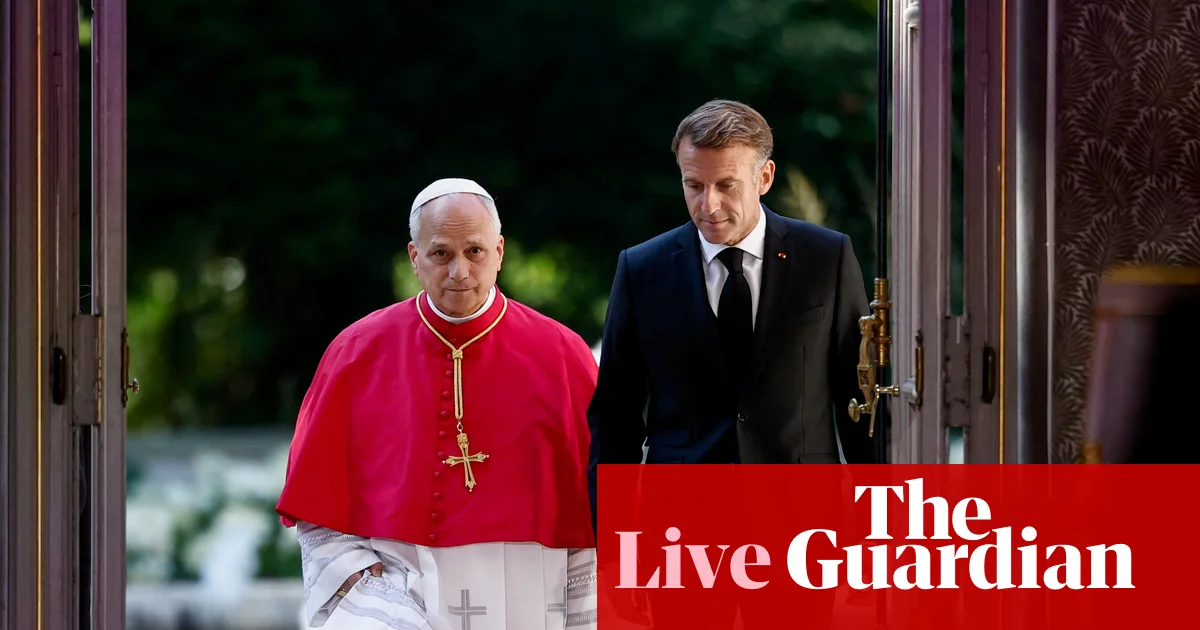
Leo’s visit in generally secular France attracted a fairly unexpected level of public interest, with over a million people expected to turn out to see him during the four-day trip.
There are a few sticking points between France’s secular public policy and the Catholic church’s teachings, including on abortion (the right was enshrined in the constitution in 2024) and assisted dying. The French Catholic hierarchy opposed both measures, but Leo is seen as unlikely to wade into these issues.
In political terms, the pope’s visit is seen as a big win for Macron in his final months in the office: his predecessor, Pope Francis, visited France three times, but never on an official state visit.
Only around 5% of France’s 69 million residents regularly attend Catholic church, AFP noted, but some 40% see themselves as Catholic.
Interestingly, Leo’s paternal ancestors were French, so there’s also that.
Key events
Pope Leo warns against ‘a paradise of machines’ as he focuses on AI concerns
Giving an early indication of what he will want to say about the role of AI later, Pope Leo says that while “technological development has contributed to a significant improvement in the living conditions of humanity,” it also regularly prompted discussions about “the ambiguous side of technology, which can cause harm when not used for good.”
He warns about AI creating “a paradise of machines” – it’s a reference to Georges Bernanos’s 1947 book France Against the Robots – and the need to avoid this, as “the French civilisation worked for centuries to cultivate free individuals fully responsible for their actions.”
He says there is an urgent concern that “we do not lose our humanity amid the paradise of machines that are invading and conditioning our daily lives.”
“There is an urgent need to train minds in ethical discernment, capable of recognising what is morally good,” he says.
Pope Leo responds in French, which no doubt will delight the hosts.
He says France is “often at the heart of his prayers,” given his family links – which draws a warm response from the audience – before he moves on to a broader tribute to France with its “deep Christian roots.”
In a particularly well-written paragraph, he says:
“For centuries, France has shone as a cultural, artistic, and spiritual beacon – not only in Europe but across the globe.
Through its schools, cathedrals, universities, and academies, as well as its pursuit of truth, France has helped shape minds far beyond its borders.
It exemplifies a unique French spirit – one deeply rooted in the Catholic tradition – that highlights how science, art, literature, and philosophy can serve the greater good of humanity when directed toward the pursuit of the beautiful, the good, and the true; indeed, ‘French’ has become synonymous with excellence in many fields.”
He also pays tribute to all involved in the reconstruction of Notre Dame Cathedral, which he is going to visit later today.
He then expands on the issue of France’s Christian roots, as he says:
“This constant regard for the inherent dignity of every human being finds an echo in your national motto: liberty, equality, and fraternity are not merely words carved onto the pediments of public buildings, but point to universal ethical imperatives that also find an inexhaustible source of inspiration and fulfilment in the Gospel message.”
French secularism ‘not negation of religion,’ Macron tells Pope Leo, as he welcomes him to France
Macron begins with a grand welcome, saying the visit is “a great honour and a source of great joy,” with the pope’s message of hope.
He draws on Pope Leo’s family roots in France, and France’s “unique story that binds Christianity to our nation” over 2,000 years, with the country’s landscape “dotted with cathedrals, basilicas, churches, and priceless monuments.”
He also mentions the reconstruction of the Notre Dame Cathedral, “restored not only for Catholics, but all French people, and indeed, the entire worlds.”
“For Notre-Dame is a part of us, an emblem of that quintessentially French desire to offer the world all the beauty the human spirit can create when moved by an ideal of universal fraternity.”
Macron also says that the French Republic’s secularism is not a “negation of religion,” but an intellectual position that “enables every individual … to think and express their views in all spheres fo life, to believe or not believe.”
He also talks about the growing number of acts of intolerance or hatred against different religions, pledging to protect all places of worship, of all religion.
The president also talks about the need for peace, human rights, sovereignty at a time when all of these get questioned or challenged more often than before.
He also goes through a number of other issues, including the fight against poverty and exclusion, the need for good education, and touches on climate change, too.
Macron also talks about AI, expected to be a big theme of Leo’s visit, as he says “human beings must be liberated by the digital realm, not bound by it.”
“Artificial intelligence must be a servant, not a master. The digital revolution must lead, not enslave. It is therefore our responsibility to prevent the most advanced models from falling into the hands of a few who would then decide for all of humanity. Nor should we allow its most exponential advances to lead us to lose control.”
He also talks about protecting children online, in line with one of his main areas of focus in recent months.
Back to Paris, we are expecting to hear from Macron and Pope Leo shortly.
In fact, they are speaking now.
I will bring you all the key lines here.
Meanwhile, Russian authorities released the full results from the country’s parliamentary election, and, would you believe it!?, the main Kremlin party, United Russia, won it big time.
Totally unexpected.
The party will get more than three-fourths of the seats in the lower house, the State Duma, a record high, AP noted. The tightly orchestrated vote excluded virtually any genuine opposition, it added.
As Luke Harding reported last week,
“Western governments denounced the polls held in Russian-occupied areas of Ukraine as a “sham”.
Russia’s supreme court last month banned the only party that opposes the war, Yabloko, from participating, leaving liberal voters with no option to express discontent.”
And here are some photos from the palace …
Back in Paris, Pope Leo has arrived at the Élysée Palace, where he was greeted by the French president Emmanuel Macron and his wife Brigitte.
Crowds lined the streets of the capital to greet the pope, before his car arrived at the official residency of French president.
A particularly long red carpet was rolled out as the Macrons appeared to warmly welcome Leo to the palace.
Television footage showed the pope and the president talking to one another as they made their way through the grand building.
Ukraine hit two Russian oil refineries in the past day, president Volodymyr Zelenskyy said.
Zelenskyy said facilities has been struck in Bashkortostan and the Samara region, and that there had also been unspecified strikes in the Black Sea.
Trump made final decision to give Ukraine licences to produce Patriot missiles, Zelenskyy claims
Meanwhile, we are getting a strong news line from Ukraine, with president Volodymyr Zelenskyy telling reporters that US president Donald Trump told him during their recent meeting that Ukraine would receive licenses for the production of Patriot missiles.
In a voice note to journalists, Zelenskyy said:
“At our last meeting, President Trump emphasised to me that yes, I have made a final decision. Ukraine will receive licences for the production of Patriot missiles.”
Trump first suggested the move in July, though he later appeared to backtrack on the promise.
As Peter Beaumont explained at the time, it would mark a significant shift for Ukraine – if actually delivered on:
“It would be a diplomatic coup for Kyiv, which has been struggling to counter Moscow’s increasing missile threat.
Zelenskyy has for years been asking for more of [the missiles], and more recently for a license so that Ukraine can manufacture its own. Even at the current increased rate of production it is estimated that the US would not manage to replenish its stockpile for its own use until 2028.”
Leo’s visit in generally secular France attracted a fairly unexpected level of public interest, with over a million people expected to turn out to see him during the four-day trip.
There are a few sticking points between France’s secular public policy and the Catholic church’s teachings, including on abortion (the right was enshrined in the constitution in 2024) and assisted dying. The French Catholic hierarchy opposed both measures, but Leo is seen as unlikely to wade into these issues.
In political terms, the pope’s visit is seen as a big win for Macron in his final months in the office: his predecessor, Pope Francis, visited France three times, but never on an official state visit.
Only around 5% of France’s 69 million residents regularly attend Catholic church, AFP noted, but some 40% see themselves as Catholic.
Interestingly, Leo’s paternal ancestors were French, so there’s also that.
