


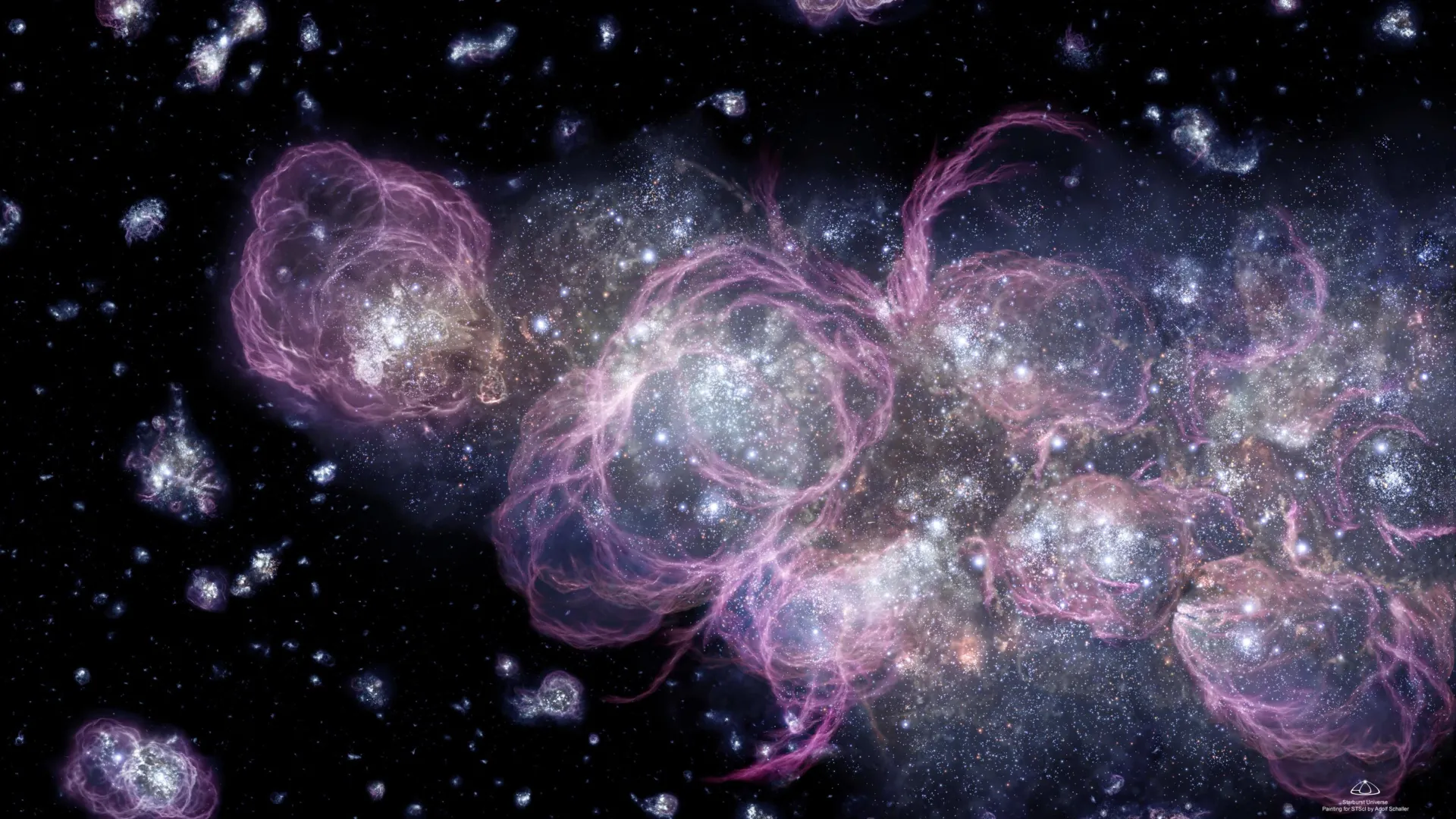
Astronomers are finding that the first generations of galaxies do not always behave the way existing models predict. One possible reason is that their most massive stars may have evolved very differently from massive stars in the modern Milky Way.
A new survey led by the University of Utah is using the Hubble Space Telescope to investigate those differences. The project, known as the Treasury of Extremely Metal-Poor O Stars (TEMPOS), relies on ultraviolet (UV) measurements from Hubble’s Cosmic Origins Spectrograph (COS) to examine massive stars in nearby galaxies that resemble the environments found in the early universe.
The unusually large TEMPOS dataset could allow researchers to improve models of massive stars and better understand how these powerful objects influenced young galaxies. That work is becoming increasingly important as the James Webb Space Telescope, which launched in 2021, continues to uncover unexpectedly complex galaxies from the universe’s early history.
“Webb opened up a whole bunch of new questions about the evolution of these early galaxies — they’re weird,” said Grace Telford, assistant professor in the Department of Physics & Astronomy at the University of Utah and lead author of the study. “That’s the scientific motivation behind the TEMPOS program: to help understand what is going on in these early galaxies.”
The survey was published on Sept. 21, 2026, in The Astrophysical Journal Supplement Series.
Massive Stars Shape Entire Galaxies
Stars more than 10 times as massive as the sun are uncommon, but their influence can extend across an entire galaxy. They emit enormous amounts of radiation, continuously lose material through stellar winds and eventually end their lives in supernova explosions.
“They burn very hot, bright and fast and they end their short lives as supernova explosions that deposit a lot of energy and material into the surrounding gas,” said Telford. “They govern the evolution of their host galaxies by heating and essentially regulating the gas that’s then available to cool and form into new stars.”
One major difference between early galaxies and galaxies today is their chemical composition. Astronomers use metallicity to describe the amount of elements heavier than hydrogen and helium present in a star or galaxy.
The earliest galaxies had produced far fewer of these heavier elements than galaxies such as the Milky Way contain today. As a result, massive stars born during that era may have had physical properties that differ substantially from massive stars astronomers can study closer to home.
“Massive stars at low metallicity are particularly important for building accurate models of early galaxies,” Telford said. “And we can’t just study how metal-rich massive stars in the Milky Way behave to interpret those observations.”
Nearby Dwarf Galaxies Offer a Window Into the Past
Astronomers cannot examine individual massive stars in the distant early universe in enough detail to measure many of these properties directly. TEMPOS therefore turned to relatively nearby dwarf galaxies whose chemical compositions provide a useful comparison.
The survey examined 29 massive stars spread across six local dwarf galaxies. Every galaxy in the sample has a metallicity below one-fifth of that of the sun, making the stars useful stand-ins for studying conditions that were common much earlier in cosmic history.
Ultraviolet light provides particularly valuable information about these stars. Their UV spectra contain fingerprints of chemical elements in their atmospheres while also revealing details about the stellar winds carrying material away from their surfaces.
Obtaining those measurements is difficult because individual massive stars beyond the Milky Way are extremely faint. Studying them can require many hours of observing time on some of the world’s most capable telescopes.
“It’s a sample of 29 stars, which doesn’t sound like a lot, but when each one costs up to 35 hours of Hubble time to observe, it gets really expensive,” Telford said.
TEMPOS added new observations of 12 stars to previously gathered measurements, producing a larger and more consistent dataset for comparison.
Stellar Winds Slow Dramatically at Low Metallicity
Massive stars gradually shed material through powerful stellar winds. The strength and speed of those winds are closely connected to a star’s metallicity.
Metal ions help transfer energy from a star’s radiation into surrounding material, pushing that material outward. Scientists therefore expect stars with fewer heavy elements to produce weaker winds and lose less mass during their lifetimes.
TEMPOS confirmed the broad pattern astronomers anticipated. As metallicity falls, the maximum speed of stellar winds also tends to decrease.
At the most extreme end of the sample, however, something unexpected appeared.
For stars with metallicity below about 10% of the sun’s, wind speeds dropped much more sharply than trends measured at higher metallicities would predict.
“There’s sort of a smooth trend and then suddenly for lowest-metallicity stars, the wind speed really drops off,” Telford said. “I was so excited to find that fun surprise in the data.”
That sharp decline could have major consequences for how massive stars live and die. If extremely metal-poor stars lose less material through their winds, they could preserve more of their original mass throughout their lives.
That difference could alter their later evolution, their eventual deaths and the amount of energy and material they return to their surroundings. Because massive stars help control the gas available for future star formation, even changes occurring within individual stars can ultimately influence the development of entire galaxies.
Iron Could Be a Crucial Missing Piece
Among the heavy elements found in massive stars, iron may be especially important. It helps drive stellar winds, influences how massive stars evolve and plays an important role in the processes leading to their eventual supernova explosions.
Yet measuring iron in extremely metal-poor environments is notoriously challenging.
Astronomers frequently estimate metallicity by measuring oxygen in the gas of a galaxy. Oxygen ions produce bright emission lines when illuminated by massive stars, which makes them comparatively easy to detect.
Researchers often assume that iron abundance follows oxygen abundance closely. However, the two elements do not necessarily increase or decrease in exactly the same way.
TEMPOS allowed researchers to investigate that relationship more directly by examining extremely faint iron absorption features in the ultraviolet spectra. In simple terms, the team measured how much UV light was being absorbed by iron compared with the amount of light that would otherwise be present.
They found that massive stars in more oxygen-rich (high metallicity) galaxies generally show substantially stronger iron absorption than stars in oxygen-poor (low metallicity) galaxies.
At the same time, the range of iron absorption measured by TEMPOS indicates that these metal-poor stars may contain surprisingly different amounts of iron.
“This is the first time we’ve had the statistical power to see that trend across a large sample of stars in six galaxies, all with different chemical compositions,” Telford said. “TEMPOS gives us the foundation for determining how massive-star physics changes as iron abundance changes in the very low-metallicity regime.”
A Larger Sample Reveals Hidden Trends
Before TEMPOS, Telford had performed detailed modeling of three stars that are now included in the larger survey.
That smaller dataset was not enough to reveal the broader patterns that are becoming visible with dozens of stars.
“With only three, you don’t see these trends,” she said. “We’ve always just been stuck in this low number statistics regime, so this is our very best attempt to build a big enough sample to do something more useful.”
The researchers now plan to push the analysis further by combining Hubble’s ultraviolet measurements with visible-light observations collected at the Keck Observatory in Hawaii.
Using both datasets will allow scientists to build more detailed models of the stars and calculate properties including their chemical abundances and the rates at which stellar winds strip away their mass.
Those measurements could ultimately improve models used to interpret the unusual early galaxies being observed by Webb.
The TEMPOS science-ready UV spectra will also be made publicly available through the Mikulski Archive for Space Telescopes, giving other researchers an opportunity to investigate additional questions about massive stars and their influence on galaxy evolution.
The survey’s collaborators are Christiana Erba of California State University, Fresno and the Dowing Planetarium; Kristen McQuinn of the Space Telescope Science Institute (STScI) and Rutgers University; Calum Hawcroft, Julia Roman-Duval and Claus Leitherer of STScI; Andreas Sander of Christian-Albrechts-Universität zu Kiel and the Astronomisches Rechen-Institut (ARI); John Chisholm and Danielle Berg of The University of Texas at Austin and the Cosmic Frontier Center; Varsha Ramachandran of ARI; Yong Zheng of Rensselaer Polytechnic Institute; Abby Mintz of Princeton University; and Evan Kirby of the University of Notre Dame.
The work was based on observations with the NASA/ESA Hubble Space Telescope and was supported by NASA (grant numbers GO-16767, GO-16920, and GO-17491).
