


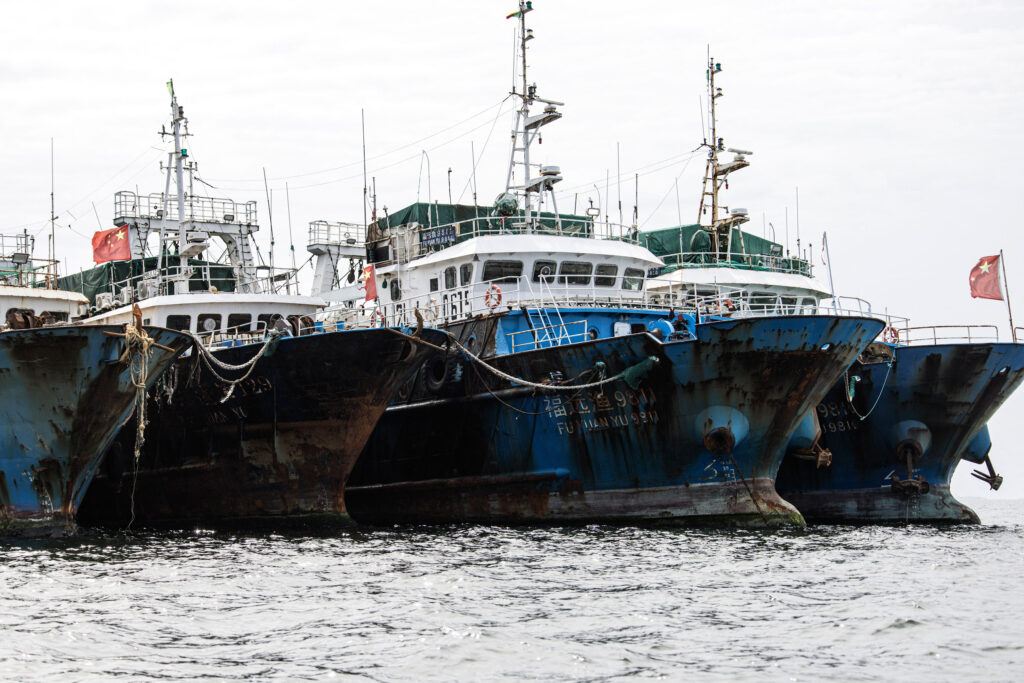
Seafood isn’t just a key source of protein and calories; it’s also where millions around the world get essential vitamins and minerals needed to build tissue, fight infections and grow. Yet, as modern mechanized fishing fleets plunder global waters, populations in low-income countries are losing out.
If the fish caught by foreign-flagged bottom trawlers went to local populations instead of international markets, over 10 million people in nutritionally vulnerable countries could reach adequate vitamin and mineral intake, according to a team of scientists from Oceana.
In sub-Saharan Africa and South Asia, micronutrient deficiencies—including a lack of omega-3, vitamin B12 and zinc—are a significant cause of cognitive and immune impairments.
While seafood can be an important source of nutrients, foreign fishing operations primarily export their catch abroad, leaving little for local food systems, according to the paper published in npj Ocean Sustainability.
“There’s a huge problem with food security,” said David Costalago, lead author and senior marine scientist at Oceana. “The most negatively impacted countries are mostly in West Africa,” he said, where around 80 percent of the coastal population depends on sardine species that are frequently shipped to European markets or ground up for animal feed.
While countries often receive money for allowing foreign bottom trawlers to fish in their waters, those payments are not comparable to the value of the catches taken from their seas by the large industrial ships dragging gargantuan nets along the seafloor, according to Costalago.
Often termed “hidden hunger,” nutrient deficiencies can bring long-lasting consequences. In the case of calcium, this includes health problems like osteoporosis, a medical condition that results in weak bones. A lack of B12 is a key driver of developmental delays in children, and iron deficiencies result in anemia.
While bottom trawling accounts for over one quarter of the global marine catch—producing nearly 28 million tons of seafood annually—it’s a highly unselective approach responsible for almost half of all the fish discarded globally.
“Bottom trawling is like hunting with bulldozers,” said Sarah Foster, a senior researcher at the University of British Columbia, in an email to Inside Climate News. “Hundreds of thousands of these boats tow wide-mouthed, heavily weighted nets across the seafloor, indiscriminately catching a huge number of species and damaging marine habitats.”
It also exemplifies structural imbalances in the governance of global fisheries.
Indeed, ninety percent of distant-water catches come from fishing boats from just five countries that heavily subsidize an otherwise unprofitable industry: China, Taiwan, Japan, South Korea and Spain.
The fleets predominantly haul the coastal waters of Africa and Pacific Island nations—seven of the top ten most impacted nations are in West Africa alone: Guinea-Bissau, Guinea, Gambia, Liberia, Côte d’Ivoire, Sierra Leone and Togo. Three other African nations fill the top spots: Gabon, the Republic of the Congo and Namibia.
“Bottom trawling is like hunting with bulldozers.”
— Sarah Foster, senior researcher at the University of British Columbia
In Guinea-Bissau, more than half of the population with inadequate nutrient intake could transition to adequate vitamin and mineral levels if domestic fish stocks weren’t fished by foreign fleets.
In the case of calcium, 99.9 percent of Bissau-Guineans with a currently inadequate intake could achieve adequate levels if foreign-caught catch was retained locally.
Global reductions in fish stocks—driven by rampant overfishing and climate change—will only worsen current nutrient availability. Such declines could lead to 11 percent of the world’s population suffering zinc or iron deficiencies, and 19 percent becoming deficient in vitamin B12, omega-3 and fatty acids.
While banning foreign bottom trawling wouldn’t guarantee nutrients for local populations—many countries lack the infrastructure to harvest and process enough catch themselves—the report highlights alternative, lower-impact fishing gear, such as hooks and longlines, that could be used instead.
Researchers are now calling for a more balanced approach to fisheries management, one that weighs nutrient needs when divvying up the world’s marine resources.
“It’s also a call to action for food security to be built into fisheries management and policy decisions, not treated as an afterthought,” said Foster. “Any country serious about the food security of its most vulnerable people needs to examine how much of its fish and other marine life is being taken by distant water fleets, and how much that catch is fuelling hunger and malnutrition.”
About This Story
Perhaps you noticed: This story, like all the news we publish, is free to read. That’s because Inside Climate News is a 501c3 nonprofit organization. We do not charge a subscription fee, lock our news behind a paywall, or clutter our website with ads. We make our news on climate and the environment freely available to you and anyone who wants it.
That’s not all. We also share our news for free with scores of other media organizations around the country. Many of them can’t afford to do environmental journalism of their own. We’ve built bureaus from coast to coast to report local stories, collaborate with local newsrooms and co-publish articles so that this vital work is shared as widely as possible.
Two of us launched ICN in 2007. Six years later we earned a Pulitzer Prize for National Reporting, and now we run the oldest and largest dedicated climate newsroom in the nation. We tell the story in all its complexity. We hold polluters accountable. We expose environmental injustice. We debunk misinformation. We scrutinize solutions and inspire action.
Donations from readers like you fund every aspect of what we do. If you don’t already, will you support our ongoing work, our reporting on the biggest crisis facing our planet, and help us reach even more readers in more places?
Please take a moment to make a tax-deductible donation. Every one of them makes a difference.
Thank you,
Fisheries Reporter
Johnny Sturgeon is a London-based reporter covering fisheries and aquaculture. Joining us from the Outlaw Ocean Project, he has experience producing in-depth maritime investigations for nonprofit newsrooms. A former boatbuilder, he holds a B.A. in History & Politics from the University of Oxford, and an M.S. from Columbia Journalism School.
