


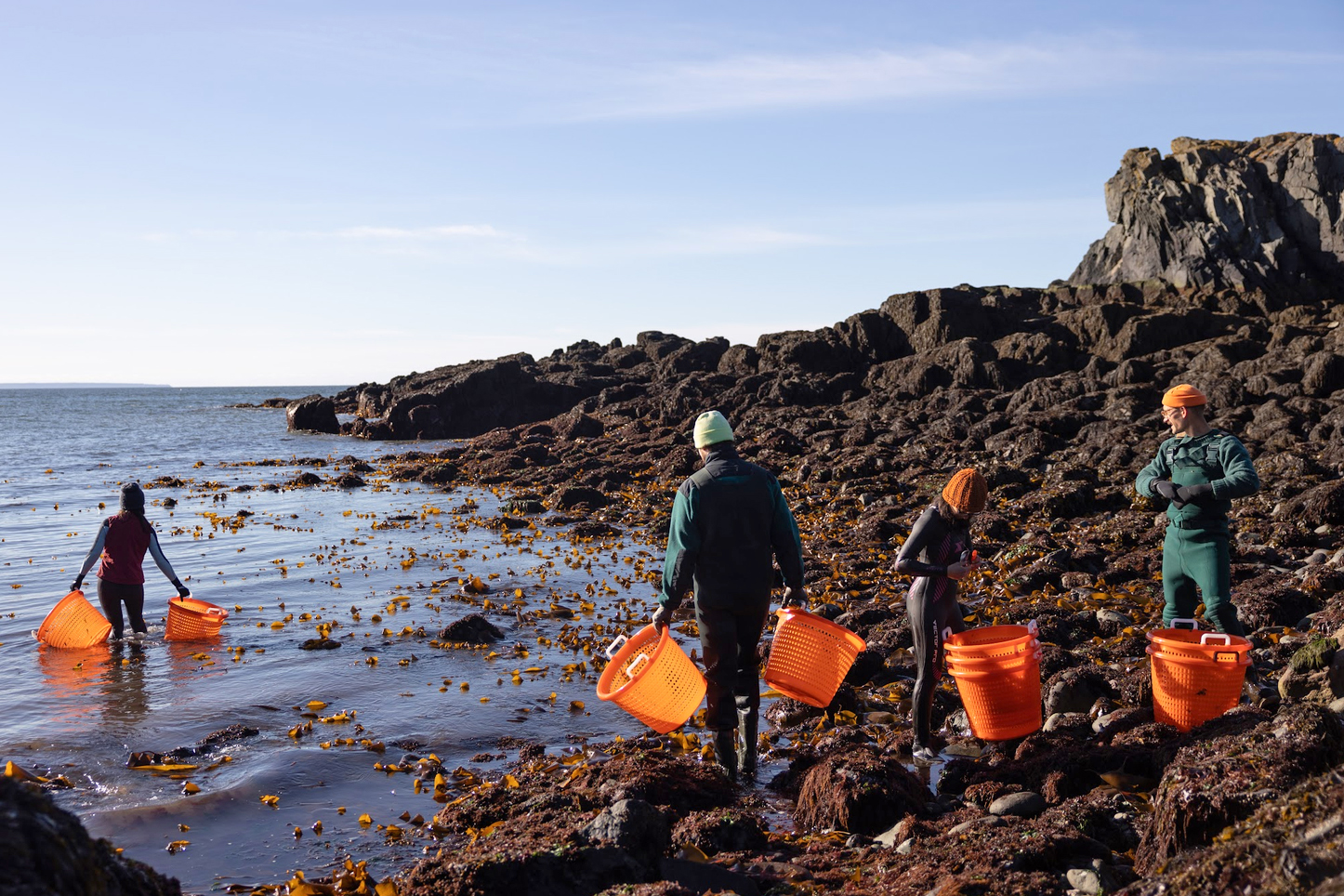
Glenda Beal’s roots in lobstering run nearly as deep as her roots in the town that shares her name: Beals Island, Maine. Her husband and two sons are lobstermen, as were her father and uncle, both grandfathers and a few generations before that.
“Our economy runs on lobster fishing, predominantly,” said Beal, 60, a descendant of one of the island’s original settlers.
It’s a tough industry in which to make a living, Beal said, and the three salmon farming operations in nearby Eastern Bay only make it tougher. She said her community’s lobstermen have noticed barren and polluted waters, damaged gear, floating trash and, on one occasion, dead salmon washed up on their shorelines, and they believe aquaculture is to blame.
The corporation that owns these operations, Cooke Aquaculture, a Canadian multinational based in Saint John, New Brunswick, is being sued for business practices alleged to harm the environment, local fisheries and tourism.
“Having areas taken up by [a] large acreage of pens prevents fishermen from fishing in these traditional waters that they’ve always been able to use,” Beal said. “There isn’t a fisherman out there that likes it.”
That’s why Beals Island and a few other Maine towns have recently tried to exert more local control over whether and how aquaculture facilities operate in their waters.
The Growing Industry
Maine’s aquaculture industry contributed more than $200 million to the state’s economy in 2023, according to the Maine Aquaculture Association.
The largest company is Cooke Aquaculture, which has 24 active lease sites along Maine’s coastline, plus inland hatcheries and a processing facility, according to records on the state’s Department of Marine Resources website.
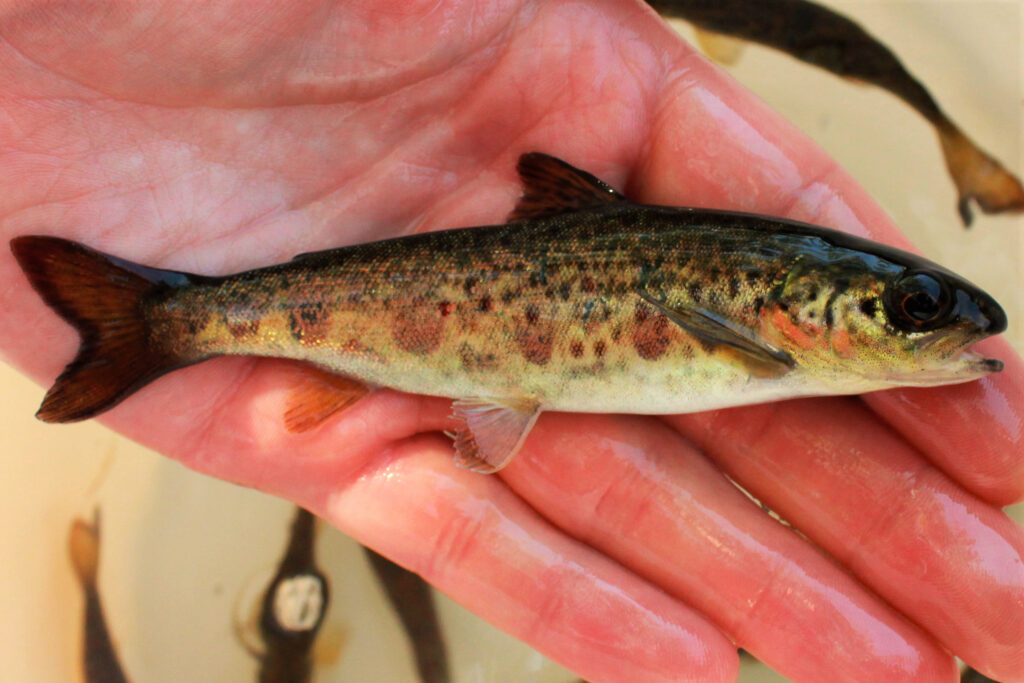
Cooke operates in 16 countries. Its Maine facilities primarily grow Atlantic salmon in open net pens, floating cages within a larger body of water. Each lease site has multiple pens that hold tens of thousands of salmon during their growth from juvenile to adult size.
The company’s net-pen facilities dot sheltered bays along the Maine coast, places that also sustain ecosystems of lobster, periwinkles, oysters, clams and juvenile fish, including the endangered wild Atlantic salmon. Many of those species form the basis for Maine’s commercial fisheries.
According to state regulations, aquaculture sites aren’t allowed to harm these sensitive ecosystems or interfere with active fisheries. Yet, Beal said that’s exactly what she sees happening. The Conservation Law Foundation agrees—and filed a lawsuit in the U.S. District Court for the District of Maine in January 2025 alleging ongoing Clean Water Act violations at Cooke facilities and harm to area fishing and tourism.
Dead in the Water
The daily upkeep of salmon aquaculture—feedings, pen maintenance, treatments for disease and pests when needed—all occurs in the open water and influences the ecosystem far beyond the pen’s boundaries.
Beal said local fishers have reported that former harvest sites near the pens are no longer viable and the seabed is unusually empty of life.
Waste from the pens, including excess food, excrement and sometimes bits of dead fish, rots and can upset the balance of nutrients like nitrogen and sulfide, Beal said. The resulting low-oxygen conditions suffocate life on the seabed below, including the eelgrass beds that protect young fish and crustaceans.
“That’s the nursery bed of all our sea creatures,” Beal said. “They are critically important.”
The CLF lawsuit against Cooke described a “thick layer of toxic sediment on the ocean floor” and a “foul-smelling black sludge” on lobster traps near the net-pen sites.
According to the CLF, Cooke has repeatedly reported toxic sulfide levels at multiple sites. The lawsuit also alleges the company has failed to meet state monitoring requirements on several occasions, exceeded pollutant discharge limits and reported sediment samples “indicative of poor ecological quality.”
Salmon aquaculture formerly used chemicals to treat sea lice in the pens, which were toxic to other marine life. Today, Maine Aquaculture Association Executive Director Sebastian Belle said the industry instead relies on hot-water baths to kill the lice and letting sites fallow to stop disease and parasite spread.
The CLF lawsuit, however, claims that Cooke boats have been witnessed dumping water with blood and a “chemical odor” after delousing activity.
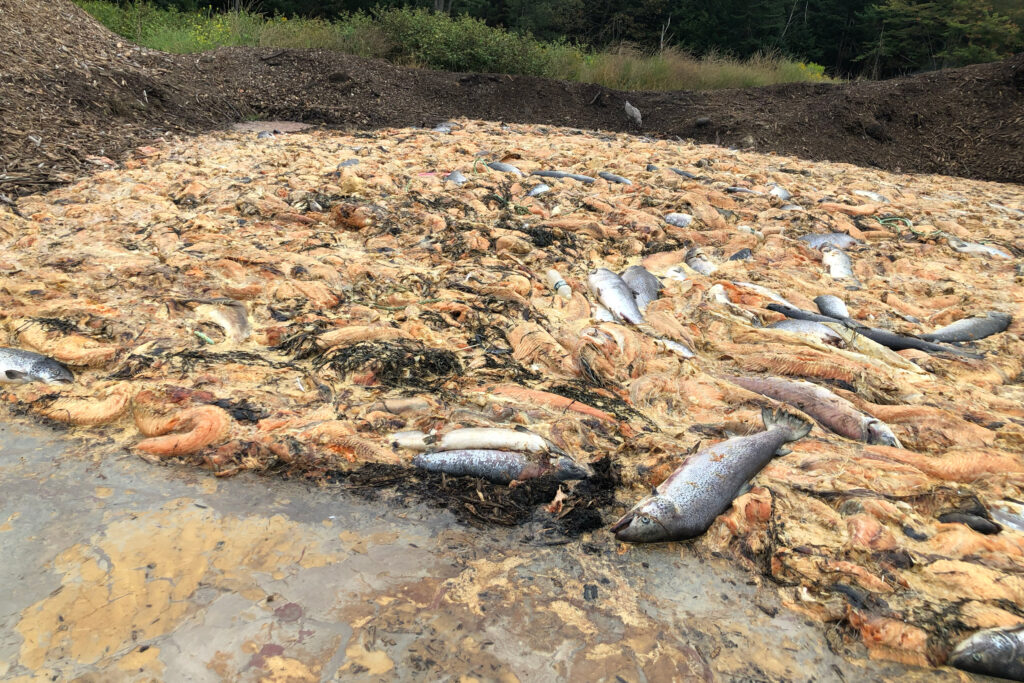
Cooke facilities had major die-offs of their stock at one Maine site in 2021 and two others in 2024. Disease or pests can cause these mass deaths to occur, as can high temperatures or low oxygen.
Beal said dead salmon floated in the water and washed up on beaches around Beals Island after the 2024 die-off. Though the state cleared Cooke of wrongdoing, Beal said there was “very little satisfactory explanation” about what happened, and she believes pollution from the pens played a role.
Past Infractions
Cooke has received six letters of warning and 20 notices of violation from the Maine Department of Environmental Protection in the past decade, as well as a 2019 consent agreement to pay $190,000 in fines for improper sulfide sampling and exceeding the allowed number of fish per pen.
The company has previously been sanctioned in Chile and fined in Canada and Washington state for other violations. Cooke was accused of animal rights abuses and neglecting sanitary standards at Maine facilities in 2019 and again earlier this year.
The latest undercover video, published in May by an animal rights group, prompted state and third-party investigations.
Cooke did not respond to interview requests, but it previously put out a statement declaring that the CLF’s claims are false. Cooke has also filed a motion to dismiss the suit, which is currently awaiting a judicial decision.
Belle and the Maine Aquaculture Association have also repeatedly called the lawsuit’s claims false and misleading. Belle asserted that modern management practices have reduced the input of excess feed, antibiotics and chemicals into the water and have made salmon aquaculture safe and sustainable.
Dwayne Shaw, the executive director of the Downeast Salmon Federation, a nonprofit focused on wild salmon restoration, cast doubt on the effectiveness of those practices: “Even with that, they’ve not been able to prevent the pollution and the impacts.”
A Sensitive Species
The proximity of farmed salmon to wild salmon concerns Shaw. Net pens can fail and allow escapes due to storms, seal attacks, employee error or equipment degradation, as happened at Cooke sites in Maine in 2020 and 2023.
This can be a big problem for wild Atlantic salmon, which Shaw said are a “very sensitive species.”
Federal and state agencies and groups like the Downeast Salmon Federation have put years of work into breeding efforts and habitat restoration to keep them from extinction.
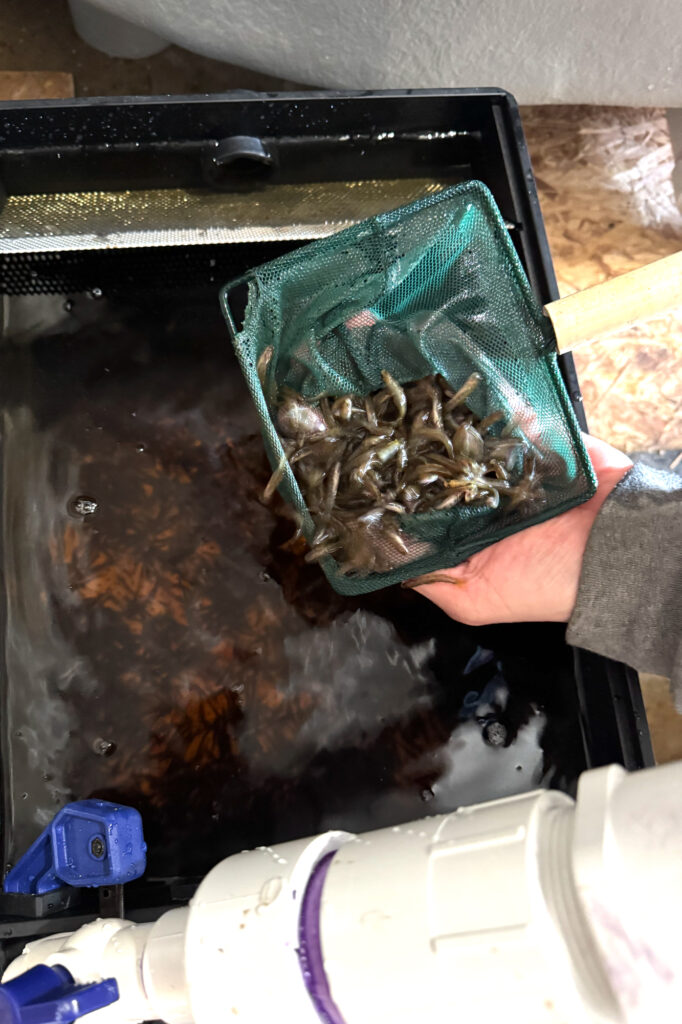
Right now, there are less than 2,000 wild Atlantic salmon living in Maine, Shaw said, well below restoration goals.
Escaped farm salmon are additional competitors for food and other resources, and they can spread disease and parasites, Shaw said. Researchers have found that farmed salmon in Norway have repeatedly spread sea lice that killed wild Atlantic salmon. The CLF lawsuit attributes at least one disease outbreak among wild salmon to Cooke fish.
Farmed salmon are bred to produce better meat, but those traits make wild survival more difficult. “If those genes mix, then you’ve got an inferior creature in terms of its fitness in the wild,” Shaw said.
He worries about the possibility of interbreeding between escaped domestic salmon and wild salmon. Two Cooke facilities are “immediately adjacent” to Downeast Salmon Federation sites, he said.
There are some protective measures in place. Companies must put identifying marks on their salmon and create an annual containment plan to prevent escapes. Belle said escaped fish are lost profits, so the industry is incentivized to create protections.
The U.S. Fish and Wildlife Service does genetic screenings to make sure its wild salmon hatcheries don’t use fish with domesticated DNA.
DMR staff also do testing to prevent farm-raised salmon from entering spawning areas. Since aquaculture companies keep genetic records of their stock, the DMR can attempt to find a match and trace an escapee back to its source.
So far, there are no known instances of interbreeding in Maine. However, it has occurred in several Norwegian rivers after farmed salmon escapes, and Scotland and Ireland have also found escaped salmon traveling and spawning with wild salmon.
Washington decided to ban net-pen farming of non-native fish after a 2017 net failure at a Cooke facility released 250,000 fish into Puget Sound. California, Alaska and British Columbia have similar restrictions in place or planned for the near future.
“On the West Coast they’ve been banned, so why are we having them on the East Coast?” Beal asked
The Coastal Economy
Even if aquaculture lease sites don’t overlap with seafood harvest areas on paper, Beal said they still impact local fishers. “I don’t believe there’s a fisherman around who would think having Cooke in our waters is a good thing,” she said.
The CLF lawsuit states that some of the foundation’s members have had to relocate lobster traps and other fishing gear farther away from “dead zones” near the net pens. Floating trash, such as feed bags, tubes, ropes and nets, appears in the water and on the shoreline around the island, and Beal said Cooke appears to be the most likely source.
Tubes and ropes are a danger to fishing boats, Beal said, and “could cost them a day’s work, could cost them major repairs.”
Boats traveling to and from the Cooke sites have damaged lobster traps or accidentally cut their lines. In Lubec, a coastal Maine town northeast of Beals Island, a Cooke boat damaged the town’s commercial pier earlier this year. The CLF lawsuit alleges that Cooke’s presence has also harmed tourism industries like whale watching.
At Severine von Tscharner Welcome’s farm on Cobscook Bay, near another Cooke net-pen facility, she sometimes sees “acres of foam floating off of those sites that are closest to me” while working in her seaweed and oyster beds.
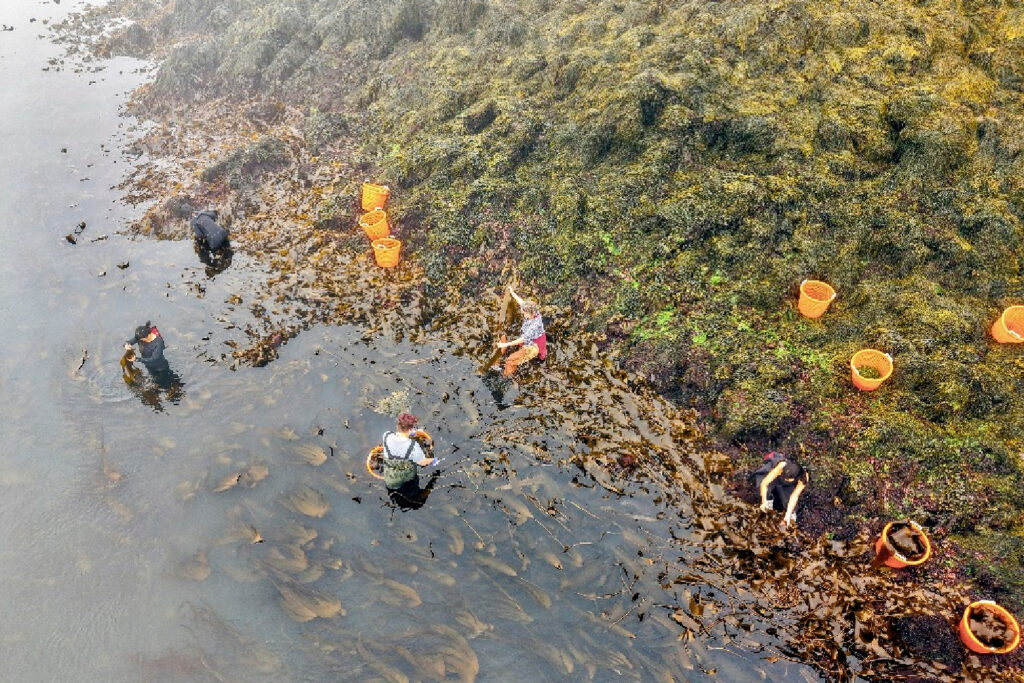
Welcome, 45, said she worries about how the unidentified foam and other pollutants will affect her crop and the people who help her harvest it. “They’re violating the principles of sustainable practice and they’re making a bad impact on the bay at large,” said Welcome, who is also the director of Greenhorns, a nonprofit for new farmers.
She said Cooke lease sites “monopolize the whole space” in Cobscook Bay. “Our economy is not Cooke. Our economy is diverse fisheries, recreation, tourism, ‘Vacationland,’” Welcome said, referencing the state’s nickname.
Cooke does pay wharf and property taxes and other fees at each of its facilities, and Belle said salmon farming employs about 200 Mainers.
But according to Beal, those revenues don’t come close to the costs her town has experienced.
“They’re really not compensating the towns enough for that use to make up for the pollution and the lack of fishing waters,” she said.
Crystal Canney, the executive director of the Protect Maine’s Fishing Heritage Foundation, said she’s heard seafood harvesters along Maine’s coast complain about large-scale aquaculture and how the state regulates it. “A lot of the lobstermen are just ticked off,” Canney said.
An Oversight Problem
Maine’s Department of Marine Resources and Department of Environmental Protection set the standards for aquaculture operations and environmental impact. However, most of the compliance data is monitored and reported by the facilities themselves.
The DMR conducts an initial site review for proposed facilities and annual inspections of existing facilities and fish health. The DEP also conducts annual site visits.
Everything else—feed reports, sediment and water quality tests, pollution discharge monitoring, fish health reports, biosecurity audits and annual containment management plans—is documented by the company and submitted to the state for review. These reports are considered proprietary and aren’t made public.
“There’s no transparency there,” Canney said. “I would like to see the state take the responsibility it should in the oversight of these net pens instead of abdicating it to the very businesses they’re supposed to be overseeing.”
This story is funded by readers like you.
Our nonprofit newsroom provides award-winning climate coverage free of charge and advertising. We rely on donations from readers like you to keep going. Please donate now to support our work.
Aquaculture companies must report major incidents like fish escapes, disease outbreaks or excessive pollutant discharge to the state, along with a plan to address the problem.
This prompts a site visit by the DMR or DEP to investigate the cause and solutions. Belle said aquaculture facilities are also subject to third-party audits when these incidents occur.
However, Beal believes that DMR and DEP scientists are too far away to respond quickly to reported problems, and that the state is essentially “rubber-stamping” lease applications and renewals because it wants the industry to grow.
In 2025, the state Legislature removed the option of public hearings for aquaculture lease renewals, though the DMR must still notify adjacent landowners, publish a local newspaper notice and accept public comments for 30 days. The stated goal was to reduce administrative burdens for the DMR and lease applicants.
For towns like Beals Island, the loss of public hearings feels like being shut out of the process. “It’s pretty egregious that the government would lease state waters to a known violator for 20 years and remove public comment from that process,” Welcome said.
Local Control
Beals Island is one of nine Maine communities that have passed ordinances restricting aquaculture operations in their waters.
“Basically, we felt that the state was not doing enough to protect our waters,” said Beal, who was chair of her town’s selectboard during the ordinance’s year-long drafting process.
The Protect Maine’s Fishing Heritage Foundation has helped several of these towns in drafting their ordinances, though Canney said the final decisions are always up to community members. A few towns have ultimately decided against the proposed ordinances.
Beal said residents at her town’s public meetings were overwhelmingly in favor of establishing an aquaculture review committee, with violation enforcement by the harbormaster.
The ordinance also sets a limit on the total acreage of aquaculture in Beals Island waters and how much space any single company can lease. Cooke’s upcoming lease renewals would exceed that limit.
Since the ordinance passed in October 2025, Beal said the town has already issued a notice of violation to Cooke for a navigational hazard, which was then corrected.
“I do think the ordinance keeps them on their toes,” she said. “I feel like that is affirmation that what we have done was necessary.”
These ordinances are on shaky ground, however. Municipalities have limited control over intertidal zones, but only the state DMR commissioner can decide on aquaculture siting and lease applications. The DMR has already publicly objected to these municipal ordinances, which it said lacks legal standing.
But since the DMR has not expressed interest in going to court over these ordinances, it’s unclear what will happen when state and local decisions conflict.
Beal said large-scale aquaculture has its place on Maine’s coast, as long as there’s enough regulation, independent monitoring and enforcement. She also wants to see the state deny leases when there are repeated violations or a lack of community support.
“Aquaculture has a right to be there, but not at the expense of these traditional fisheries,” Beal said.
About This Story
Perhaps you noticed: This story, like all the news we publish, is free to read. That’s because Inside Climate News is a 501c3 nonprofit organization. We do not charge a subscription fee, lock our news behind a paywall, or clutter our website with ads. We make our news on climate and the environment freely available to you and anyone who wants it.
That’s not all. We also share our news for free with scores of other media organizations around the country. Many of them can’t afford to do environmental journalism of their own. We’ve built bureaus from coast to coast to report local stories, collaborate with local newsrooms and co-publish articles so that this vital work is shared as widely as possible.
Two of us launched ICN in 2007. Six years later we earned a Pulitzer Prize for National Reporting, and now we run the oldest and largest dedicated climate newsroom in the nation. We tell the story in all its complexity. We hold polluters accountable. We expose environmental injustice. We debunk misinformation. We scrutinize solutions and inspire action.
Donations from readers like you fund every aspect of what we do. If you don’t already, will you support our ongoing work, our reporting on the biggest crisis facing our planet, and help us reach even more readers in more places?
Please take a moment to make a tax-deductible donation. Every one of them makes a difference.
Thank you,
Contributor
Sydney Cromwell is a freelance journalist based in Maine. She has a bachelor’s in journalism and mass communication from Samford University. Sydney previously founded Southern Science, which covers environmental issues in Alabama. Her work has appeared in The New York Times and in local publications around Birmingham, Ala.
