


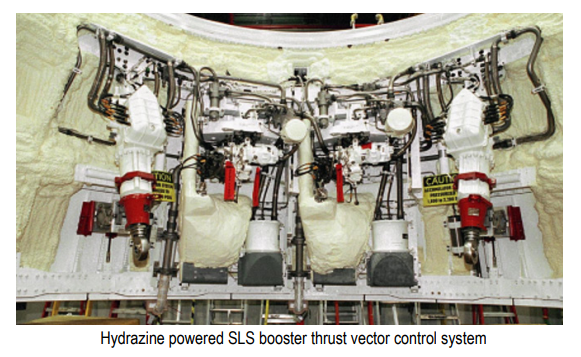
For more information, contact Jonathan E. Jones, Langley Research Center, jonathan.e.jones@nasa.gov
The purpose of this Technical Bulletin is to communicate the risks associated with freeze–thaw cycles in hydrazine monopropellant systems and to provide general recommendations for mitigating damage, operational hazards, and loss of system reliability in propulsion and auxiliary hydrazine systems.
Background
Hydrazine (N2H4) freezes near 1.6°C, and its phase transition is known to introduce risks to flight hardware. Multiple NASA programs have historically encountered hydrazine freeze related issues:
• Space Shuttle APU hydrazine lines were vulnerable to freeze induced contraction followed by thaw induced over expansion, capable of bursting plumbing. Shuttle flight rules permitted no more than two freeze–thaw cycles before considering the system degraded or failed.1
• Voyager propulsion systems faced mission threatening scenarios as hydrazine temperatures approached the freezing/slush formation range (0.1–1.6°C). Detailed thermal modeling was required to prevent freezing of lines, blockage, and thruster malfunction.2
• Hydrazine thermodynamic properties confirm significant changes in density and pressure across phase transitions, emphasizing the sensitivity of propellant lines to freeze–thaw stress.3
These combined lessons form the basis for risk identification and mitigation.
Problem Summary
Freeze–thaw exposure of hydrazine systems presents the following critical risks:
• Structural Damage Hydrazine contraction during freezing allows additional propellant into confined lines, producing “superpacked” conditions that cause line or fitting rupture upon thaw.2
• Valve, Seal, and Diaphragm Compromise Elastomeric components and precision valve seats may experience cracking, distortion, or loss of sealing capability due to differential thermal expansion. Voyager thermal assessments highlighted susceptibility of long stainless steel runs to asymmetric temperature profiles.2
• Line Blockage and Slush Formation Partially thawed hydrazine can remain “slushy,” restricting flow, altering mass flow rates, and causing thruster hard starts or misfires.2
• Hazardous Leaks Freeze induced damage may allow hydrazine to escape confinement, posing significant toxicity, reactivity, and ground crew exposure hazards.
• Loss of System Reliability As documented in Shuttle operations, hydrazine systems exposed to freeze–thaw cycles become life limited, reducing redundancy and mission availability.1
• Thermal Margin Uncertainty Voyager experience demonstrated that simple temperature readings cannot reliably determine true line temperature, necessitating high fidelity thermal modeling.2
Recommendations Prevention Measures
• Maintain Hydrazine Above Freezing Margin Keep all hydrazine systems above freezing, using heaters, insulation, blankets, or warm gas purge. Include uncertainty analysis in modeling and testing to ensure appropriate margins against freezing are maintained during all phases of operation.
• Avoid Uncontrolled Cooling During Ground Operations Ensure that tank, line, and valve components remain in environmentally controlled areas until integrated into the vehicle.
Post Freeze Response Protocol
If freezing cannot be ruled out:
• Suspend System Use Do not operate the hydrazine system until engineering evaluation is completed.
• Assess Number of Freeze–Thaw Cycles Treat each cycle as life limiting, an engineering assessment (static and fatigue) should be conducted based on conservative estimates of the line pressures during/after freeze/thaw cycles to understand potential line/component damage. Appropriate margin should be applied based on analysis uncertainty and/or underlying assumptions.
• Conduct Integrity Verification Perform pressure decay tests, NDE (if design allows), and valve health assessments.
• Implement Slow, Uniform Thawing To prevent thaw induced over pressure, warm hardware gradually and evenly. Shuttle experience with “superpacking” reinforces the necessity of controlled thawing.
Thruster and Valve Operational Readiness
• Ensure catalyst beds and valves reach proper thermal operating conditions before commanding any flow.
• Conduct pre start thermal stabilization periods, especially when flight readiness temperatures are marginal.
Thermal Modeling and Monitoring
• Utilize high fidelity thermal line modeling, emulating Voyager’s detailed propellant line modeling approach.2
• Avoid relying solely on bulk plate or tank temperatures to infer line readiness.
• Use thermal analysis and test to guide instrumentation placement on of the flight systems to monitor key temperatures set points.
Documentation and Incident Tracking
• Record all freeze exposures as reportable anomalies.
•Assign engineering disposition and track hardware life reduction accordingly.
Conclusion
Hydrazine freeze–thaw cycles present significant structural, operational, and safety risks for propulsion and auxiliary systems. Historical NASA programs show that prevention of hydrazine freezing is the most effective mitigation, with freeze exposure requiring formal engineering assessment, life limit adjustments, and controlled recovery procedures. Adhering to these recommendations will reduce risk to personnel, flight hardware, and mission success.
References
1. Space Shuttle Operational Flight Rules, Vol. A. All Flights, Mission Operations Diretorate, 20 June 2002. 2. W. C. Ledeboer, “Creating a Voyager Thermal Model 39 Years Into the Flight Mission, Along With Model Correlation and Application,” 8 July 2018. 3. J. L. Haws and B. G. Harden, “Thermodynamic Properties of Hydrazine,” Nov 1965.
