


- For internationally acclaimed photographer Federico Borella, documenting Sri Lanka’s human-elephant conflict goes beyond the gory story often depicted globally and instead offers an opportunity to learn about a complex web of experiences and responses, and a window for coexistence.
- Borella has been documenting human-elephant conflict in Sri Lanka for four years and has found intense conflict intertwined with genuine affection for the animals, despite the scale of human suffering.
- As a professional documentary photographer, Borella insists his role is to document the reality as he encounters it and not to sit in judgement as to whose suffering matters more.
- He intends to convert his body of work into a book, then hold exhibitions and work with schools to bring the complex story directly to the affected communities and the next generation.
COLOMBO – For award-winning Italian photographer Federico Borella, capturing Sri Lanka’s human-elephant conflict on camera is more than just a photographic assignment. Keen to record the complexity of the battle, he has been focusing on Sri Lanka for four years — documenting not just the conflict, but also the unique relationship between people and elephants with the gravitas it deserves.
“I have seen something close to veneration toward elephants, and even after being victims of elephant attacks, people are often kind to them,” Borella says. “Not everyone wants to retaliate or harm elephants, which is also a part of their relationship.”
For Borella, his current work is not only about the elephants in Sri Lanka, “but also about the kind of relationship we are building with the natural world everywhere.”
In a career studded with achievements, his work on the human-elephant conflict in Sri Lanka won him the prestigious Picture of the Year International (POYi) award under the environmental category in 2024.
He won the prestigious Photographer of the Year award at the 2019 Sony World Photography Awards and the top award in the documentary category for his Five Degrees project, a moving visual documentary of the tragic link between climate change, severe drought and high rates of suicide among South India’s male farmers.
In 2022, he came second in the wildlife and nature category of the Sony World Photography Award for his series, “Exotic appetite: Inside the Italian exotic animal trade”. In the 2026 awards, he took third place in the portraiture category, for his work on Koryo-saram people, the descendants of ethnic Koreans forcibly deported to Uzbekistan in 1937 by Joseph Stalin.
Photographer and photojournalism educator, Federico Borella. Image courtesy of Federico Borella.
Despite a glittering career, Borella remains convinced that documentary photography should not exist for a photographer’s personal glory, but should ultimately serve a higher purpose and, in some way, benefit the subjects he photographs.
His work has appeared in leading Italian and international publications, including National Geographic, The New York Times, Newsweek, TIME magazine, CNN, Days Japan, XLSemanal and Neue Zürcher Zeitung.
An educator in photography and photojournalism, he also organizes photography workshops in his native Bologna, Italy. Having exhibited his work in major cities worldwide, Borella is drawing up similar plans for Sri Lanka. “My purpose is not to tell people what to think about human-elephant conflict,” he adds. “It is to document an extremely complex reality and to make that complexity visible.”
Federico Borella spoke to Mongabay’s Dilrukshi Handunnetti while on a photographic assignment in Sri Lanka.
This interview has been lightly edited for length.
Mongabay: Your portfolio spans diverse global social and environmental issues. What drew your attention to Sri Lanka’s human-elephant conflict (HEC)?
Federico Borella: The spark came when I realized that, at some point, my professional path as a photographer had to intersect with my lifelong connection to animals.
After finishing high school, where I had studied Greek and Latin, I had the opportunity to apply for veterinary medicine, which in Italy is a highly competitive, limited-entry degree. I took the entrance exam and missed admission by just four places. I then decided to pursue a completely different path.
But that desire never disappeared. It remained somewhere in the background until a few years ago, when I went back to university. I am now studying to become a veterinary nurse.
I hope that one day I will be able to bring these two sides of my life together: Photography and animal care. The human-elephant conflict in Sri Lanka felt like a natural place for those two paths to meet because it is a story about animals, but also profoundly about people, land, survival and coexistence.

Mongabay: When selecting locations to visually document HEC, how did you prioritize places?
Federico Borella: The locations were selected after a careful study of the available sources, particularly Sri Lankan newspapers and local reporting. I wanted to understand where the conflict was most intense rather than traveling to the areas commonly associated with elephants or wildlife tourism.
Through research, it became clear that districts such as Anuradhapura and areas like Galgamuwa [in the North Central and North Western provinces respectively] were particularly affected by human-elephant conflict. Local reporting was extremely helpful in identifying not only the geographical hotspots, but also individual incidents, communities and situations that helped me understand what the conflict looks like on the ground.
Mongabay: International audiences tend to view Sri Lanka through the romanticized lens of wildlife tourism and majestic pachyderms. How did you personally reconcile this global perception with the gritty, tragic reality of a conflict over land and survival on the ground?
Federico Borella: I am honestly still trying to understand how these two realities can coexist.
One of the things that affected me most was the extraordinary relationship Sri Lankan people have with elephants. There is a genuine and very deep affection for these animals, even among people who have suffered terribly because of them. I met families who had lost a father, a mother or a child to an elephant attack, and yet, inside their homes, I found images and representations of elephants. That contradiction moved me deeply.
It made me realize that this cannot simply be reduced to a story of humans against elephants. The relationship is much more complex. There can be grief, fear and anger; at the same time, there can still be admiration, respect and even love for the very animal that has caused enormous pain. I am still trying to fully grasp how all these emotions can exist together.

Mongabay: Your work explores the relationship between humans and nature. In capturing this crisis, how did you balance portraying the human suffering, such as deaths, injuries and loss of livelihoods, with the devastating mortality rates of the elephants?
Federico Borella: It is extremely complicated. I do not want to judge anyone, and judging is not a part of my personality or my role as a photographer. What I can do is to document reality as I encounter it, even when that reality contains an enormous amount of suffering on both sides.
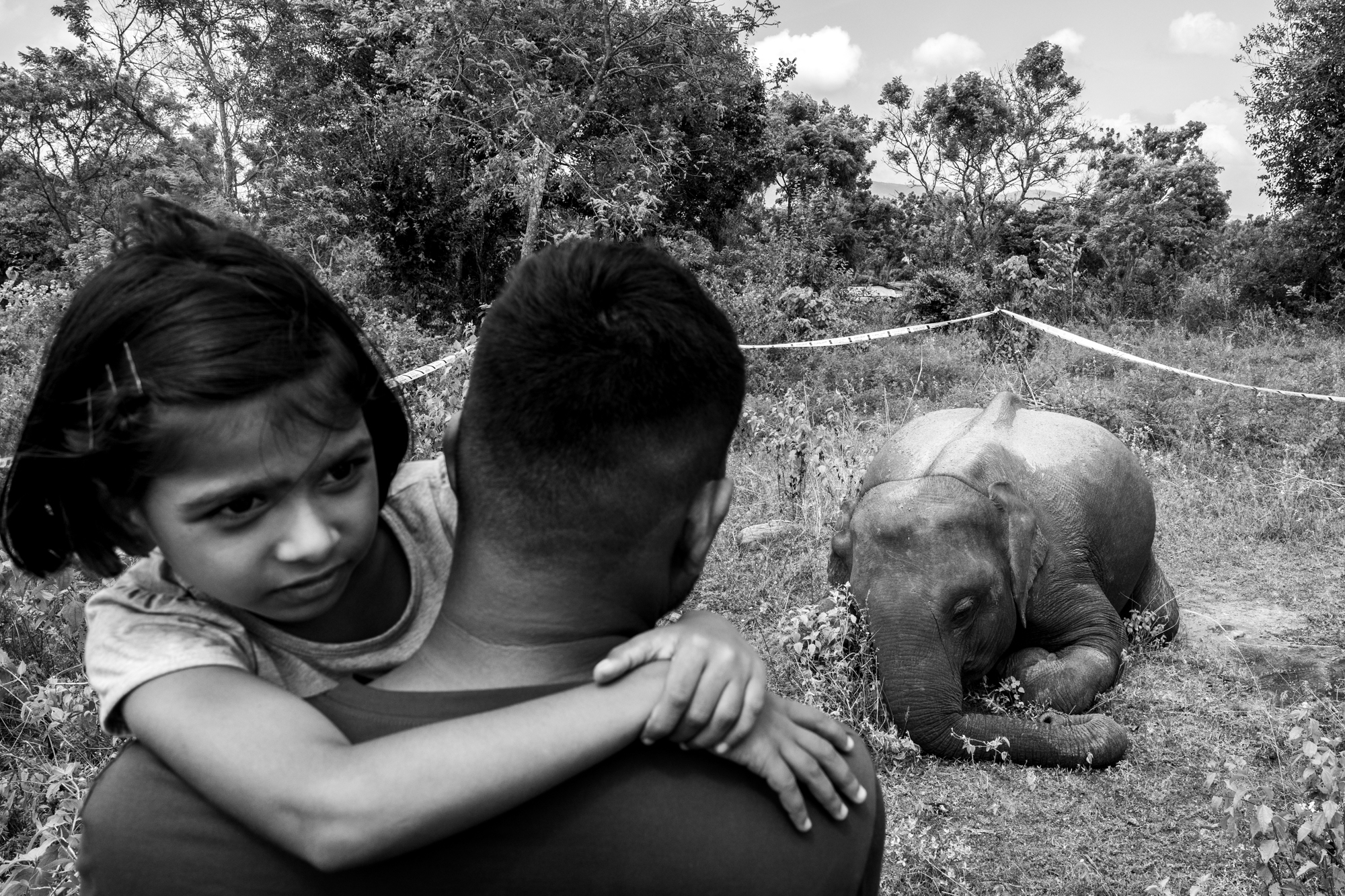
I witnessed funeral rituals of people who had been killed by elephants, but I also saw entire villages gathering around the body of an elephant that had been shot.
For me, those moments somehow contain the essence of this story. Human suffering and elephant suffering are not two separate narratives. They exist alongside one another, sometimes within the very same communities and even within the same people.
It is almost as if the two sides of the conflict are fused together: Grief for human lives and livelihoods and, at the same time, a profound emotional connection with the elephants themselves. My role is not to decide whose suffering matters more, but to show that both realities exist, simultaneously, within the same landscape.
Mongabay: Your photography vividly documents vulnerable areas, from home gardens to agricultural fields, where daily life intersects with danger. What were some of the logistical, cultural or safety challenges you faced while documenting HEC first-hand in Sri Lanka?
Federico Borella: The main logistical challenge was finding contacts capable of informing me when the most significant episodes of the conflict were happening, sometimes in real time.
When you are trying to document events such as a person being killed by an elephant or, as happened recently, an elephant being killed by a human, timing is crucial. Without a reliable network of people on the ground who could alert us quickly, reaching these situations would have been almost impossible.

When it came to finding information and navigating the territory, the people of Sri Lanka were extraordinarily helpful. Whenever we stopped someone on the road to ask for directions or information, they went far beyond simply answering our questions. People would change their own destination, turn their motorbikes around and accompany us in the direction we needed to go.
That generosity became an essential part of the work. Without the willingness of local people to help us, guide us and share what they knew, documenting this story would have been infinitely more difficult, probably even impossible.
Mongabay: Besides visually documenting HEC, do you intend to use the images for education or awareness creation?
Federico Borella: From the beginning, I took these photographs with a specific long-term purpose in mind. My final ambition for this project goes beyond conventional schemes. When I eventually feel that the work is complete, I would like to turn it into a book.
It will primarily be a photographic book, but I would also like to combine the images with a fictional or narrative component. I still do not know exactly what form that story will take, but the idea is already clear in my mind.
Once the photographic work is finished, one of my priorities is to find a way for it to have a life beyond photography itself. I would like the photographs to become useful in some way, particularly in Sri Lanka, by contributing to strengthening awareness of the complexity of human-elephant coexistence.
For that reason, collaborating with local organizations and communities is one of my goals. I have also thought about creating an association, collaborating with schools or organizing exhibitions that could bring the story directly to younger generations and to communities affected by the conflict.
At this stage, I have not yet developed a formal collaboration, as I still consider the project to be ongoing. But it is a part of what I want the next phase of the work to become.

Over time, I have also become increasingly convinced that documentary photography should not exist for the photographer’s personal recognition. For me, the purpose of making this kind of work is to bring a story, in all its complexity, to as many people as possible. The photographs should ultimately serve the story and the people involved in it, rather than the photographer’s ego. That is something I want to remain very conscious of as this project develops.
Mongabay: Through your interactions with local farmers and villagers, did you detect common misconceptions about HEC among people or the international media?
Federico Borella: I cannot fully answer that question yet because I still consider this project unfinished. I have not yet reached the stage where I feel I can make definitive conclusions about how an international audience understands the conflict.
What I do feel very strongly is that this is not a situation that should be approached through easy judgement. I am not here to judge anyone, and I do not believe anyone should do so without first understanding what life in these areas means.
It is very easy, from a distance, to condemn a human being who kills an elephant or to see an elephant that kills a person simply as a dangerous animal. But anyone who reduces the conflict to one of those two positions has probably never stood in these villages, spoken to the families involved or understood the complexity of what is happening on the ground.
I do have my own personal feelings and opinions, but I keep them separate from my work. The purpose of this project is not to tell people what to think. It is to document a reality that is extremely complex and to make that complexity visible.
I also believe this issue goes far beyond Sri Lanka. HEC is one particular expression of a much larger problem. In other parts of the world, the species will be different, the landscapes will be different and the forms of conflict will change. But as human populations expand, habitats shrink and pressure on land increases, I believe we will see more situations in which humans and wildlife are forced into direct competition.

For me, that is one of the most important dimensions of this story: It is not only about elephants and Sri Lanka; it is also about the kind of relationship we are building with the natural world and the conflicts that relationship may increasingly produce in the future.
Mongabay: Having witnessed the frontline of HEC, do you consider a sustainable path for coexistence between Sri Lanka’s rural communities and wild elephant populations can truly exist, or, are we documenting the twilight of a charismatic species?
Federico Borella: I have seen, heard and read about many different approaches intended to reduce the conflict and make coexistence possible, but I cannot say which of them is ultimately the most effective or whether any single solution can address a problem this complex.
Keeping traditional elephant corridors open and protecting their movement routes is clearly important and I believe it can make a real difference, but I do not know whether that alone is enough.
What has become clear to me is that there is no simple solution. This is a conflict shaped by land use, livelihoods, elephant behavior, habitat fragmentation and many other factors. I therefore would be cautious about presenting one measure as the answer.
At this stage, my role is still to observe, listen and understand as much as possible. I hope that coexistence is achievable, but I do not yet have enough knowledge to say with certainty what combination of solutions can make it sustainable in the long term.
Mongabay: When photographing wildlife that poses an immediate physical threat in high-stress environments, what technical equipment choices do you make, such as specific focal lengths or lighting approaches, to capture both the raw intimacy of human grief and the immense, intimidating presence of the elephants without compromising your safety?
Federico Borella: I try to keep my equipment as light and unobtrusive as possible. This is documentary photography: There is no controlled studio environment and reality does not wait for you. You should be quick, react immediately and, as much as possible, already have a clear idea in your mind of what you are looking for. There is very little room for unnecessary experimentation when situations are unfolding in front of you.

Most of the time I work with a fast 24-70 mm zoom. It gives me enough flexibility to move from relatively wide environmental photographs to more intimate images without constantly changing lenses or interrupting what is happening around me.
When I need to photograph elephants from distances that I obviously cannot — and should not — reduce by physically approaching them, I use a telephoto lens. In those situations, the longer focal length is not simply an aesthetic choice: It allows me to make the image while maintaining the necessary distance.
In terms of lighting, I work with available light almost all the time. I want the equipment to interfere as little as possible with the people, the animals and the situation itself. When the available light is not sufficient, I use a very small LED light, but I try to use additional lighting only when it is genuinely necessary.
Ultimately, the technical choices are quite simple. I want equipment that allows me to react quickly, remain unobtrusive and move between human intimacy and the physical scale of the elephants without forcing a situation or putting myself unnecessarily close to an animal simply to obtain a photograph.
Mongabay: Your visual style often carries a powerful, somber aesthetic that echoes deep documentary investigation. What was your post-processing approach for your Sri Lankan HEC series to authentically reflect the gravity of the situation without sensationalizing the tragedy?
Federico Borella: Thank you for this question, because the visual language of the project was something I thought about before I even started photographing it.
I always try to decide in advance how a project should look visually. From the very beginning, I knew that I wanted to work in black and white for several reasons.
Firstly, black and white photography has been my expressive language for a long time. It is a way of seeing and interpreting an image that feels very natural to me.

Secondly, there was also a question of visual consistency. Sri Lanka is an incredibly green country and, if I had worked in color, that same dominant green would have appeared repeatedly across many photographs. In a photographic sequence, especially over a long body of work, that can become visually repetitive and can influence the way the images relate to one another.
The third reason is perhaps the most important: Black and white helps me concentrate on what is actually happening inside the frame. It reduces the distractions created by color and allows me to focus more directly on gestures, expressions, relationships, light and composition.
The post-production itself is extremely simple. I make only very subtle adjustments, mainly to refine contrast, tonal balance and the overall rendering of the black-and-white image.
I do not use generative AI or any kind of artificial intelligence to alter the content of my photographs and I do not use invasive Photoshop techniques to remove or add elements to an image. In documentary photography, for me, that would cross a clear ethical line.
If a photograph does not work because something is wrong inside the frame, I simply do not use it. I would rather discard an image than manipulate reality to make it stronger.
So, the somber quality of the work does not come from trying to dramatize the photographs in post-production. It comes primarily from the situations themselves, from the decision to work in black and white and from very restrained tonal adjustments intended to preserve the atmosphere that was already present when the photograph was made.
Banner Image: A young elephant lies dead in Kurundewa, a village near Galgamuwa in Sri Lanka’s North Western Province, after being shot twice in the head. Image courtesy of Federico Borella.
Cite this article
Dilrukshi Handunnetti (2026). Photographing Sri Lanka’s human-elephant conflict — Interview with Federico Borella. Mongabay Conservation news. DOI: https://doi.org/10.66709/news-330440

