


- A new report from U.K.-based NGO the Changing Markets Foundation lays out several scenarios for the aquaculture sector’s expansion between now and 2040.
- The scenarios assess projected increases in demand for wild-caught fish to feed farmed fish, from 13% of global catches, if production of aquaculture species requiring little or no wild fish were to expand; to 46%, if production of species such as salmon and shrimp, which largely rely on feed made from wild-caught fish, expands.
- In response to the report, a senior U.N. Food and Agriculture Organization (FAO) said that a 75% growth “milestone” for the aquaculture industry published by the organization in 2023 is not a real goal of the FAO, which instead aims to grow the sector by 35% by 2030.
- The report was published on the eve of the Committee on Fisheries meeting, an FAO forum where policymakers set the direction for developing the fisheries and aquaculture sectors, and intensified an already heated debate at the meeting between the FAO and representatives of small-scale fisheries.
ROME — Nearly half of the wild-caught fish harvested globally could be used to produce feed for farmed aquaculture products by 2040 if the industry were to grow exponentially in line with a roadmap developed by the U.N. Food and Agriculture Organization (FAO), according to a report published Sept. 4.
The report was published by UK-based NGO the Changing Markets Foundation on the eve of the 37th meeting of the Committee on Fisheries (COFI), held Sept. 7–11 at the FAO’s headquarters in Rome. At the biennial intergovernmental meeting, policymakers set the direction for developing the fisheries and aquaculture sectors globally.
The publication has intensified debate over support for aquaculture, which involves cultivation of aquatic organisms, including plants, fish and shellfish, in marine or fresh water. Aquaculture is currently the fastest-growing food industry in the world. Since 2022, it has accounted for half of the global seafood supply, but representatives of artisanal fisher organizations attending COFI described it as a “destructive” industry.
“What we found is that it really depends on what species are chosen to be farmed,” Tara Ganesh, a senior campaigner at Changing Markets Foundation, told Mongabay in Rome. “Based on that, the impact varies dramatically.”
The report, produced together with researchers at the University of British Columbia in Canada, analyzes how the use of wild-caught fish to produce fish feed would change if the aquaculture sector were to reach a “milestone” set out in a roadmap published by the FAO in 2023.
In the FAO roadmap, fisheries and aquaculture is named as one of “ten pivotal domains, representing areas where immediate action is imperative” in order to support the U.N.’s zero-hunger target while staying within the Paris Agreement’s goal to limit global warming to 1.5 C°. Among other milestones, the document urges progress on reaching “at least 75% growth in global sustainable aquaculture” from 2020 levels by 2040.
Today, about 13.3% of wild-caught fish is used to produce feed for aquaculture. The University of British Columbia researchers developed several scenarios, assessing greater or lesser expansion of production based on carnivorous aquaculture species, which largely rely on feed made from wild-caught fish.
In one scenario, the demand for wild-caught fish for fish feed production could reach 13%-17% of the total, if the “growth were steered” toward aquaculture species requiring little to no fish-based feed, such as shellfish or carp.
In another scenario, the demand for wild-caught fish to supply aquaculture feed would increase to 29%-38% of the total under current trends, where part of the growth comes from high-value carnivorous species such as shrimp, salmon, sea bream or sea bass.
In a third scenario, market-driven expansion concentrated more heavily on these carnivorous species would push that demand for wild-caught fish to 34%-46% of the total.

Manuel Barange, assistant director-general of the FAO and director of its fisheries and aquaculture division, commented on the Changing Markets report, disavowing the 75% milestone for aquaculture growth. “It’s not a target, it’s not a proposal of FAO,” he told Mongabay. “It’s purely a discussion on options on the table.”
According to Barange, the actual FAO target for aquaculture growth is 35% by 2030 compared with 2020 levels, as set out in an earlier roadmap called “Blue Transformation” published by the organization in 2022.
“Between 2020 and 2024 the sector has already grown 17%, so 35% is essentially reflecting the trends the sector is following,” he said.
Sustainable aquaculture
Barange said the FAO’s target concerns “sustainable” aquaculture. What falls under this definition is outlined in its Guidelines for Sustainable Aquaculture, the first global policy instrument on aquaculture, adopted by COFI members during the 2024 meeting.
Changing Markets has criticized the guidelines for their “growth orientation” and a lack of precautionary measures to ensure food security. “In earlier drafts there was actually some very concrete language acknowledging the competition between food to feed people and food to feed fish,” Changing Markets’ Ganesh said. “When the final guidelines were adopted, those safeguards disappeared.”

The NGO’s new report alleges that Norway, the world’s leading salmon producer, funded and influenced the consultation process that led to the FAO guidelines.
Kristina Sigurdsdottir Hansen, state secretary at the Norwegian Ministry of Industry, Commerce and Fisheries, denied that Norway had influenced the process of drafting the guidelines. She said Norway funds several FAO projects to support development cooperation, not business-oriented research. “It is important to us that research projects remain fully independent and that responsibility for the findings and conclusions rests entirely with the project itself,” she told Mongabay in an email.
Barange said the guidelines were adopted by consensus among all COFI members, and that the FAO has not estimated what impact achieving the 35% growth target by 2030 would have on the use of marine ingredients in aquaculture production.
“My prediction is that the volume of marine ingredients will not grow during this period,” he told Mongabay, pointing out that the industry has proven its potential to increase feed efficiency by developing alternative ingredients.
Feeding the planet
The Changing Markets report intensified an already heated debate at the meeting between the FAO and representatives of small-scale fisheries. In a position statement, these representatives describe the social and environmental impact of industrial aquaculture as “destructive,” in part because it “takes fish and livelihoods away from local communities, especially in low-income countries, to feed fish … destined for consumption in wealthier nations.”

“When we came here, we saw and realized that there is no space for small-scale fisheries in the future, it’s only aquaculture,” Herman Kumara, the Sri Lanka spokesperson of the Uganda-headquartered World Forum of Fish Harvesters and Fish Workers, told Mongabay. “Our governments are jumping into aquaculture because there is more profit involved.”
According to Laura Elsler, a researcher at the Harvard T.H. Chan School of Public Health in the U.S. and co-author of a study on the nutritional impact of aquaculture, at the global scale, “aquaculture has a very large contribution to nutritional security” with much of the industry’s growth in low- and middle-income countries destined for domestic consumption.
However, Elsler said Changing Markets’ calls for better regulation of the sector are “reasonable”, referring to the nutritional risks faced by some developing countries that contribute the fishmeal used in aquaculture.
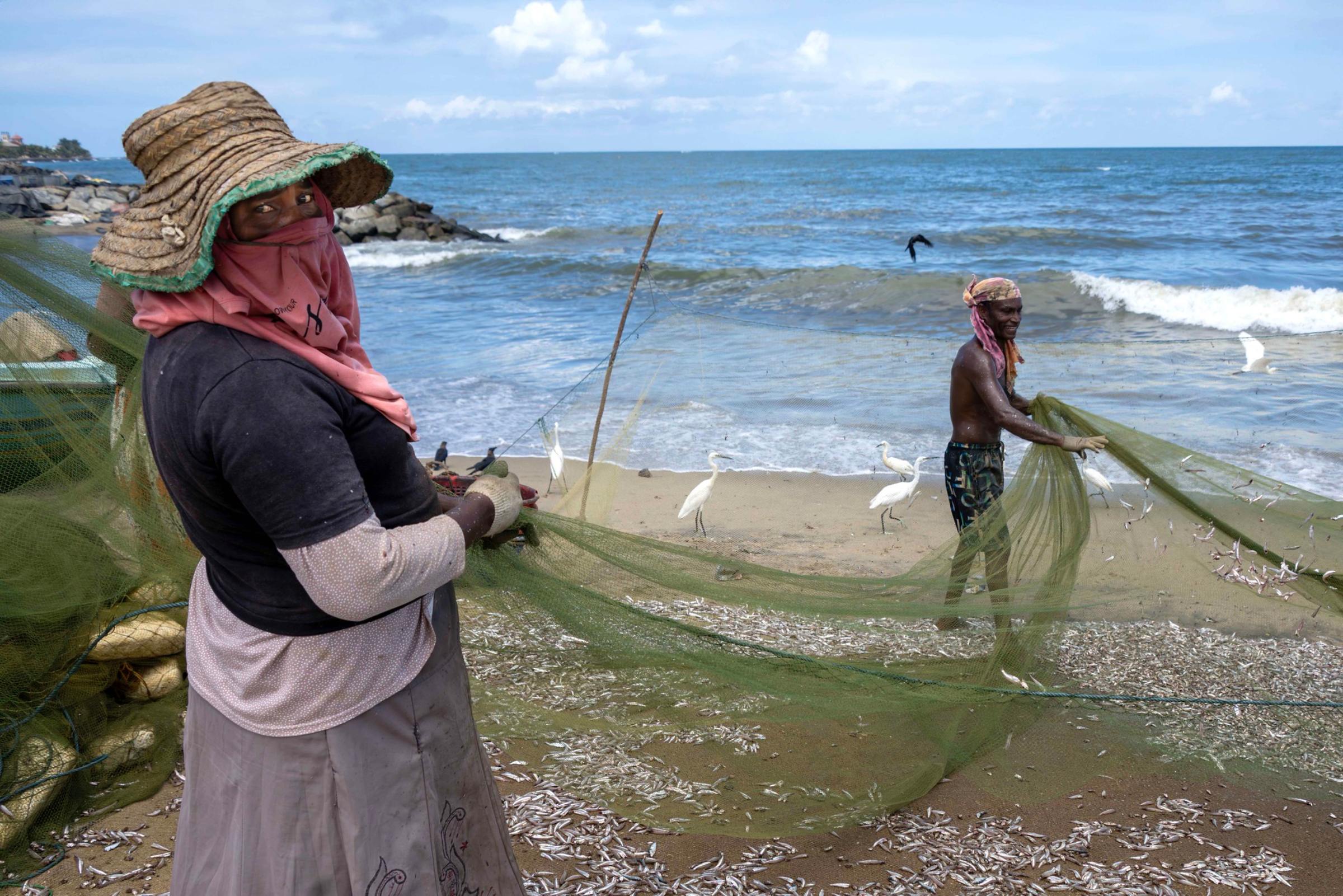
Banner image: Small-scale fishers with their gear on a beach in Sri Lanka. Image by Rod Waddington via Flickr (CC BY-SA 2.0).
Citations:
Elsler, L. G., Gephart, J. A., Zamborain-Mason, J., Cashion, T., Troell, M., Naylor, R. L., … Golden, C. D. (2026). Global nutritional equity of fishmeal and aquaculture trade flows. Proceedings of the National Academy of Sciences, 123(7). doi:10.1073/pnas.2506699123
Van der Meer, J., Callier, M., Fabi, G., Van Hoof, L., Nielsen, J. R., & Raicevich, S. (2023). The carrying capacity of the seas and oceans for future sustainable food production: Current scientific knowledge gaps. Food and Energy Security, 12 (4).
doi:10.1002/fes3.464
New study maps the fishmeal factories that supply the world’s fish farms
Feedback: Use this form to send a message to the editor of this post. If you want to post a public comment, you can do that at the bottom of the page.
Cite this article
Francesco De Augustinis (2026). 46% of wild-caught fish could be fed to farmed fish and shrimp by 2040, says report. Mongabay Conservation news. DOI: https://doi.org/10.66709/news-330337

