


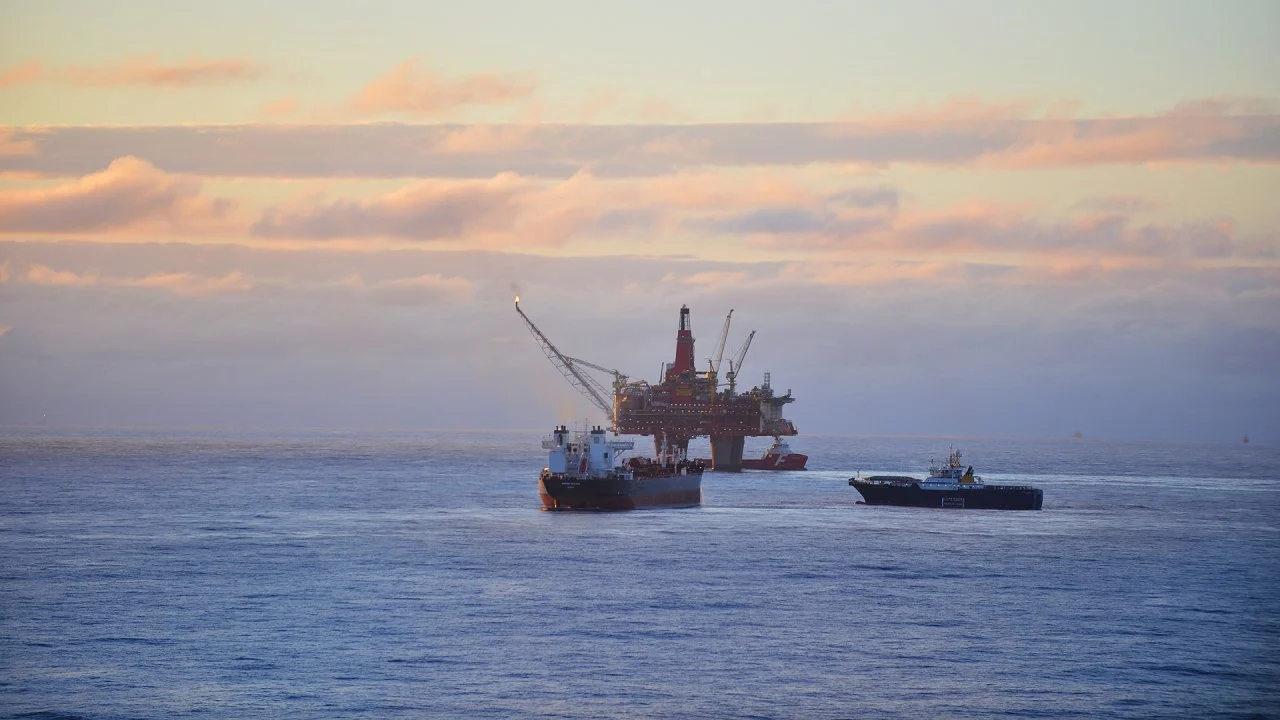
Low-emission uncrewed aviation specialist Flylogix has crossed an international maritime boundary to survey an oil platform for methane emissions, marking the UK’s first civilian cross-border offshore drone operation.
A Flylogix uncrewed aircraft has surveyed Equinor’s Statfjord B platform for methane emissions during a 4-hour, 50-minute round trip, covering 290 nautical miles from its UK base into Norwegian waters and back, testing a low-emission surveillance model designed to scale across multi-jurisdictional energy basins.
Sindre T Johnsen, Polaris ACC, Avinor ANS – the state-owned provider responsible for safe and efficient air traffic control in Norwegian airspace – said: “The successful completion of this operation has been a valuable milestone for the introduction and integration of uncrewed aviation in the North Sea. High standards for operational safety and a harsh environment make this area a challenging task. It is also an area where the potential in uncrewed operations is clearly visible.
“The framework for safe integration of crewed and uncrewed operations is therefore brought forward by accomplishments like this. Close cooperation of Aviation Authorities, Air Navigation Service Providers, Equinor and Flylogix has made this possible.”
The firm deployed one of its uncrewed aircraft on July 11, 2026, from Tingwall in the Shetland Islands to carry out a methane emissions survey of Equinor’s Statfjord B platform, situated on the other side of the UK-Norway maritime boundary.
This operation is said to represent the first time a civilian cross-border drone flight has been made from the UK and is among the first of its kind in Europe. The flight forms part of Flylogix’s ongoing work with Equinor to monitor and measure methane emissions from its North Sea infrastructure.
Charles Tavner, Flylogix’s CEO, commented: “This is a hugely significant moment for Flylogix and for the wider industry. Flying a drone from the UK to survey an asset in Norwegian waters shows that our long running ambition to deliver remote, cross-border drone operations safely has been realised.
“Norway has always been a key part of our growth strategy – this flight is the clearest possible demonstration of what that expansion looks like and we will now look to take our pioneering solution further afield. We’re grateful to Equinor for their partnership and trust, on which we look forward to building further in the years ahead.”
Flylogix completed the operation in close coordination with the relevant UK and Norwegian aviation authorities, alongside Equinor’s own operational teams, to ensure the flight met the regulatory requirements of both basins.
The Statfjord B platform, which sits in the southern section of the field in 145 meters of water, was installed in 1982 and started production that same year. The uncrewed aviation firm claims its low-emission, remotely piloted drones offer a safer and lower-cost alternative to conventional aerial survey methods, while significantly reducing the work’s carbon footprint.
Tavner emphasized: “The North Sea has become a genuine proving ground for our technology and our approach to regulation. Having established what safe, remote drone operations look like in practice, we’re now in a position to take that model to other basins that need to tackle their methane emissions.”
Discovered by Mobil in 1974, Statfjord is one of the oldest producing fields on the Norwegian Continental Shelf (NCS), and the largest oil discovery in the North Sea. Following first production in 1979, operatorship of Statfjord transferred to Statoil, now Equinor, in 1987.

Power Your Brand With Offshore Energy ⤵️
Take the spotlight and anchor your brand in the heart of the offshore world!
Join us for a bigger impact and amplify your presence at the core hub of the offshore energy community!
