


Reading Time: 14 minutes
Editor’s note: This story was produced with financial support from the Education Writers Association’s Reporting Fellowship program.
Click here to read highlights from the story
- Wisconsin’s 2024 Wisconsin Guarantee law automatically admits students in the top 5% of their high school class to UW-Madison and top 10% to other UW campuses if they apply by the required deadlines.
- Early evidence suggests the program has had little effect on who applies to or enrolls at UW-Madison, despite reducing admissions anxiety for some students.
- An unpublished UW-Madison study estimates 95% of students admitted through the Wisconsin Guarantee would have been accepted anyway, with the program changing admissions outcomes for about 50 students annually.
- The policy has produced unintended consequences, prompting some students to treat UW-Madison as a “safety school” while raising concerns about fairness, class rank and grading differences among high schools.
- The Cap Times interviewed about 40 students, educators and researchers and obtained exclusive research for a first comprehensive look at how the law is working in practice.
Jaidyn Glaus was sitting in her English class at Durand-Arkansaw Middle & High School last fall when she was called to the principal’s office. She had no idea why.
The Pepin County school’s principal and guidance counselor had news: Thanks to her high grades, Glaus qualified for a new program called the Wisconsin Guarantee, automatically granting her a spot at the University of Wisconsin-Madison after graduation.
Glaus had never heard of the program. “It came really as a surprise,” she said.
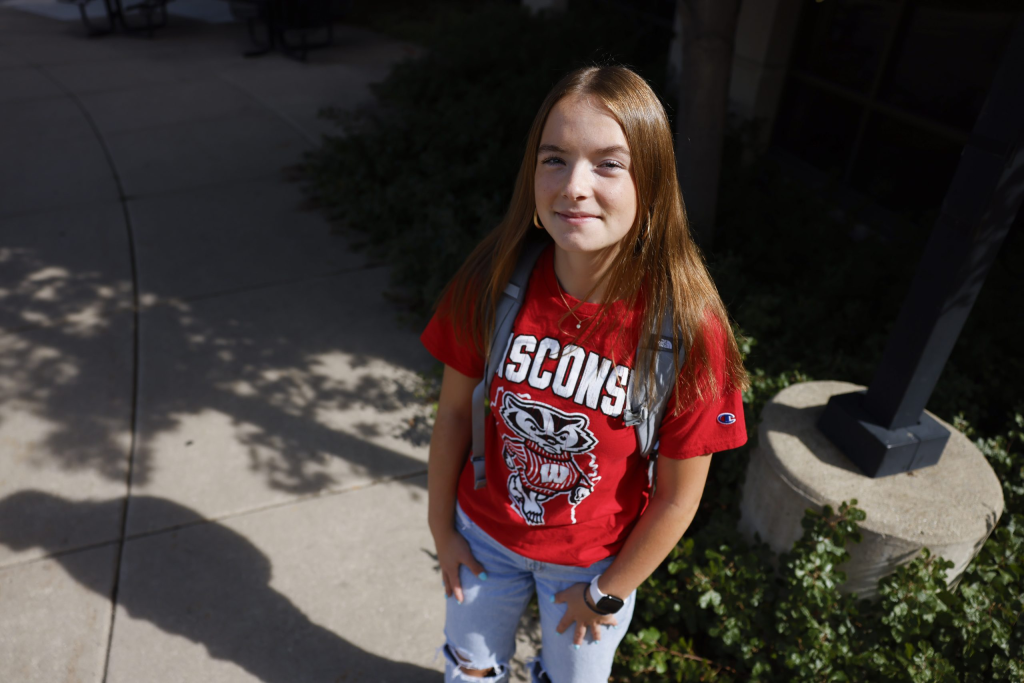
A few weeks ago, Glaus moved into Smith Residence Hall and started classes at UW-Madison as part of the second group of students to enroll through the Wisconsin Guarantee.
State lawmakers created the program in 2024, believing automatic acceptance for top high schoolers would make the admissions process less cryptic and help ensure the state’s “best and brightest” attend Wisconsin’s 13 public universities, with a particular focus on Madison. Democratic Gov. Tony Evers signed the bill into law as one of 16 conditions in a controversial 2023 deal struck between Republican legislators and UW system leaders.
Under the law, students in the top 5% of their high school class are guaranteed admission at UW-Madison if they apply by an early deadline. All other UW campuses automatically accept students in the top 10% if they apply by a regular deadline. Homeschool students may also qualify depending on their ACT score, and National Merit finalists receive automatic admission to all the state’s public universities.
To provide a comprehensive first look at the program, the Cap Times spoke with about 40 people, including students, school administrators and researchers. While most people agreed with the Wisconsin Guarantee’s aspirations and believe it has reduced anxiety for some students, views were more mixed on how the program is affecting admissions.
The policy has raised concerns about fairness in college admissions as school districts rank students differently. Some administrators worry it places too great an emphasis on grades, which don’t necessarily capture the rigor of students’ coursework. The program is also prompting some students to view Wisconsin’s flagship as a “safety school” and apply to more competitive universities out of state — contrary to what lawmakers intended.
The majority of those interviewed doubt the Wisconsin Guarantee is making a substantial difference in who applies and enrolls at UW-Madison.
A research paper exclusively obtained by the Cap Times supports that view. The study, which has not yet been published, examined a decade’s worth of UW-Madison admissions data and estimates the Wisconsin Guarantee generated about 240 more applications annually from traditional public high schools — or a sliver of the roughly 75,000 applications UW-Madison has received in recent years.
About 95% of students who received the guarantee would’ve likely been admitted to UW-Madison anyway through its standard admissions process, the research also estimates. That rate would mean the guarantee changed admissions outcomes for about 50 students from public high schools each year.
“I hope that students eligible for the guarantee apply,” said Heather Little, a UW-Madison Ph.D. student who authored the working research paper. “And then for students who aren’t eligible for the guarantee, I don’t think you should be deterred because … there’s still a huge chance that you can be admitted.”
The long-term effects of the guarantee remain to be seen, though researchers questioned if the program will keep high-achieving students in the state. While some said the program could theoretically help rural or first-generation students access UW-Madison, others raised concern that the university’s student body could become less diverse.
The guarantee is another example in Wisconsin’s long history of implementing higher education policies that have “very little” evidentiary support and documented unintended consequences, said Taylor Odle, a UW-Madison assistant professor of education policy studies.
“This is a policy that’s well intentioned, that’s kind of mistargeted. … And it has no teeth,” Odle said.

‘More complicated than it might appear’
During a public hearing at the state Capitol three years ago, Sen. Rachael Cabral-Guevara, R-Fox Crossing, held up a thick document Republican legislators received from UW-Madison about its admissions process.
Cabral-Guevara paged through the document, revealing most of the contents were redacted. She shared how one high-achieving student in her district had approached her seeking answers after UW-Madison rejected their application. Cabral-Guevara said she couldn’t explain why.
The senator then raised doubts about UW-Madison’s standard admissions process, known as holistic admissions, in which the university evaluates students using a variety of factors, such as grades, course difficulty, extracurriculars and essays.
Citing her time teaching at UW-Oshkosh, Cabral-Guevara said she observed firsthand how holistic admissions could be “manipulated” to benefit one student over another.
“The public doesn’t even really know what it takes to get into the UW system,” she said. “We have many highly qualified students that are rejected every single day, and, in turn, they take up admission into other colleges and universities that might be out of our state.”
Wisconsin-born adults who move to other states tend to be more highly educated than residents who stay in the state or others who move here, according to a recent Wisconsin Policy Forum report.
“The bottom line is that we are losing too many of our ‘best and brightest’ high school graduates to neighboring colleges and universities,” Rep. Jerry O’Connor, R-Fond du Lac, said in written testimony. “Is this not a form of institutionalized brain drain?”
The solution proposed by Cabral-Guevara and her co-authors was a bill to automatically admit students who rank at the top of their high school classes based on criteria developed by local school districts.
The bill garnered praise from some Republicans at the hearing, including Rep. Dave Murphy, of Hortonville, who chairs the Assembly’s higher education committee. Murphy said he knew a high-achieving white student in the top of their class who didn’t get into UW-Madison and ended up going to the University of Minnesota.
“The bill could be labeled as an anti-DEI bill,” O’Connor added. “And I’ll just say, I don’t care about DEI in this situation. This is simply about not discriminating against the best of the best coming out of our high schools.”

UW-Madison and UW system representatives expressed concern in written testimonies about the bill, saying the state’s public universities were already accomplishing the bill’s intent of keeping high-achieving students in Wisconsin.
UW-Madison defended holistic admissions as the best way to acknowledge differences in resources and educational opportunities across high schools with “the desire to capture wide representation from talented and impressive graduates from all 72 Wisconsin counties.”
The university noted the bill would require K-12 schools to rank students and that many schools used different methods to calculate GPA, a scale that converts letter grades into numbers. A majority of applicants didn’t have class rankings on their transcripts at all, the university said.
“To be clear, this is not an impossible change,” UW-Madison wrote. “But it is more complicated than it might appear and one that deserves very careful consideration of the costs as well as the benefits.”
The final legislation signed by Evers required all high schools to use GPA as the “sole criterion” for ranking students.
At the time, it was unclear why the automatic admissions policy was included in a wide-ranging deal between Republicans and the UW system, which largely centered around cutting diversity-related positions and programs in exchange for hundreds of millions of dollars in funding for the UW system.
In a recent interview with the Cap Times, Murphy said he was involved in some talks over the deal and Republican leaders included the policy to avoid a potential veto from Evers.
“That bill probably wouldn’t have been signed by Gov. Evers otherwise without getting it into some kind of a package to make that work,” Murphy said.
A spokesperson for Evers didn’t respond to requests for comment.
Unintended consequences
A few months after the bill was signed into law in 2024, the first group of Wisconsin Guarantee recipients received notice from their high schools that they were automatically admitted based on their class rank at the end of their junior year.
Over a quarter of in-state students who enrolled at UW-Madison last fall received admission through the program. Public data on the second cohort, who started classes a few weeks ago, isn’t yet available.

The Cap Times spoke with students and school administrators from nearly 20 districts across the state, including high schools that historically send a lot of students to UW-Madison and some that don’t. They largely agreed the guarantee hasn’t been a significant factor in students deciding to go to UW-Madison, but it relieved some pressure in the application process.
“I still had to do all of the work,” said Elise Hendrickson, a Neenah High School graduate who received the guarantee and is now a sophomore at UW-Madison. “It’s just that I didn’t have to feel as stressed about like, ‘Oh, am I going to get in or not?’”
While the guarantee strengthened some high-achieving students’ confidence in attending UW-Madison, it nudged others to look outside the state.
“Some of our families, the kids will get the guarantee, and then they will shoot for the most selective schools in the country,” said Zach Galin, founder of the college admissions consulting firm Galin Education. “And if they don’t get in, they know they have this guarantee to go to UW-Madison. … They’re much more willing to apply broadly and see where the chips fall before making any decisions.”
That’s the calculus Lauren Alibali made. Shortly after the Madison West High School senior received the guarantee last fall, she met a friend at Indie Coffee on Regent Street. Alibali considered only applying to UW-Madison because she thought it would be easier.
But Alibali’s friend pushed back, reminding her of all the hard work she’d put in to qualify for the guarantee and be at the top of her class. Why not try to get into the country’s most prestigious schools?
Knowing she had “an awesome safety school” with UW-Madison, Alibali applied to Ivy League schools and other universities she considered to be a reach. Then she got into and decided to attend the University of Chicago.
“I don’t know if the opportunity of Chicago would present itself again,” she said.
Many school officials and students who spoke with the Cap Times had mixed feelings on whether the guarantee’s benefits outweigh its side effects.
Some school counselors and principals worried the program placed too great of a focus on grades alone. They felt the policy created unnecessary pressure for already stressed students to be at the top — even though many would still be well positioned for admission to UW-Madison without the guarantee.
“Whenever you have a rank, it’s a competition. Let’s be honest. And unfortunately, it pits students and families against each other at a very hard time,” said Deanne Lensert, principal of Waunakee Community High School. “We’ve definitely seen that as an unintended consequence.”
Stephen Trudeau, the high school principal of Durand-Arkansaw Middle & High School, feels torn. Growing up in a blue-collar family in Minnesota, he said college wasn’t often talked about as an option for him.
“I came from a small school. I didn’t have those types of opportunities,” he said, “so I think anytime we can create opportunities for kids to see pathways to these institutions and see themselves there, I think that’s really important.”

Still, Trudeau felt conflicted about promoting the program to his students because of the focus on rankings and grades. He knows some students may be ranked lower because they took more challenging coursework.
“Anytime we start talking rank and we start talking percentages … there becomes a game that gets played, right?” he said. “I think sometimes we lose the value of education. Are we learning for the purpose of learning, or are we learning for the purpose of some sort of external motivator or some sort of extrinsic award, such as … the guarantee?”
That’s part of why Trudeau waited to talk to top students about the guarantee until after they’d already qualified. That included Glaus, who started attending UW-Madison this fall.
Others worry the program is unfair. Vanessa Ivanov, who graduated from UW-Madison in December, has a little sister who wanted to follow in her footsteps as a Badger — but she missed the top 5% cutoff at Germantown High School by one spot. She wasn’t admitted through holistic admissions, either.
“She is very disappointed,” Ivanov said. “She ended up at UW-Milwaukee, which … is still a great school. But she looks at a lot of her classmates and the opportunities that they’re being given here at (UW-Madison), and she does not really view it as being fair or being equitable.”
Some high schools use unweighted GPAs, which award equal points for all courses regardless of difficulty. Weighted GPAs give more points for more challenging classes like Advanced Placement and honors classes.
“This program and not requiring that schools weigh their GPA puts a significant disadvantage for those who are actually taking those college preparatory classes and working to put themselves in a position where they’d be perhaps more able to succeed in that higher education environment,” Ivanov said.
Debate over weighted GPAs in response to the Wisconsin Guarantee continues to play out at certain high schools, especially those that typically send a greater share of students to UW-Madison. For some school districts with unweighted GPAs or that use other ranking systems, ties have emerged among the top students.
Representatives from some districts that have created tiebreakers or reworked GPA systems said the guarantee has sparked a lot of conversation — and stress — in their communities.
“We didn’t create the law, we didn’t create the rules, and we had no voice in the creation of the guidance,” said Curt Mould, director of digital media, innovation and strategy for the Sun Prairie Area School District. “But yet we’re on the hook for implementing. … It was never really explained to (school) systems why this was necessary.”

New research raises questions
As state lawmakers passed the Wisconsin Guarantee in 2024, policymakers in New York and elsewhere were eyeing top-percent admissions plans in response to a 2023 U.S. Supreme Court ruling banning race-conscious admissions.
Top-percent admissions plans originated in the 1990s following state-level affirmative action bans in places like Texas, Florida and California. Because most students attend schools close to their homes and because neighborhoods often are racially divided, policymakers hoped top-percent plans would help maintain diversity at selective public universities since the same proportion of top students at every high school receives automatic admission.
However, studies have largely found top-percent admissions programs have minimal effects on enrollment patterns in the long term and fall short of meaningfully changing which high schools send students to selective public universities.
The new paper by Little, the UW-Madison Ph.D. student, builds on that body of research by studying Wisconsin’s new top-percent policy.
Through a data partnership between UW-Madison’s Division of Enrollment Management and the Student Success Through Applied Research Lab, Little compiled application data from over 800 traditional public high schools in Wisconsin and Minnesota. The Minnesota schools served as a control group since Minnesota students receive tuition reciprocity but are ineligible for the guarantee.
Little’s findings suggest shortcomings in the Wisconsin Guarantee’s ability to persuade the state’s “best and brightest” to stay. She estimates just half of all guarantee-eligible students applied to UW-Madison, and top 5% students were less likely to enroll than applicants who were admitted through holistic admissions.
For students who received the guarantee but didn’t apply, it’s unclear where they landed after graduating high school. An informal survey Little conducted of high school counselors indicated the guarantee wasn’t a significant factor in students’ college decisions. Sixteen counselors who provided written responses pointed to factors like cost, geography and proximity to home as driving students’ decisions.
Little found the “rare” students whose applications likely received a “significant admissions boost” from the guarantee were those with high academic performance but less difficult classes. However, Little said it isn’t possible with the available data to determine whether certain students who just missed obtaining the guarantee were hurt by the program.
“The students who are more likely to be hurt by the policy are kind of like the last admit from these (schools that) were sending lots of people before,” Little said. “I don’t have any evidence of that … but that’s what economic theory would tell us.”
Little’s survey of high school counselors and written responses from about two dozen UW-Madison freshmen revealed conflicting sentiments about the guarantee. She said people who feel well served by the holistic admissions process may think the new program is unnecessary, while others who perceive admissions as opaque may appreciate the benefits.
“How you feel about the policy depends on how well you think holistic admissions is working,” she said.

‘A statement that we care’
Administrators at UW-Madison and the UW system said it’s too early to know the effects of the Wisconsin Guarantee. Johannes Britz, the UW system’s senior vice president for academic and student affairs, said it could take years to get a clearer picture.
However, the UW system said it’s not tracking how many students have enrolled through the program. It’s also unclear how many high school students have qualified for the program, regardless of whether they later applied to a state university. The Wisconsin Department of Public Instruction isn’t tracking that data, said John Johnson, a senior policy adviser for the state agency.
Murphy, the Republican lawmaker from Hortonville, said he has received fewer phone calls from parents complaining their child wasn’t admitted to UW-Madison with the guarantee in place. He previously fielded dozens of calls on this topic in any given legislative term, he said.
More transparency around UW-Madison’s admissions is still needed, he said, but the guarantee makes the UW admissions process better.
Cabral-Guevara called the guarantee “a critical first step in ensuring that Wisconsin’s best and brightest students are given a spot on our campuses.”
“As with any new program, I am happy to work with folks on ways to make improvements so that we can continue on the progress we’ve made so far,” she said in a statement.
Researchers who’ve examined top-percent programs elsewhere expressed surprise at the approach and policy aims outlined in Wisconsin’s guaranteed admissions law — as well as skepticism that it would achieve its goals.
“Most of the percentage plans have come out of a desire to increase racial diversity in a way that doesn’t explicitly use race in the process,” said Daniel Klasik, an associate professor at the University of North Carolina-Chapel Hill. “How far these policies can go in terms of actually generating new students into the system that weren’t already going before is a little bit unclear. I have a few … doubts about that.”
Some researchers questioned how the guarantee will change UW-Madison’s enrollment in the long run. Odle, the UW-Madison assistant professor, estimated the program will help support the admission of mostly affluent, white, female students — demographics overrepresented in the top 5% across Wisconsin, which the university is already good at recruiting and retaining.
Given Wisconsin’s population is less diverse than other states with top-percent admissions programs, some also questioned if the guarantee could decrease the racial and socioeconomic diversity among students at the flagship.
“In the end, wealthier schools and families will actually benefit more from a top-percentage plan than if everything is equal in terms of all the resources and opportunities across the state,” said Carson Byrd, an associate research scientist at the University of Michigan. “A lot of this sounds like it’s more meritorious, but really, what it’s doing is compounding the educational and socioeconomic inequalities of communities.”
Britz, the UW system official, said the guarantee provides the state’s public universities another recruitment tool, and he believes rural students could benefit.
“It is not a data thing,” Britz said. “It is, for me, a statement that we care for the best and the brightest.”

As Glaus moved into her dorm at UW-Madison a few weeks ago, her parents and her brother helped haul pillows, clothing cubes and a fake plant into the tight room.
Glaus’ mom, Miranda, proudly reported she hadn’t cried yet moving Glaus into the dorm — though she admitted to tearing up on the three-hour car ride to Madison and again during lunch at a campus dining hall.
With Glaus being a first-generation student, her admission and the move were bound to bring up a lot of emotions.
“Overwhelming. Proud. Excited. Sad,” Miranda Glaus said. “Dad is very nervous.”
“I’m glad she chose here,” Brad Glaus, her dad, added.
“It was either here or Michigan,” her mom said.
While Glaus debated enrolling at the University of Michigan, she chose UW-Madison for its kinesiology program and proximity to home, much to her parents’ delight. The Wisconsin Guarantee merely reinforced her choice to become a Badger.
“I’m not really sure that it influenced my decision too much,” she said. “It made me feel even better about going there, knowing that they want me.”
Whether or not the guarantee existed, Glaus’ parents never doubted their daughter would get into UW-Madison.
“I knew she deserved it,” Miranda Glaus said. “She was going to go wherever she wanted to go.”
Erin Gretzinger is a K-12 education reporter and Becky Jacobs is a higher education reporter for the Cap Times in Madison. They can be reached at egretzinger@captimes.com and bjacobs@captimes.com.
Wisconsin’s college admissions law has unintended consequences is a post from Wisconsin Watch, a non-profit investigative news site covering Wisconsin since 2009. Please consider making a contribution to support our journalism.
