


- The U.S. National Oceanic and Atmospheric Administration (NOAA) Fisheries published a list of 34 priorities in early September that outline its intention to loosen restrictions on domestic fishing.
- The list includes walking back restrictions on fishing near protected species, removing fishing restrictions at marine national monuments and weakening NOAA Fisheries’ national standards, the regulatory guidelines that have shaped the agency since its inception.
- What NOAA Fisheries is proposing to strip back are “the absolute basics of conserving a healthy ocean ecosystem,” Andrea Treece, deputy managing attorney for the Oceans Program at the San Francisco-based NGO Earthjustice, told Mongabay.
- The agency’s priorities list also emphasizes updating fisheries monitoring technology and data-sharing methods, and including fishers in planning and decision-making.
The federal agency that oversees U.S. fisheries released a list of priorities on Sept. 2, advancing the Trump administration’s promise to deregulate the domestic industry.
The list of 34 priorities was published by the U.S. National Oceanic and Atmospheric Administration (NOAA) Fisheries, which oversees scientific research, data collection and regulation of commercial fishing operations in the United States alongside regional and tribal councils. The list outlines the agency’s intention to loosen restrictions on where, when and with what gear fishers are allowed to fish.
U.S. fisheries are globally recognized as some of the most heavily-regulated and sustainable in the world. Conservationists say the agency’s new priorities are the latest signal from an administration intent on deregulating and defunding the agency. They warn that deregulation will open the door to overfishing and do lasting harm to ecosystems that support ocean health and sustain fisheries.
“If we are reducing regulations and overfishing some really valuable fisheries this year or next year, it may take years for those fisheries to get back on track to healthy [stock] levels,” Reggie Paros, senior director of public affairs at the New York-based NGO Environmental Defense Fund, told Mongabay by phone. “The outcomes we would see on the water would be particularly damaging.”
The list of priorities includes walking back restrictions on fishing near protected species, and proposes removing fishing restrictions at marine national monuments, protected areas of the ocean intended to preserve natural, scientific and cultural resources. It recommends weakening NOAA Fisheries’ “national standards,” the regulatory guidelines that have shaped the agency since its inception. The priorities also call for fisheries to update monitoring technology and data-sharing methods, and better integrate fishers in planning and decision-making.
In announcing the agency’s new priorities, NOAA Fisheries assistant administrator Eugenio Piñeiro Soler wrote: “Our mandate is clear: We must regulate only where necessary, innovate where possible, and always evaluate our work by the real-world economic and conservation results we deliver to the American public.”
Mongabay reached out to NOAA Fisheries for comment but did not receive a reply by publication.

Rolling back fishing restrictions
The 34 priorities follow an executive order from President Donald Trump in April 2025, which promised to promote domestic fishing and remove “the pressure of unnecessary regulations and unfavorable policies.” In the Sept. 2 priorities announcement, NOAA Fisheries pledged to release a broad plan for U.S. fisheries, called the America First Seafood Strategy, in “the coming months.”
As Mongabay reported in June, the administration’s proposed fiscal year 2027 budget includes deep cuts to NOAA Fisheries, including the termination of certain fisheries management programs, fisheries surveys and data collection. It would also cut several of NOAA Fisheries’ key conservation programs, including grants to support endangered species.

The Trump administration weakened the Endangered Species Act (ESA) in July by dropping habitat protections. In its priorities list, NOAA Fisheries vowed to reconsider fishing restrictions previously required under the ESA and Marine Mammal Protection Act, specifically concerning North Atlantic right whales (Eubalaena glacialis), harbor seals (Phoca vitulina), humpback whales (Megaptera novaeangliae), smalltooth sawfish (Pristis pectinata), giant manta rays (Mobula birostris), and several species of sea lions, ice seals and sea turtles.
What NOAA Fisheries is proposing to strip back are “the absolute basics of conserving a healthy ocean ecosystem,” Andrea Treece, deputy managing attorney for the Oceans Program at the San Francisco-based NGO Earthjustice, told Mongabay by phone.
“That is the building block for having a healthy, long-term fishery in the first place,” she said.

Some of the agency’s priorities are already in effect, like opposing any future requirement of the Northeast lobster fishery to use ropeless gear, an expensive restriction whose proponents argue would prevent entangling critically endangered North Atlantic right whales, of which less than 400 remain.
Trump signed a proclamation on June 11 attempting to remove commercial fishing restrictions on three marine national monuments in the Pacific Ocean: Papahānaumokuākea, Rose Atoll and Mariana Trench. The objective appeared again in NOAA Fisheries’ priorities list, with the addition of “Pacific Remote Islands,” the former name for Pacific Islands Heritage Marine National Monument.
The Trump administration released a separate proclamation in April 2025 to open that monument to commercial fishing, but a federal district court in Honolulu struck down the directive in August 2025. The June 11 proclamation is also facing challenges in court. Together, those monuments represent 3.1 million square kilometers (1.2 million square miles) of critical ecosystems, including coral atolls, deep-sea trenches and islands.
Trump also opened the Northeast Canyons and Seamounts Marine National Monument southeast of Cape Cod to commercial fishing again by proclamation on Feb. 6. That monument was not mentioned in the priorities list, but it, too, faces legal challenges from environmental groups.
‘New and emerging threat’

Another section of the priorities list suggests altering U.S. fisheries’ national standards guidelines. These are long-standing pillars of the 1976 Magnuson-Stevens Fishery Conservation and Management Act, the nation’s landmark fisheries management law.
This is new territory, according to Paros with the NGO Environmental Defense Fund. “I don’t think we have seen in previous administrations where they intended to actually revise those national standard guidelines and move forward with deregulation for deregulation’s sake,” he said.
“I do think this is kind of a new and emerging threat that we’re experiencing,” Paros added.
Fishers worry about a depleted agency
Many fishing industry groups applauded NOAA fisheries’ focus on deregulation and modernization.
But with each new administration, fishers are “holding our breath” to see what new policies will arise, and which will be cast away, Beth Casoni, executive director of the Massachusetts Lobstermen’s Association, told Mongabay by phone.

To fishers like Scott Hickman, a charter boat captain and commercial red snapper shareholder harvester in Galveston, Texas, NOAA Fisheries’ desire to shore up domestic fishing is something he can get behind. But weakening the Magnuson-Stevens Act is not the way to do it, he told Mongabay by phone.
“The current administration wants more American protein from the ocean and I support that,” Hickman said. “How do we get there? How do we increase that? It’s through better management, better science, and better technology managing these stocks.”
There’s a lot of good in the NOAA Fisheries priorities, he said, namely in the focus on data sharing and advanced technologies. For several years, Hickman has hosted a University of Massachusetts pilot project on his boat to test Starlink satellite-supported video monitoring, which tracks vessel location and catch data. There’s plenty of room for innovation in the way fishers are monitored and share data, he said.
But that won’t replace the Magnuson-Stevens Act, he added, and it won’t make up for budget cuts.
“You know we’re trying to do stock assessments and do the science,” Hickman said. “Well, hell, you got rid of half the [fisheries staff] and then you cut all these programs.”
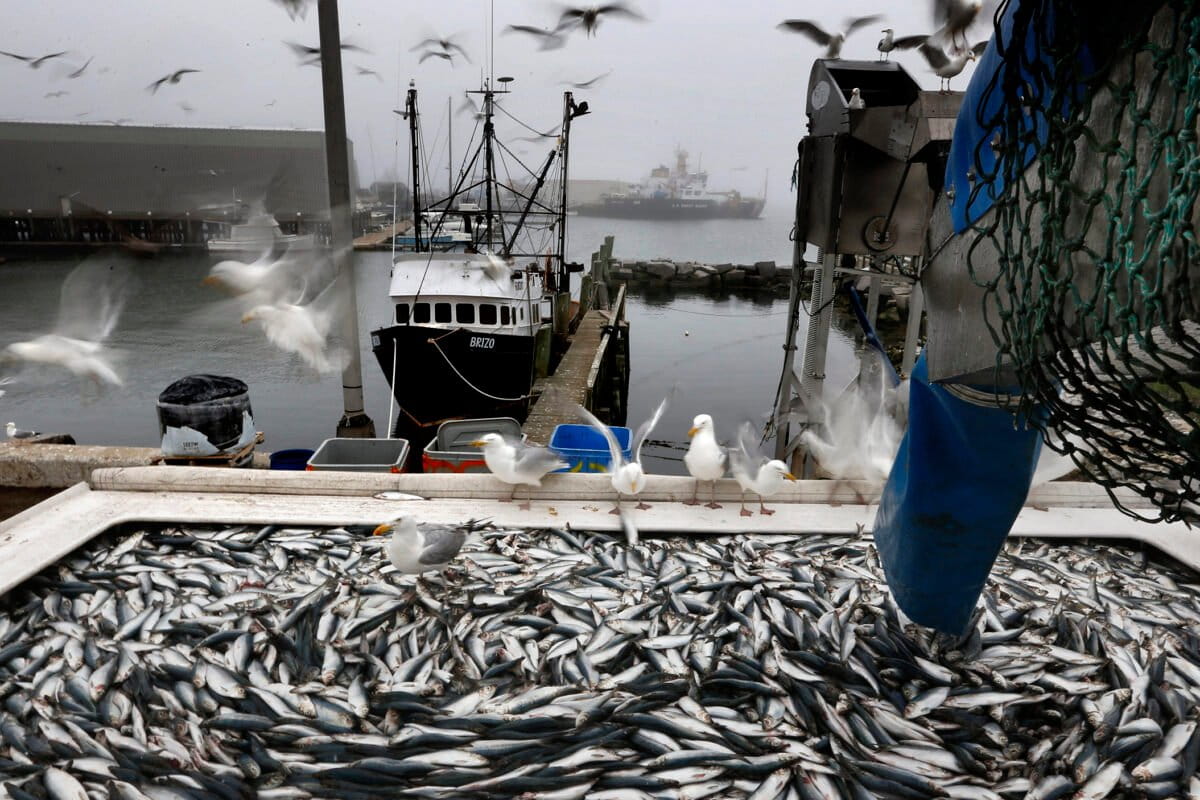
Banner image: Herring are unloaded from a fishing boat in Rockland, Maine, in 2015. Image by Robert F. Bukaty/AP Photo.
Fisheries and climate research would be hit hard in Trump’s proposed budget
Landmark US Magnuson-Stevens fisheries law turns 50 amid budget cut concerns
Feedback: Use this form to send a message to the editor of this post. If you want to post a public comment, you can do that at the bottom of the page.
Cite this article
Jules Struck (2026). US move to loosen restrictions on fishing could harm vital ecosystems, experts warn. Mongabay Conservation news. DOI: https://doi.org/10.66709/news-330081

