


LONDON (AP) — How does a grizzly bear cross the road? With the help of Indigenous people, ranchers and governments.
That’s the idea behind the Yellowstone to Yukon Conservation Initiative, which is working to keep the Rocky Mountains an unfettered migration route for wildlife from Wyoming to northwestern Canada. To do so, the group works with local people and governments throughout the region to protect wild lands and build overpasses, underpasses and fencing to help animals cross busy roads.
The charity is one of the 15 finalists announced Friday for the 2026 Earthshot Prize, created by Britain’s Prince William to support conservationists and entrepreneurs developing solutions to climate change, pollution, habitat loss and other environmental threats. The winners in each of five categories receive 1 million pounds ($1.34 million) and assistance in expanding their projects.
William launched the prize in 2020, inspired by U.S. President John F. Kennedy’s 1962 “Moonshot” speech that challenged Americans to go to the moon by the end of that decade. The prince’s goal is to accelerate the pace of environmental innovation and “repair the planet” by 2030.
Other nominees for this year’s prize include an Argentine project that uses artificial intelligence and satellite data to spot and track wildfires across Latin America; the Zero Emission Maritime Buyers Alliance, which aims to cut carbon emissions from shipping, and Orsted, one of the world’s biggest developers of offshore wind farms.
The winners will be announced Nov. 17 during a televised awards show in Mumbai.
Jason Knauf, chief executive of the Earthshot Prize, said finalists such as Yellowstone to Yukon work to transcend barriers like the ones that have grown up between Canada and the United States during their recent trade war.
“People want to protect nature for the sake of future generations. That is what the vast majority of people want in the U.S., in Canada, and everywhere in the world,” Knauf said. “This is a really, really popular agenda, and we cannot allow ourselves to get distracted by short-term political noise, as noisy as it may be.”
Yellowstone to Yukon, which is based in Canmore, Alberta, with U.S. offices in Bozeman, Montana, has been pursuing its goal of creating an interconnected system of wild lands and waterways along the spine of the Rocky Mountains since 1993.
Jodi Hilty, the group’s president and chief scientist, said in a video statement that it works with governments to identify wildlife crossings, consulting ranchers to keep predators and livestock away from one another and supporting Indigenous peoples’ plans for protected areas.
From Wyoming to the Yukon Territory there are now 204 wildlife crossings and some 24 million hectares (59 million acres) of protected lands, as campaigners seek to counteract problems caused by human development.
“The solution is surprisingly simple,” Hilty said. “Animals need space to move, and they don’t recognize borders. So we bring people together in this landscape to the same table …. We work with them all to come up with the solution in order for animals to be able to move freely across the landscape.”
By Danica Kirka, Associated Press
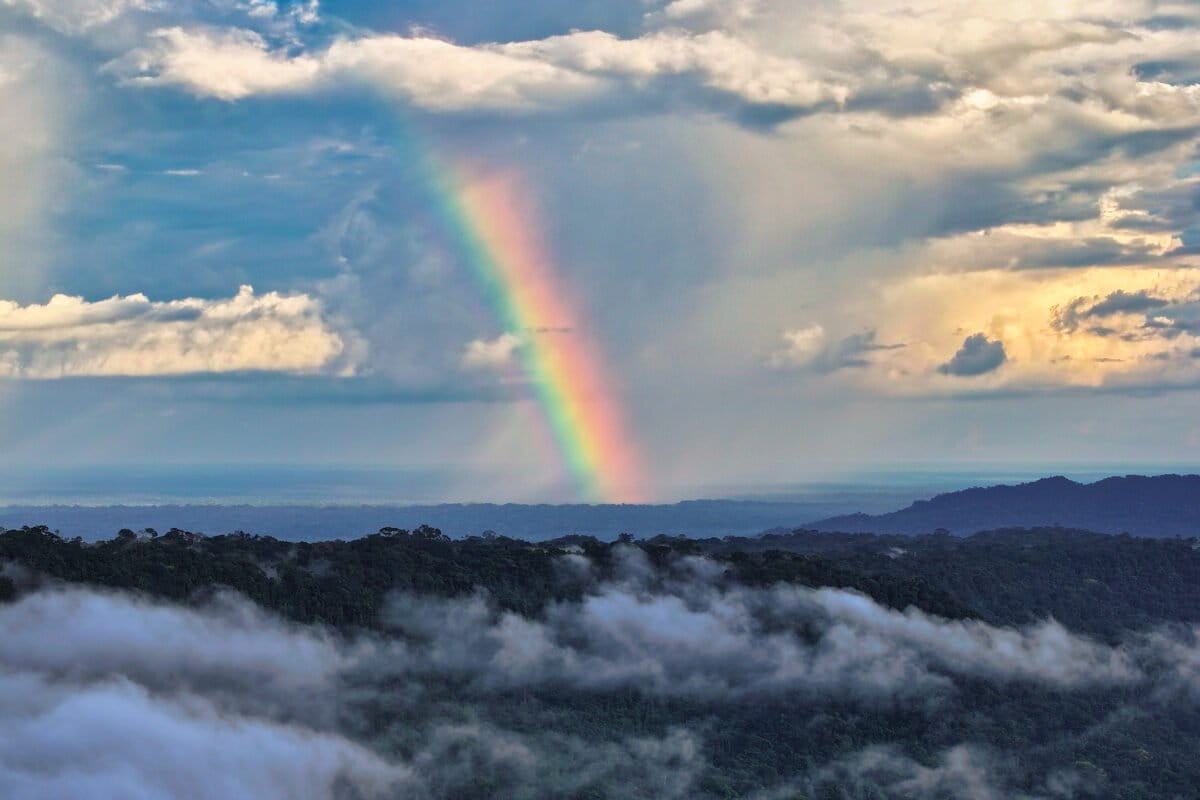
Banner image: Rainbow over the Amazon rainforest. Photo by Rhett Ayers Butler
