


In February, Hungary’s flagship public broadcaster, M1, debuted a new daily program called Horrors of War.
“Forced conscription, families torn apart, poverty, and countless victims,” the presenter said at the start of the first broadcast, standing amid computer-generated rubble while artificial explosions lit up the studio. The program then cut to images of bombed apartment blocks, grieving civilians, and shattered streets in Ukraine. “Last year alone, 2,500 civilians were killed,” the 17-minute episode concluded.
Debuting nearly four years into Russia’s full-scale invasion, but just two months before Hungary’s general election in April, Horrors of War was not intended to inform viewers. Rather, it was designed to persuade them to vote for Viktor Orban, Hungary’s then-prime minister, whose central campaign promise was to keep Hungary out of the war in neighboring Ukraine as he maintained close ties with Moscow.
Under Orban, public radio and television channels became tools of his right-wing Fidesz party. The government’s control over the media, including the centralized public broadcaster, helped Orban sustain his 16-yearlong illiberal rule. Yet, on April 12, Peter Magyar, a political novice, unseated Orban, with his Tisza party obtaining a historic majority of the vote and two-thirds of parliamentary seats.
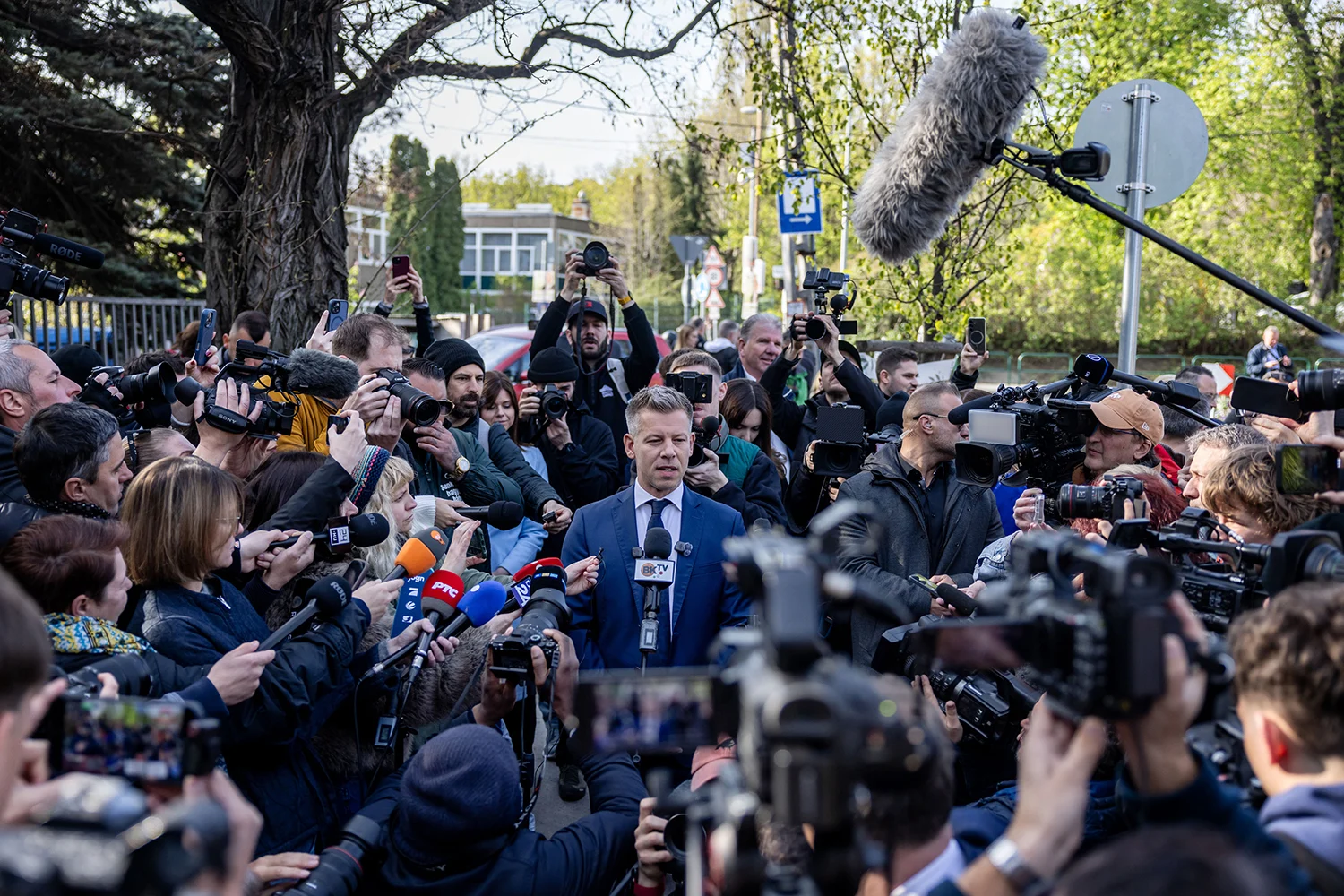
Now, Magyar’s center-right government faces the challenge of decentralizing public media and reestablishing viewers’ trust. If it succeeds, Hungary could provide a model for other places seeking to dismantle propaganda networks and restore faith in an independent but state-funded press as a public good.
Hungarian journalists participate in a hunger strike to protest against censorship in Hungarian state-owned media in Budapest on Dec. 14, 2011. Attila Kisbenedek/AFP via Getty Images
When Orban reentered office in 2010 after eight years out of power, he seized the public broadcasting network. That year, the Fidesz-majority parliament passed a media law that merged state-run but separate radio and television channels and news websites, as well as the state news agency, into a new body, the Media Service Support and Asset Management Fund (MTVA).
Fidesz brought this body under the control of the new National Media and Communications Authority (NMHH). Although that agency was nominally independent, the government controlled the election of NMHH’s president and members of its media council, effectively enabling Fidesz to exert influence over the public broadcaster’s content. Fidesz fired approximately one-third of the public media workforce and then filled MTVA’s ranks with loyalists.
With generous state financing, the party turned public service media into an “audio-visual propaganda tool,” the International Press Institute later observed.
At the same time, Fidesz-friendly businesspeople obtained control over approximately 80 percent of Hungary’s media landscape, including almost all television and radio channels, according to Reporters Without Borders. The international journalism watchdog noted that due to the “discriminatory allocation of state advertising,” these outlets were well-funded, while independent ones became financially strained. Journalists critical of the government also faced surveillance, threats, and limited access to decision-makers and public information.
“Orban’s Hungary was an informational autocracy, in which the main tools of the system were hatred, disinformation, and conspiracy theories,” said Peter Kreko, director of Budapest-based research institute Political Capital. “The public media was part of this.”
By the mid-2010s, the Fidesz government was using the state broadcaster as a campaign tool, showing images of refugees allegedly storming Hungary’s borders to bolster its anti-immigration agenda, smearing the opposition, and exaggerating Orban’s achievements. Newly revealed documents show that government ministries instructed journalists on how to cover news events.
Kreko likened M1 under Orban to Breitbart, a far-right U.S. news outlet that fiercely supports U.S. President Donald Trump. “They didn’t even attempt to feign objectivity,” he said. (Kreko previously sued the public broadcaster, which falsely claimed that he was anti-vaccination in a smear campaign.)
In interviews with Foreign Policy, employees of the state news agency recounted increasing editorial pressure to toe the party line. Sources who might be critical of Fidesz, they said, were off-limits.
Ahead of the 2026 election, one of Fidesz’s main campaign tools became the specter of Ukraine. M1 and other taxpayer-funded channels delivered a single message: Only Orban could keep Hungary out of war. In contrast, these outlets portrayed Magyar as a pro-war crook working with Kyiv. None of the state-run TV or radio channels granted him an interview ahead of the election.
Istvan Pataki, an ethnic Hungarian originally from Ukraine, joined hirado.hu, a digital news outlet under the MTVA umbrella, as a journalist in February 2025. “Then requests started coming in,” he recounted. As the election approached, editors instructed him not to report on an opposition protest and to stop using the Kyiv Independent as a source of information. He added that he was also told which foreign leaders not to criticize, a list that included Trump and Turkish President Recep Tayyip Erdogan.
Eventually, he said, he was fired in July 2025 with no official reason. He failed to find a job in the shrinking independent media landscape and now works in commerce.
“I was really angry at my colleagues, because I knew that many of them didn’t agree with what they were doing,” he reflected. “But they fulfilled the orders. … They could have said no, and maybe this dictatorship would never have developed.”

A message reads, “The public media shouldn’t lie. We apologize for still doing that for many years. The public media is now transforming to be independent and credible. News service is temporarily suspended. Stay tuned!” on a home TV in Agard, Hungary, on July 7. Attila Kisbenedek/AFP via Getty Images
Magyar, for his part, has promised radical change. “We will cease this fake news service,” he said in an April interview with M1 shortly after the election. It was his first appearance with the public broadcaster since 2024, when he had his first and last interview as an opposition leader.
“Public media should serve the population, not the interest of politics or power,” wrote Zoltan Tarr, Magyar’s new culture minister, in a Facebook post in June. “Hungary deserves free, independent media, not war propaganda and lies.”
At first, the shift in tone was gradual. In the months following the election, the same presenters kept reading the news, and many Hungarians wondered what change might actually entail. But in June, Tisza, which has a supermajority in parliament, passed a new amendment to the media law, seeking to dismantle the current system. This established a nonpartisan supervisory board and an independent news agency. It also created a new funding model and a transparent process for choosing the public broadcasters’ leadership.
Current leaders and Fidesz-elected members of the media authority were relieved of their mandate as the new law came into force in late June. On July 7, all MTVA broadcasts ceased abruptly. M1, the flagship TV channel that once aired Horrors of War, displayed a stark message against a black background: “The public media shouldn’t lie. We apologize for still doing that for many years. The public media is now transforming to be independent and credible. News service is temporarily suspended. Stay tuned!”
The same message appeared on MTVA’s websites, including hirado.hu. That evening, M1 started showing Hungarian movies, with no news service or other disruptions. The radio channels came to a halt.
On Aug. 20, a public holiday celebrating the foundation of the Hungarian state, news programs on M1 finally resumed, with a new design and a fresh set of presenters, including journalists who had previously worked for independent and local outlets around the country.
The complete makeover is still in progress. The Culture Ministry has received more than a hundred suggestions from civil-society organizations and associations for specific reforms, and the new board and the head of public media will be nominated in the autumn.
For now, hirado.hu still displays a message asking for the “understanding and patience” of readers while the work continues to “create independent and credible public media.”

A vendor sorts newspapers and magazines on display in Budapest on June 17. Attila Kisbenedek/AFP via Getty Images
Genuine healing, of course, will take longer.
“The information autocracy has caused a kind of destruction that we don’t see anywhere else in the EU,” Kreko said. “The [fearmongering] campaigns had an immediate, measurable, and evaluable impact on public opinion.”
Ildiko Nagy, a Hungarian communications specialist, echoed this sentiment. Watching the public broadcaster every day, her mother became radically pro-Fidesz, to the point where she broke off contact with her children. “They chased her into a psychosis,” Nagy said. “She found herself in a frustrating, depressing situation, and the public channel reinforced the idea that the world is scary and bad.”
Fracturing relationships over politics are not unique to Hungary—nor is state capture of the media, which contributes to deepening polarization. But the new Hungarian government has a unique chance to mend those relationships. In April’s election, Tisza received over 53 percent of the vote—more than any party in the country’s history—and an estimated 70 percent of Hungarians now support Magyar’s party. With this mandate, Tisza may be able to not only restore independent journalism but champion rhetoric that unites, rather than divides, Hungarians.
If Magyar’s government succeeds in healing families, relationships, and friendships, it could serve as an example for other governments tackling the aftermath of autocracy.
Even in these early days, the effects of the end of Fidesz’s aggressive communications strategy are palpable. Aniko Rakosy, a 78-year-old sculptor and lifelong Fidesz supporter, said that before the election, she constantly felt “worried” about the future of the country.
Four generations of Rakosy’s family live together in Szentendre, a riverside suburb of Budapest. Rakosy survived the Russian occupation of Hungary, when her family’s property was confiscated, and the Soviet era, when the government spied on her husband. Given her past experiences, she felt that her daughter and granddaughter weren’t heeding her warnings that only Fidesz could keep Hungary safe, which created tension in her family.
Before the public broadcast was halted in July, she watched TV every evening—though ahead of the election, she started avoiding public channels that talked too much about war, only lingering on their news programs for a few minutes. “It just made me nervous or angry,” she noted.
“Since the election,” she said, “I have become so much calmer.”
