


Unlock the White House Watch newsletter for free
Your guide to what Trump’s second term means for Washington, business and the world
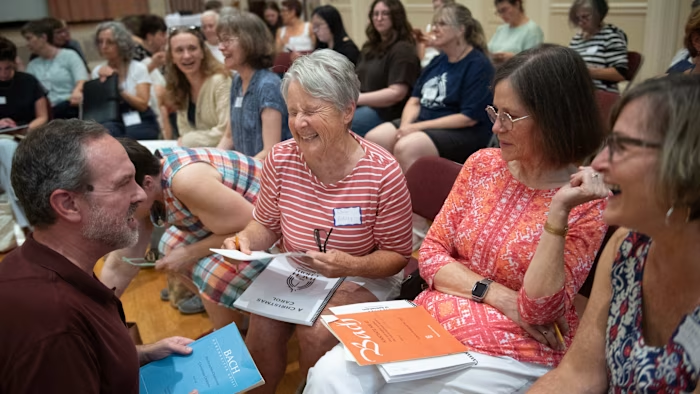
On a Monday night in late August, Ryan Morrow joined 120 other members of the Bach Choir of Bethlehem to take solace in song and transcend a country filled with political discord.
“We all may sing a different voice part within the hymn but we still sing one hymn, right?” he says.
Morrow, a 40-year-old music teacher, can trace his family roots back to the early Moravian settlers who founded Bethlehem in 1741 after fleeing what is now part of Germany and the Czech Republic. But he is the first of his family to join the choir.
For more than 125 years, the Bach Choir of Bethlehem has made this small city famous for its voice. It is the oldest Bach choir in the US, championed by the industrial tycoon Charles Schwab, who was president of both the Bethlehem steel mill and the Bach choir in the early 20th century.
From Carnegie Hall to the BBC Proms to Bachfest in Leipzig, the volunteer ensemble has performed at some of the world’s best-known venues and festivals. Closer to home, it has become a rare symbol of unity in a divided state.
Bethlehem is one of the key electoral battlegrounds in the US. Donald Trump won this post-industrial Pennsylvania city’s district by three points in 2016, lost by less than a point in 2020 and then won again by three points in 2024.
In July, the president sought to galvanise support for Republican Congressman Ryan Mackenzie with a rally in Macungie, a 30-minute drive south from Bethlehem, ahead of a tight race in November’s midterms.
In the same month, Quinnipiac University, a non-partisan university pollster, found that 56 per cent of Pennsylvanian voters approved of Democrat Josh Shapiro’s performance as governor (although this was a four-point dip from last year).
It does not take long for choir board member Anthony Thompson, an 80-something former attorney, to state that he voted for Trump in the past three elections. “Who else could you have voted for?” he says. “I did not want the alternatives,” he adds.


Even so, Thompson insists that all politics are left at the choir door. Fellow board member Harold Black says people are fed up with talking about Trump. “When you’re singing in a choir, or listening, you’re not fretting over existential problems,” he says. “You let the sound wash over you, to be free.”
Choir master Christopher Jackson agrees. He says the choir “transcends the blue and red divide”. Via outreach and school programmes it tries instead to be useful to the community. “It is a refuge,” he says. “It presents an opportunity for people to come together, to step away from the divisions.”
Unlike other rustbelt towns across the US, Bethlehem did not face dismal decline after the closure of its steel mill in 1995. This is partly due to the arrival of companies like B Braun, Mack Trucks and Crayola. This month yoghurt-maker Chobani announced a five-year plan to invest $1.2bn in the Lehigh Valley, creating 900 jobs.
But there is notable poverty here, with low home-ownership levels and nearly 16 per cent of people living with an income that is below their basic needs. Rising housing costs and inflation are concerns that could increase political divergence. Census data shows that Bethlehem is split between a non-Hispanic white majority and a growing Latino population, at 56.1 per cent and 28.7 per cent respectively. Hispanic working-class families are becoming the new political battleground.
Still, Morrow believes that there is a unity in the Moravian faith that he thinks underscores the town’s politics. A Protestant denomination, it calls for “in essentials unity, in non-essentials liberty, in all things charity”.
This seems to chime with the choir’s executive director Leela Breithaupt’s claim that significant donor support “entrusts the Bach choir continues as a central part of the fabric of our community for generations to come”.
But Chip Dangelmajer, a 60-something small-business owner and choir board member, is more pragmatic about life in both Bethlehem and Trump’s America. “I really don’t care about red or blue,” he says, before leaning in with a joke: “I just want to see the green.”
