


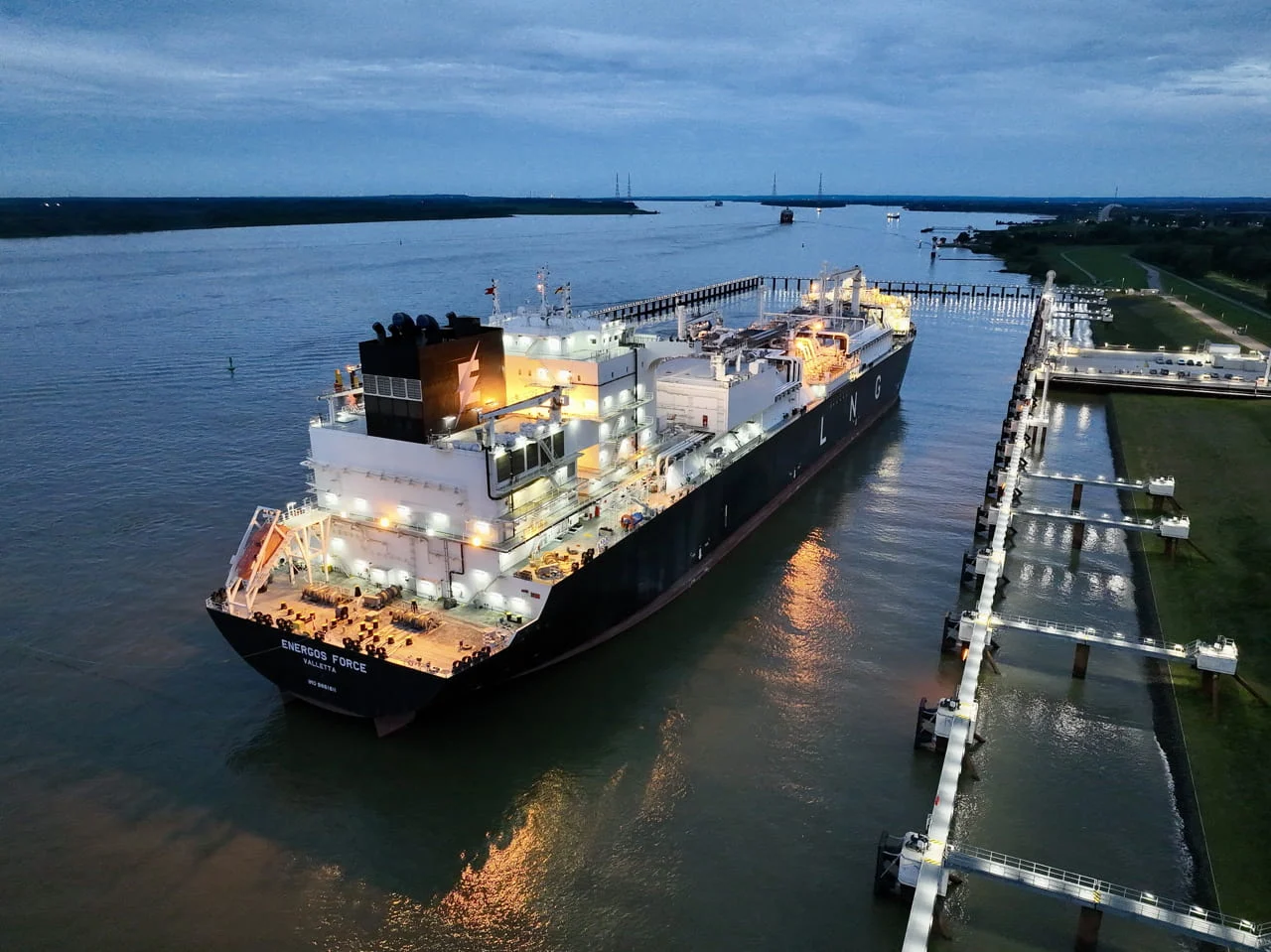
A 294-meter-long floating storage and regasification unit (FSRU) has arrived at the new liquefied natural gas (LNG) terminal in Stade, marking the start of commissioning preparations and bringing the facility a step closer to operations, with gas feed-in to Germany’s grid expected from November.
Deutsche Energy Terminal (DET), a German state-owned company that operates the federal government’s LNG terminals, has begun preparations to commission its new floating LNG terminal, after the FSRU Energos Force came to the Stade-Bützfleth industrial port. The arrival of the vessel, chartered by DET, marks the start of preparations to commission the Stade floating LNG terminal.
Dr. Peter Röttgen, DET’s CEO, remarked: “As promised, the return of the regasification vessel to the Stade jetty marks the start of preparations for the terminal’s commissioning. We expect the first fully loaded LNG tanker to come alongside in early November. From then on, Stade will begin feeding gas into the grid, thereby making the anticipated and important contribution to security of supply.
“The road to this point has not always been easy. Shortly after assuming responsibility for completion, we brought all necessary partners on board, who are working together with full commitment toward this common goal. I would like to take this opportunity to express my sincere thanks for ensuring that we can move forward at the necessary pace.”
The German LNG operator expects the Stade terminal to feed up to 3.2 billion cubic meters of natural gas into the grid from 2027, which would be sufficient to supply approximately 2.6 million four-person households with heating energy for a full year. Niedersachsen Ports (NPorts) constructed the jetty specifically for the FSRU and the onshore terminal, which is still under construction.
Katherina Reiche, Federal Minister for Economic Affairs and Energy, commented: “With the arrival of the Energos Force in Stade, what security of supply means in practice is becoming visible. The FSRU, which is docking at the terminal today, can help ensure a reliable supply of energy to millions of households from November onwards. With an injection capacity of up to 3.2 billion cubic metres of natural gas per year by 2027, Stade will be an important component of Germany’s security of supply.”
The 2021-built, 47-meter-wide FSRU Energos Force has a deadweight tonnage (dwt) of 94,361 metric tons. While the vessel can regasify up to 500 million standard cubic feet of gas per day (scfd) during winter using steam boilers in a closed-loop system, it can ideally regasify up to 750 million standard cubic feet per day in summer using Elbe River water in an open-loop system.
Holger Banik, NPorts Managing Director, said: “We are pleased to see the plans we developed together now taking shape. With the jetty, we have created the necessary infrastructure in the port for the terminal in Stade to begin operations. Ports are a crucial part of our state’s energy infrastructure today.
“Without the necessary capacity along the coast, the energy transition will not succeed. The fact that, in theory, around 2.6 million households can be supplied via Stade in the future demonstrates the scale and responsibility associated with this infrastructure.”
According to DET, the expected feed-in capacity for 2027 of up to 3.2 billion cubic meters of gas represents the so-called declared total reference send-out (DTRS) value, the maximum technically feasible system output under ideal conditions, without restrictions caused by extreme weather, unplanned grid constraints, cancellations by LNG suppliers, or technical malfunctions.
In addition, lower feed-in volumes resulting from the actual sizes of the delivered cargoes need to be taken into account. Deutsche Energy Terminal works with its local partners on behalf of Germany’s Federal Ministry for Economic Affairs and Energy (BMWE) to market and operate the government-initiated FSRUs, which are used to convert LNG back into a gaseous state and feed it into the German gas grid.
Currently, DET is responsible for the terminal in Brunsbüttel, two terminals in Wilhelmshaven, and the Stade FSRU project.

Power Your Brand With Offshore Energy ⤵️
Take the spotlight and anchor your brand in the heart of the offshore world!
Join us for a bigger impact and amplify your presence at the core hub of the offshore energy community!
