


For the first time in the modern history of the Democratic Republic of Congo (DRC), a Congolese nongovernmental organization will co-manage a protected area in the country.
“It is an honor,” Dominique Bikaba, founder of the NGO Strong Roots, told Mongabay by phone.
Strong Roots has been entrusted with the management of Itombwe Nature Reserve (RNI), located in South Kivu province in the northeast DRC. Under a public-private partnership Strong Roots will manage the reserve for the next 10 years. The Congolese Wildlife Authority (ICCN), the national authority responsible for natural parks, will retain oversight of the park.
“I think the government chose us, because they have observed the work we have done in the biodiversity corridor and the way we have put local communities at the center of conservation,” Bikaba said.
Strong Roots has spent about a decade securing land for communities and wildlife to create a 1-million-hectare (2.5-million-acre) corridor through community forestry concessions. This corridor spans the area between Kahuzi-Biega National Park and Itombwe Nature Reserve.
To date, Strong Roots has secured 23 community forest concessions in the area, covering nearly 600,000 hectares (1.5 million acres) of land.
“Itombwe is made up of seven chiefdoms, and we are already working with four of them in the corridor,” Bikaba said. “So we have a very good knowledge of the reserve; we know its problems and its needs.”
Bikaba is a member of an Indigenous community in the area that was evicted to make way for another protected area. So, putting local populations at the center of conservation is particularly close to his heart, he said.
Most protected areas in the DRC were created by evicting Indigenous populations, resulting in conflicts between park personnel and the local communities. In addition to conflicts with park managers, the area is also the site of clashes involving the M23, Wazalendo and Mai-Mai armed groups. Bikaba said Strong Roots will bring together aspects of traditional and modern conservation to help reduce the decline of species as well as the conflicts that exist.
For example, Strong Roots plans to recruit people from the communities to be patrol members. “By working hand in hand, we aim to make the population less likely to turn to armed groups for their survival,” Bikaba said.
He added his organization also hopes to strengthen enforcement of laws against poaching and mining, but also demilitarize conservation and move away from armed, military-like law enforcement.
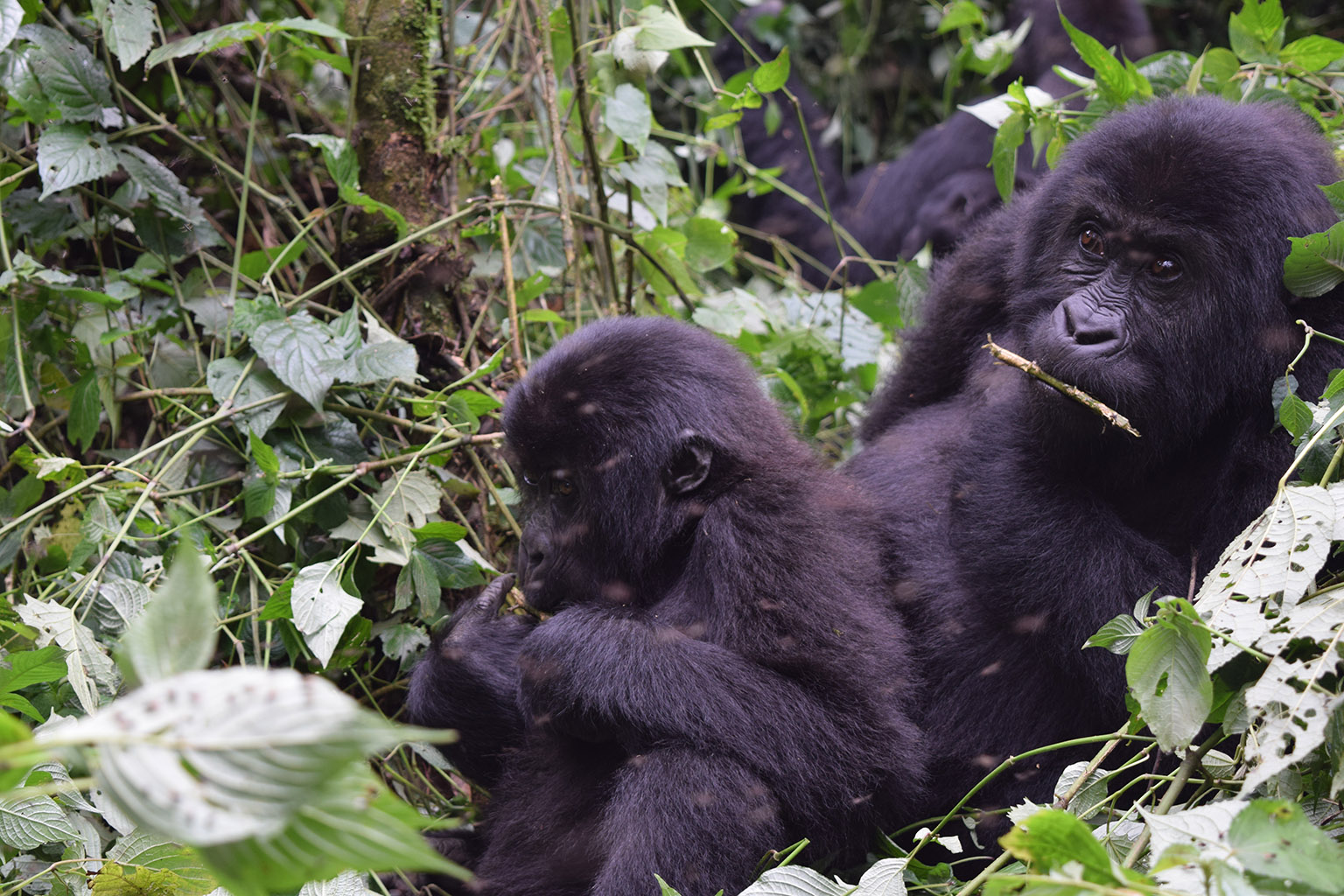
The Itombwe Nature Reserve was created in 2006 and covers around 760,000 hectares (1.9 million acres). It is home to nearly 600 bird species and is a sanctuary for the critically endangered eastern lowland or Grauer’s gorillas (Gorilla beringei graueri).
Banner image: Critically endangered Grauer’s gorillas live in Itombwe Nature Reserve. Image courtesy of Strong Roots Congo.
