


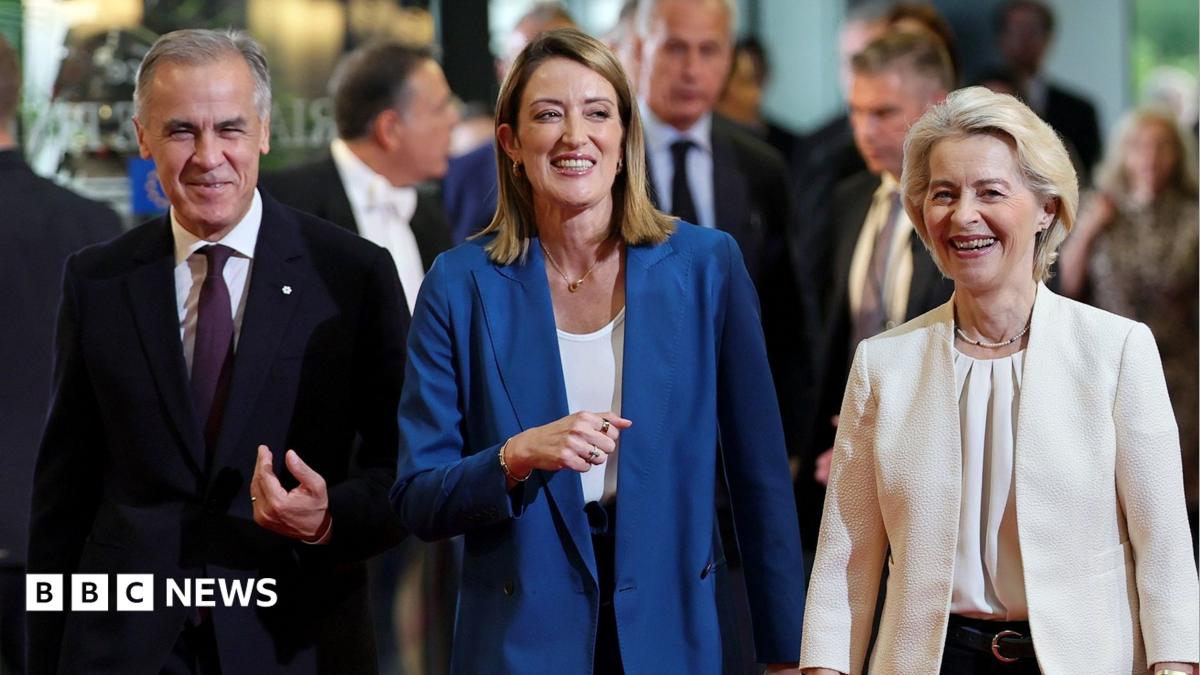
Both she and other European leaders have found a reliable ally in Carney as they deal with similar problems.
In particular, they have faced Trump’s aggressive use of tariffs and his threat to annex Greenland which is a sovereign territory of EU member Denmark.
But “associate membership” of the EU does not currently exist and the process, if agreed, could take years.
Earlier this year, Germany’s Chancellor Friedrich Merz suggested – to a mixed reaction – that Ukraine could be granted this new status.
Some countries in the western Balkans including Albania, Bosnia and Herzegovina, Montenegro, North Macedonia, and Serbia are already on the long road towards full EU membership.
In Eastern Europe, Georgia and Moldova are also applying.
Ten of the bloc’s 27 members are yet to ratify a free-trade agreement struck with Ottawa nearly a decade ago, and some capitals would prefer to build on existing defence and trade agreements rather than create a new form of membership for Canada.
Setting out the EU’s political and policy priorities for year ahead, von der Leyen also proposed the formation of a European Security Council, which would include the UK and Ukraine, amid an ongoing threat to the continent from Russia.
“For a long time, we have discussed a leaders’ format focused on the security of our continent, with partners like Canada, Norway, Ukraine, the United Kingdom and others involved,” she said in the wide-ranging address.
“This is even more urgent now, given the nature and scale of the risks at play. This is why we will set out our ideas to make a European Security Council a reality.”
Alongside global threats, von der Leyen also said many European families were worried about the cost of living, and the “dizzying speed of change” of technology and its impacts on jobs and society.
Other proposals included inviting the world’s largest AI labs for talks on how to support industry efforts to pace the frontier, as well as slashing bureaucracy for businesses in the EU.
A new emergency tool to help countries better deal with mass migration movements following the deadly influx of migrants to the Spanish enclave of Ceuta in July would also be outlined.
Plans to curb social media use among children, including banning platforms for under 13s, were also put forward. Under the proposal, children aged 13 to 15 would only be able to set up social media accounts which are supervised by parents.
