


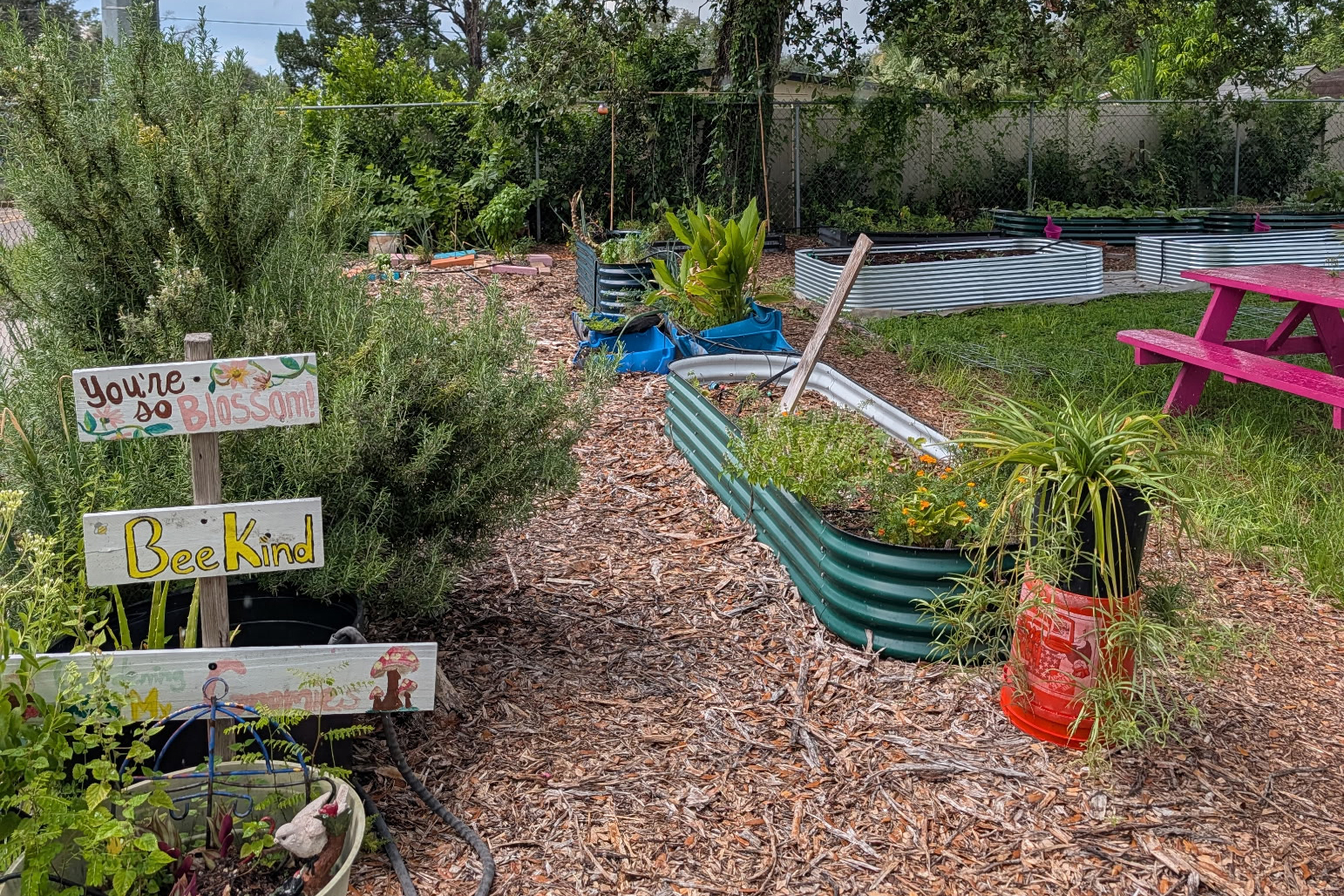
In the East Tampa neighborhood where Dee Morales bought her house, residents have been asking for a supermarket for 10 years. They still don’t have one. So Morales did the math out loud: In the decade the neighborhood has spent waiting, a community garden could have grown thousands of pounds of food.
Morales runs 813 Hood Garden, a network of growing spaces across East Tampa, Sulphur Springs and Ybor City. Two of these gardens are in neighborhoods the federal government classifies as “food deserts,” places that are both low-income and far from a grocery store.
She started 813 Hood Garden during the pandemic, after discovering the only way to get her oldest son to eat vegetables was to let him grow them himself. Adults who visited, she found, had never seen a pepper on the plant.
In Hillsborough County, more than 15 percent of residents are food insecure, according to Feeding America’s 2026 Map the Meal Gap, based on 2024 data. Across Florida, there was an increase in food insecurity from about 10 percent of the population in 2020 to 15.4 percent in 2024. Food insecurity has climbed nationally since the COVID-19 pandemic as food prices surged, according to the USDA.
Yet as need grows, the government’s willingness to measure food insecurity is shrinking. Last fall, the U.S. Department of Agriculture canceled its long-running annual survey of household food security—the most authoritative national count—calling it redundant and politicized. Increasingly, the task of mapping where hunger exists is falling to nonprofits and researchers building models of their own.
Geographer Jaryd Hinch built a model that scores every neighborhood in Hillsborough and Pinellas counties for community-garden “suitability,” weighting poverty and income most heavily—above factors like transit access and available land—in what he calls an “equity-first” design meant to steer gardens toward the residents facing the steepest barriers to fresh food. The study began as a graduate course project, was not funded or requested by any agency and was written by Hinch, a doctoral candidate at the University of South Florida whose research centers on aviation sustainability.
Published this year in the peer-reviewed journal Southeastern Geographer, it maps where a garden could, in theory, do the most good, then overlays the gardens Tampa Bay already has. The match is loose. About 58 percent of existing gardens fall in the neighborhoods his model flags as “highest priority,” better than the 40 percent random placement would predict, yet still far from alignment. Maps show some of the highest-need neighborhoods have no garden, while some of the county’s most established gardens flourish in comfortable suburbs—one of the most successful sits in Carrollwood, a middle-class area that is nobody’s idea of a food desert.
Hinch’s paper frames that gap as a planning problem: The region lacks “spatially informed decision-making tools,” he wrote. But the people closest to the work describe a different problem entirely.
“The tool doesn’t matter,” said Monica Petrella, the food-systems coordinator at the University of Florida’s Hillsborough County extension office and, in effect, the audience Hinch’s model was built for. She won’t consult a suitability map, she said, until a project already has about 30 committed volunteers and $10,000 for beds, soil and water. In her day-to-day life, she isn’t looking at any map to decide where a garden goes—she’s trying to help the gardens that exist find enough volunteers to survive.
That inverts the study’s premise. The binding constraint on community gardens, Petrella said, isn’t information about where need is highest. It’s people and money. And those, she noted, tend to pool where affluence already is: Gardens demand so much volunteer labor that they thrive in neighborhoods where residents have leisure time, disposable income and the knowledge to file for nonprofit status and chase sponsors.
According to the Coalition of Community Gardens, of the 12 gardens that started in the region between 2009 and 2011, six had failed by 2015—a 50 percent failure rate. After the coalition formed to network and support them, none failed over the next six years.
This story is funded by readers like you.
Our nonprofit newsroom provides award-winning climate coverage free of charge and advertising. We rely on donations from readers like you to keep going. Please donate now to support our work.
Petrella is blunt in her belief that gardens won’t close the hunger gap. Food insecurity, she said, is a function of economics: Grocery chains skip low-income neighborhoods they deem unprofitable, residents without cars are left with convenience stores and no amount of backyard tomatoes changes that arithmetic.
The produce itself rarely reaches the people who need it most, she said; most gardens run on individual plots, where growers take home what they raise, leaving little surplus to give away. The connection between a community garden and a hungry household, she said, is “a scenic route.” Gardens are “a cherry on top,” she said. They’re valuable for the community they build, but not a fix.
Morales agrees a garden is “part of something bigger.”
“It’s our responsibility as the people to advocate for what we want,” she said. Community gardening, in her telling, is a short-term answer while neighborhoods keep fighting for the grocery stores, transit and wages that would actually move the needle.
Notably, Morales didn’t fault the model—she called it a promising resource, as long as it captures “the actual need of the people,” something a survey, not a spreadsheet, would catch. Her frustration runs elsewhere.
“The issue isn’t that we need more community gardens,” she said. “We need support for the gardens that exist.” Organizers like her aren’t paid for their time; she works a job and pours the rest into the garden as a passion project. She can’t tell her landlord she spent 50 hours in the garden this month, she said, or ask the city for a credit on her water bill.
There’s a deeper risk, too. Ask Morales whether a garden’s success could end up pushing out the residents it was meant to serve, and she doesn’t hesitate: She’s watched it in Tampa Heights and around Robles Park, where longtime residents are now “gone.”
The USF model makes its equity commitments explicit and testable—a genuine contribution, and more transparent than the ad-hoc siting it hopes to replace. But it also illustrates the limit of mapping as a theory of change. Tampa has models, a climate plan that endorses gardens and federal grant money. What its growers say they don’t have is a supermarket that stayed, or a dollar for the hours they’ve already given.
About This Story
Perhaps you noticed: This story, like all the news we publish, is free to read. That’s because Inside Climate News is a 501c3 nonprofit organization. We do not charge a subscription fee, lock our news behind a paywall, or clutter our website with ads. We make our news on climate and the environment freely available to you and anyone who wants it.
That’s not all. We also share our news for free with scores of other media organizations around the country. Many of them can’t afford to do environmental journalism of their own. We’ve built bureaus from coast to coast to report local stories, collaborate with local newsrooms and co-publish articles so that this vital work is shared as widely as possible.
Two of us launched ICN in 2007. Six years later we earned a Pulitzer Prize for National Reporting, and now we run the oldest and largest dedicated climate newsroom in the nation. We tell the story in all its complexity. We hold polluters accountable. We expose environmental injustice. We debunk misinformation. We scrutinize solutions and inspire action.
Donations from readers like you fund every aspect of what we do. If you don’t already, will you support our ongoing work, our reporting on the biggest crisis facing our planet, and help us reach even more readers in more places?
Please take a moment to make a tax-deductible donation. Every one of them makes a difference.
Thank you,

Fellow
Kate Waxman is a Florida-based Outrider fellow at Inside Climate News, where she covers climate injustice across the state. She earned her M.S. in journalism from Columbia Journalism School and her B.A. in environmental science from Barnard, with reporting focused on coral reefs, climate science, and the communities closest to the water.
