


Welcome to Foreign Policy’s Southeast Asia Brief.
The highlights this week: An election in the Philippines’ Bangsamoro Autonomous Region was supposed to settle a decades-old conflict; Singapore defends high ministerial salaries; and app drivers in Vietnam assert their growing political importance with a strike.
The Philippines’ Bumpy Peace Election
This week in the southern Filipino archipelago of Mindanao, an election in the Bangsamoro Autonomous Region was supposed to settle a decades-old conflict.
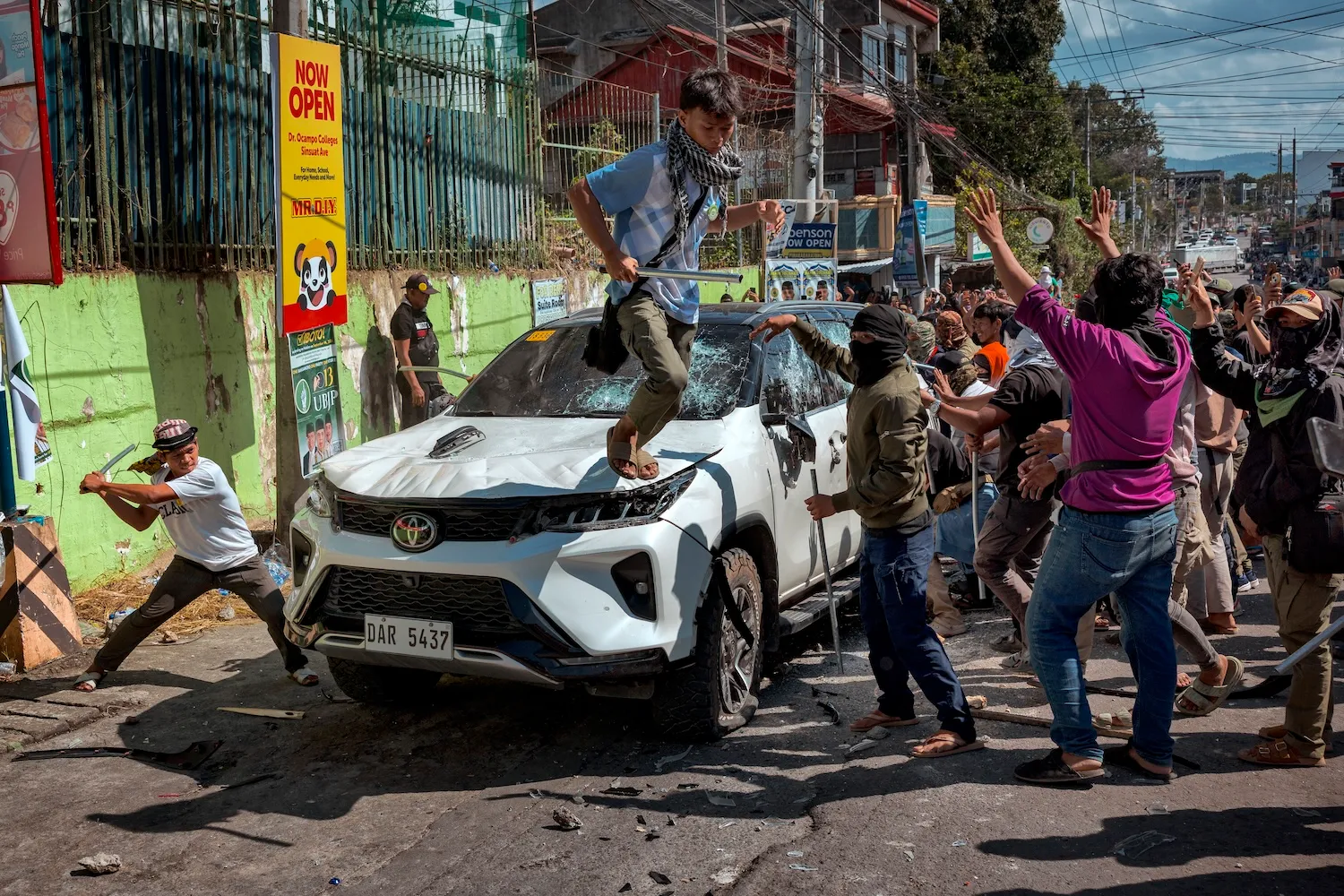
In Cotabato City, one of the region’s larger cities, I served as an election observer, accompanying a team from the International Republican Institute. Unfortunately, things were bumpy. And whether this election is the next step toward peace or the starting gun for more conflict is yet to be determined.
At least five people were killed and 18 injured over the election period, despite the heavy presence of security forces. Decades of conflict and an internal split between rebels evidently amplified tensions.
First, though, some context. Mindanao, the Philippines’ second-largest island, has a long history of struggle against national authorities. Spanish and then American colonialists struggled to subdue the majority-Muslim islands.
In the 1960s under President Ferdinand Marcos, an influx of Christian settlers from other islands sparked another round of conflict. In 1996, a rebel group called the Moro National Liberation Front (MNLF) struck a peace deal with the government that held despite imperfect implementation. The Moro Islamic Liberation Front (MILF), an Islamist splinter from the MNLF, kept fighting until it struck a deal in 2014.
On the political track, the agreement had two key components. First, the establishment of the Bangsamoro Autonomous Region in Muslim Mindanao (BARMM), an autonomous parliamentary government straddling numerous Muslim-majority areas in Mindanao with wide-ranging powers to raise revenue and legislate. Second was an election, to choose delegates for the parliament to replace its initial appointees.
The politics have been tricky, though. After BARMM formed in 2019, its first election was initially scheduled for 2022 but then subsequently delayed four times.
In the past year, the Islamist MILF has also split politically. MILF Chair Al Haj Murad Ebrahim leads the United Bangsamoro Justice Party, the organization’s political arm. Last year, he was displaced as chief minister by Abdulraof Macacua, former chief of staff for the MILF’s armed forces. Macacua subsequently joined the Bangsamoro Federalist Party. This is seen as having the barely veiled backing of the Philippine national government, and many local government officials across the region have declared allegiance to the Bangsamoro Federalist Party.
Drop this into the context of a Philippine election—where vote buying, intimidation, and outright violence are persistent problems—and you have a potentially explosive mix.
The night before the election, three people died in an explosion, with another person injured in the same incident dying the next day. On the morning of the vote, a delay delivering ballots held up proceedings at various polling stations, but once things got going, the process seemed smooth enough—at least at the polling sites where observers were permitted to attend.
As the day wore on, though, groups of masked men began to gather near polling stations and roam the streets on the backs of trucks. Locals seemed unsurprised.
A shoot-out at one school that was serving as a polling station left one more dead.
Still, it must be said: Things could have gone worse. The peace deal plan to fully demobilize MILF’s fighters stalled amid mutual recriminations. So the organization still has some 14,000 fighters, who—according to local sources—are now better armed than they were back in 2014.
At time of writing, the Bangsamoro Federalist Party looks likely to lead the next government, having achieved the highest vote share. The key now is how the MILF-aligned United Bangsamoro Justice Party takes it. (It is already crying foul over parts of the election.)
Will whatever government forms be able to keep the peace process on track?
This has implications beyond the Philippines. For decades, the country’s military focused on the task of suppressing local insurgencies. With the communist insurgents at their lowest-ever ebb, settling the Mindanao conflict would reduce the urgency of this task. And this, in turn, would allow the military to redirect its focus outward to the challenge of China.
To Lam’s diplomatic trail. On Wednesday, Vietnamese President To Lam wrapped up a three-day visit to Russia. He then stopped off in France for a few days.
The most substantive announcements to come out of the trip to Russia were related to energy. The countries’ respective state-owned firms Petrovietnam and Zarubezhneft signed a framework agreement to set up a Vietnamese strategic oil reserve.
Russia already plays a major role in Vietnam’s oil and gas sector. An agreement for Russia to help Vietnam build its first nuclear power plant, signed in March, was also reaffirmed. Other announcements included plans to boost bilateral trade to $15 billion by 2030 plus cooperation on security, transport, and other issues.
Lam’s was touted as the first official visit by a Vietnamese leader to Russia since the collapse of the Soviet Union, although he also visited in May last year. At that point, he was already the leader of the Communist Party of Vietnam, though he was not yet the country’s president.
For France, which became a “comprehensive strategic partner” of Vietnam in 2024, the most notable announcement was that it would help support the launch of a Vietnamese satellite. This builds on France helping Vietnam launch its first Earth-observation satellite in 2013.
The trips come amid a wider diplomatic push by Lam. Since 2024, he has visited more than two dozen countries, including the United States, China, and Singapore.
Ferry tragedy. Six people are dead and more than 120 are missing after a ferry sailing from the Indonesian island of Java to Borneo capsized in bad weather on Sunday. The ship was carrying 243 people, of whom 107 were successfully evacuated and six are confirmed to have died.
Indonesia has more than 17,000 islands, and ferries are a common method of transport. Accidents are sadly common. Last month, five people died when a ferry caught fire off the coast of Madura. And in July 2025, at least 19 people died after a ferry traveling between Java and Bali sank.
On Friday, the Philippines, Southeast Asia’s other archipelagic nation, saw a similar tragedy. A fire on a ferry sailing from Manila has left 76 dead and another 13 missing.
Another Philippine ferry disaster last year, which left at least 52 dead and some two dozen still missing, sparked public outcry. The owners of the ship’s ferry line now face criminal charges, and four members of the Philippine Coast Guard were dismissed over their failure to properly inspect the vessel.
Singapore defends minister salaries. On Thursday, Singaporean Prime Minister Lawrence Wong defended a government decision to hike the country’s already very high ministerial salaries.
Singapore has long had a policy of paying politicians and civil servants salaries that are commensurate to those of top private-sector employees, arguing that this is necessary to attract talent. The result is salaries that run into the millions.
Under the new scale, the prime minister’s salary will increase from $1.7 million to $2.9 million, the deputy prime minister’s will rise from $1.5 million to $1.6 million, and top ministers’ pay will increase from $1.4 million to $1.5 million.
High salaries for top public servants are a long-standing policy in Singapore.
However, this has also long been a sensitive issue. The last salary adjustment was in 2012, when the government actually cut ministerial salaries by 36 percent due to public grumbling. The reaction to this hike will be interesting to watch. Singapore’s GDP is growing strongly at 5 percent due to the artificial intelligence boom, but there are signs that workers aren’t feeling it.
Firefighters from the Manggala Agni task force and Indonesian military personnel spray water on wildfires in South Sumatra, Indonesia, on Sept. 12. The fires occur under El Niño conditions, and smoke disrupts nearby roads, contributing to transboundary haze in Southeast Asia. Bagus Kurniawan/NurPhoto via Getty Images
FP’s Most Read This Week
The World’s Only Real Hope of Maintaining Order by Charles A. Kupchan
How to Survive in a World Without Rules by Hal Brands
Top Signs You’re Heading for a Quagmire by Stephen M. Walt
Philippine President Ferdinand Marcos Jr. heads to the BRICS summit in Delhi as his push to diversify diplomatic ties continues, by Sam Beltran in the South China Morning Post.
China’s new mega-canal will bind it tighter to Southeast Asia, by Wataru Suzuki in Nikkei Asia.
Philippine Vice President Sara Duterte plays the victim card in the run-up to the country’s presidential race, by John Nery in Rappler.
In Focus: Vietnam App Driver Strike
Drivers on Grab, Southeast Asia’s answer to Uber, launched a strike in Vietnam on the weekend over excessive platform fees. The strike is notable both as a major labor action at a time when such things are increasingly uncommon in Vietnam as well as another example of app drivers becoming a major sociopolitical constituency in Southeast Asia.
Drivers said the strike was started in reaction to Grab changing its fee structure in July so that deductions by the platform could reach as much as 50 percent of fares. Other complaints include a lack of transparency in how fees are calculated and the fact that fares have been lowered.
Over the weekend, drivers were reportedly hard to find. The government’s competition regulator has announced that it now probing Grab’s fee and commissions structures.
The number of strikes in Vietnam has declined over the past decade. However, issues concerning drivers and platform fees have been a repeated flash point, with notable protests over the issue occurring in 2017, 2018, 2019, and 2020.
The persistence of the issue and the government’s move to address the complaints highlights the growing importance of app drivers as a constituency in Vietnam and the wider region.
According to Grab, it has 5 million driver partners across Cambodia, Indonesia, Malaysia, Myanmar, the Philippines, and Singapore, with 47 million people using it each month. Other apps, such as Indonesia’s GoJek and Bolt, register a few million more, though many drivers use multiple apps.
These numbers, and the apps’ centrality to urban mobility, give drivers a lot of weight. The Indonesian government moved in May to curry favor with drivers by lowering the cap on platform fees from 20 percent to 8 percent.
Authorities in Vietnam, however, tamped down on public protest, fining a citizen who made social media posts urging drivers to strike.
In 2024, Malaysia and Singapore passed laws protecting gig workers’ rights.
