


Welcome to Foreign Policy’s China Brief.
The highlights this week: Prospects for AI safety measures appear dim ahead of the U.S.-China summit, Chinese President Xi Jinping attends the BRICS summit in India, and China moves to replenish its oil stockpiles.
Welcome to Foreign Policy’s China Brief.
The highlights this week: Prospects for AI safety measures appear dim ahead of the U.S.-China summit, Chinese President Xi Jinping attends the BRICS summit in India, and China moves to replenish its oil stockpiles.
Can the U.S. and China Cooperate on AI Safety?
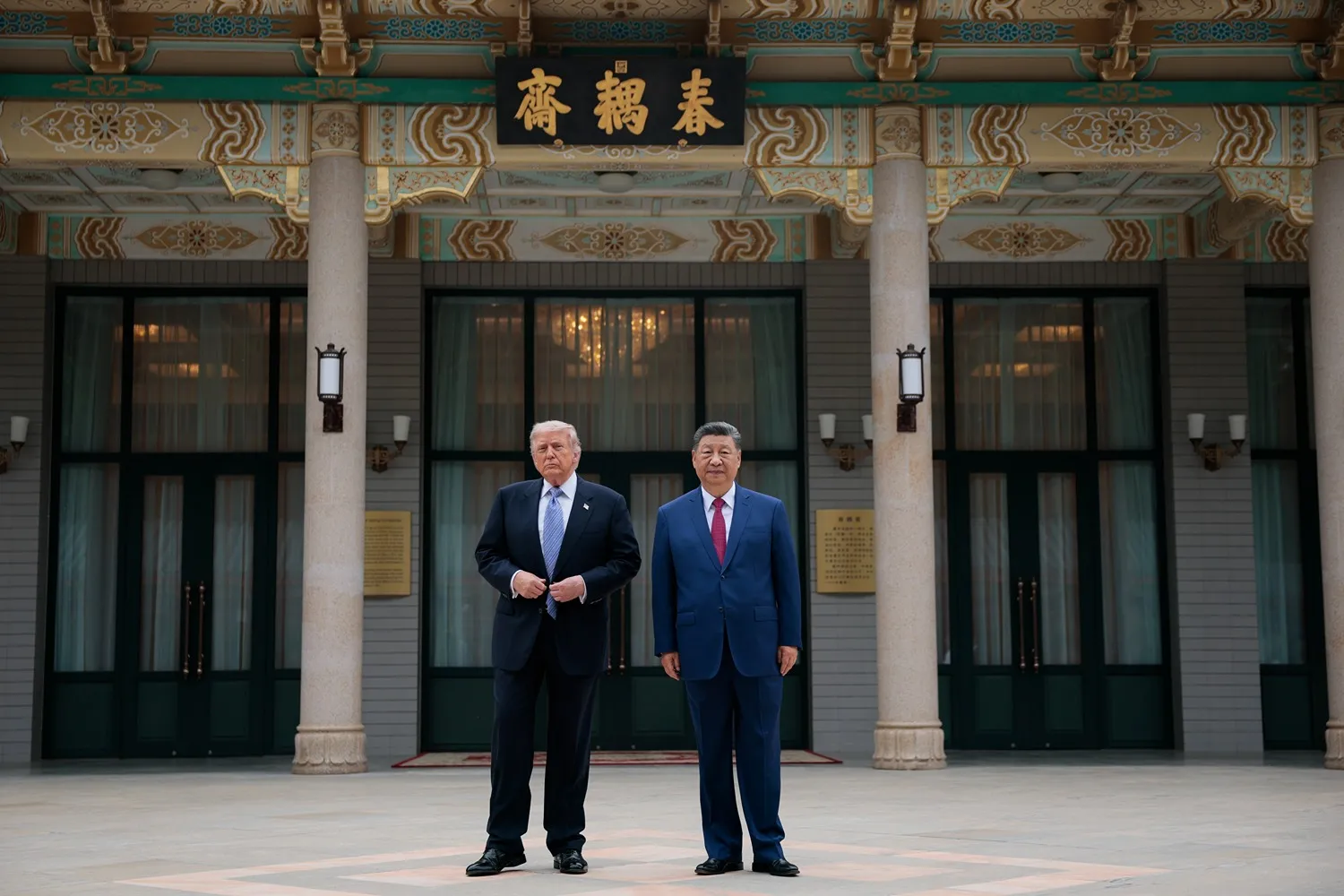
U.S. President Donald Trump and Chinese President Xi Jinping are scheduled to meet in Washington on Sept. 24, and artificial intelligence safety is likely high on the agenda.
Many analysts hope that China and the United States might cooperate to set basic international principles for governing the technology despite their geopolitical rivalry—much as the Soviet Union and United States ultimately cooperated during the Cold War on nuclear arms control, polio eradication, and protecting the ozone layer.
China has reportedly threatened to cancel the summit if the United States goes ahead with arms sales to Taiwan beforehand, but that sounds like routine diplomatic noise to me. Even if the meeting goes ahead, the chances of productive alignment on AI safety are low.
As I wrote last month, the two countries have fundamentally different understandings of AI risk. While the U.S. tech elite is preoccupied with sci-fi scenarios involving singularity and machine gods, Chinese bureaucrats operate within a tradition of cybernetics that is more concerned with technical failures and the political and economic consequences of new technologies.
Simply put, if you think the central AI problem is “control the emergence of superintelligence,” your approach will differ from someone whose concern is “prevent AI from worsening youth unemployment.”
In theory, there are still shared problems that Beijing and Washington could address at the summit, particularly in the wake of the OpenAI-Hugging Face security breach. As much as the Chinese internet is cut off from the wider world, it still depends on many of the same systems and crumbling infrastructure as the United States.
Still, another issue is that the United States and China have mismatched regulatory capacities, making it unlikely that they could impose shared standards. For better or worse, China exercises tight control over its tech sector. That has included massive fines, canceled IPOs, ideological restrictions, and pressure on executives to demonstrate political loyalty or face imprisonment.
The U.S. tech sector, by contrast, has numerous ways to resist regulation, from lobbying to legal challenges to seemingly bribing the president. Regulation would also require new legislation—an unlikely prospect in a deeply divided Congress.
Chinese leaders, who can change regulations largely at their whim, often struggle to understand these limits and might interpret any discrepancy between promises of regulation and legal reality as a sign of U.S. unreliability or dishonesty, which could scuttle further progress.
The White House has made very clear its hostility to AI regulation. On Monday, Trump wrote on Truth Social that “the only control or ‘guardrails’ that AI needs is a STRONG AND SMART (High IQ!) PRESIDENT, and the U.S.A. has that, in spades!” He doubled down on the false narrative blaming China for public opposition to AI and data centers, calling it a “sick conspiracy.”
The sudden return to anti-China rhetoric is an about-face for Trump, who has been reluctant to publicly criticize Beijing, even as other Republican politicians have indulged in plenty of China bashing.
Trump might believe that he can spread anti-China narratives at home and still cooperate with Beijing where it serves him, but Chinese leaders may not be so keen. That was evident this weekend, when Chen Yixin, the head of China’s state security ministry, wrote in an article that U.S. AI models are part of a “propaganda war and a cognitive war” against China.
What We’re Following
Xi attends BRICS summit. Xi made a flying visit to India over the weekend to attend the BRICS leaders’ summit. Though Xi stayed for only one day, the visit signaled a degree of reconciliation between Beijing and New Delhi, which in the last two years have sought to rebuild ties strained by their border conflict.
The summit itself was mostly just a talk shop, and BRICS—once heralded as a sign of a new world order—looks increasingly pointless, even with five additional members. China is more powerful and richer than the other members. Apart from its anti-Western geopolitical alliance with Russia, it is also not particularly aligned with them.
Xi made headlines for skipping a key dinner at the summit. Though some Indian media speculated this was a political signal, he probably did not attend simply because he wasn’t feeling well or wanted to rest.
Museum scandal in Shandong. A minor scandal in Heze, Shandong, flared into a much bigger one last week. It began weeks ago, when a well-meaning resident noticed that artifacts featured in a 2011 documentary about an archaeological discovery no longer appeared in the Heze City Museum’s collection, suggesting they were illegally sold into private hands.
After the resident filed a complaint, his barbecue restaurant was targeted with fraudulent inspections by five government departments and accused of everything from illegal construction to selling dog meat. Eventually, he was forced to close the business.
The local government says that the actions were prompted by citizen complaints, but it seems far more likely that this was an example of how petty and retaliatory the state can be.
FP’s Most Read This Week
Tech and Business
China rebuilds its oil reserves. China increased its oil imports in July and August, helping drive global crude prices past $100 per barrel. One of the mysteries of the oil market this year has been how China has carried on without replacing its Iranian imports, suggesting that it was doing better at moving away from fossil fuels or that its oil reserves were larger than previously thought.
China began tapping its visible reserves in June, but not on the scale many analysts expected. Beijing might now be moving to replenish those stockpiles, but it might also see higher oil prices as a way to put political pressure on Trump. Either way, increased Chinese demand is likely to have knock-on effects in neighboring countries, where the fuel-price shock has already hit hard.
Qingdao shipyard fire. A fire at a shipyard in Qingdao last Thursday killed at least 25 people—a threshold that triggers provincial-level investigation in China. Death tolls are often suppressed to avoid such probes, making the reported figure notable. This week, the investigation was raised to a State Council investigation, suggesting authorities regard the incident as highly sensitive.
The fire wrecked the Ocean Melody, a Liberian-flagged vessel that is believed to be Chinese-controlled. Overseas Chinese-language media have speculated that the ship may have been part of China’s so-called shadow fleet, a network of vessels used in sanctions evasion.
If true, the State Council probe could reflect concerns beyond an industrial accident, including the possibility of foreign sabotage.
