


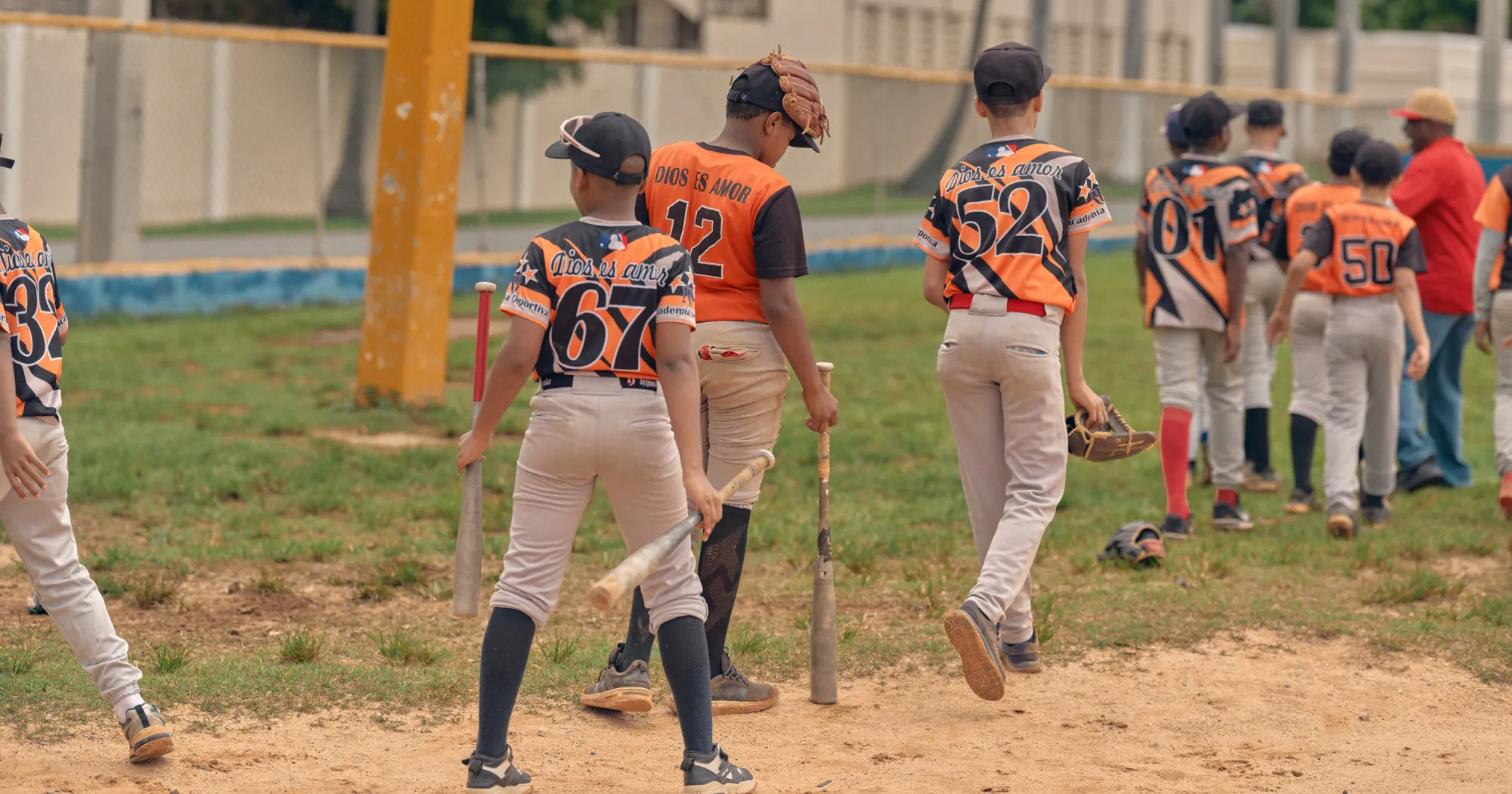
Baseball is everywhere in the Dominican Republic, which sends a disproportionate number of players to the American major and minor leagues, including Hall of Famers like Pedro Martínez and Adrian Beltré. Playing fields and training academies dot the country in villages where players who’ve made the leap to the pros are immortalized in murals.
For nearly half a century, the Dominican Republic has sent more players to the majors than any country outside the United States. The nation, which has a population roughly that of Ohio’s, had 144 players reach the major leagues last year. That’s about 10% of the league.
The Dominican baseball factory is a volume business, with teams paying signing bonuses to about 450 prospects each year. Fewer than 10% of those young players will ever see a single pitch in the majors, but in a country as impoverished as the Dominican Republic those bonuses — worth several times the country’s average annual income — could be life-changing for the players and their families. Yet Major League Baseball has long allowed a corrosive system to fester that rigs the game against young players in favor of opportunistic trainers and predatory moneylenders.
Here are the key highlights of ProPublica’s investigation into the Dominican baseball system.
Trainers coach children in exchange for future earnings.
Young baseball players in the United States and Canada must enter the major league system through its annual draft of young prospects. But in the Dominican Republic it’s a free-for-all, with players going to the highest bidder.
After MLB scouts began to recognize the Dominican Republic as a source of cheap talent, teams opened bare-bones training academies to develop young players. Eventually, the buscones — men relied on by teams to identify local talent — realized they could start their own academies. There are now hundreds of such facilities and, according to a national trade association, approximately 6,000 trainers.
In addition to coaching, the trainers who operate these academies generally provide room, board and equipment. Education often falls by the wayside. In return, they receive a share — typically 35% to 50% — of a player’s signing bonus. Most of those bonuses are valued at around $30,000, but they can be as high as six or seven figures.
From 2012 through the beginning of 2026, major league teams paid Dominican prospects $1.042 billion in bonuses, according to a ProPublica analysis. But much of that money — up to half a billion dollars — is almost immediately siphoned off by trainers and lenders.

To get around league rules, MLB teams make handshake deals with underage players.
Major league rules bar teams from making official deals with players under the age of 16, but teams have long circumvented this ban through the use of unwritten early agreements, or preacuerdos. In these handshake deals, typically arranged through a player’s trainer, the team pledges to pay a certain amount to the player once he is of legal age to be signed.
With players as young as 11 involved in such deals, it can be years before the prospect receives his bonus.
Moneylenders persuade families to sign over players’ bonuses for high-interest loans.
Preacuerdos and the lure of these promised payouts have created a cottage industry of prestamistas, or moneylenders, who persuade players’ families to sign away portions of these impending bonuses in exchange for loans with sky-high interest rates.
The Dominican Republic repealed its usury laws 24 years ago. High-interest lenders advertise online, targeting young ballplayers and their families. One WhatsApp ad touted loans for “baseball players who have agreements.”
Belfi Rivera was 14 when he made a handshake deal with the Arizona Diamondbacks that would pay him $1.8 million after he turned 16. (The Diamondbacks did not respond to a request for comment.) Ultimately, he’d see very little of that money. The trainer who had brokered the deal got his share, worth $630,000. More than $950,000 went to someone who had no hand in teaching Belfi how to play baseball: Santo Caraballo, a lender who formed a business partnership with Red Sox legend and Hall of Famer David Ortiz.
In a statement sent through his lawyer, Ortiz said that his business relationship with Caraballo “began to come to an end” more than 18 months ago.” He added that he ended his personal relationship with Caraballo “a year and a half to two years ago” after “noticing conduct by Mr. Caraballo that I considered inappropriate. I started distancing myself from him personally and placed the relevant matters in the hands of my legal advisors.”
However, in September 2025, Ortiz and Caraballo filmed themselves heading for Puerto Rico on a private jet, drinking and dancing on their way to a Bad Bunny concert.
In a brief conversation, Caraballo told ProPublica that his business was not the biggest or “that lucrative.” He added that the risk in loaning money to families is that “you never know if it will succeed or not because if the player doesn’t get signed, you don’t get paid.” Multiple attempts were made to reach him again, including sending him a summary of ProPublica’s findings. He never responded.

One lender used a player’s deadly car crash to start his empire.
Before becoming a fixture in the prestamista sphere and partnering with Ortiz, Caraballo played a shadowy role in salvaging the career of rising MLB prospect Oneil Cruz. In 2020, while Cruz was a player in the Pittsburgh Pirates’ minor league system, he crashed his Jeep into the back of a motorcycle, killing three people. Prosecutors initially said the ballplayer had been drinking, and he faced the possibility of three years in prison. According to numerous interviews and court records, Caraballo was brought in by Cruz’s parents and negotiated payments to the victims’ families. In exchange, they signed agreements withdrawing all claims against Cruz, who is currently the starting center fielder for the Pirates. The case against Cruz, who denied any wrongdoing, was dismissed. ProPublica made numerous attempts to reach Caraballo about his role, including sending him a summary of our findings. He never responded.
Cruz declined a request for an interview. His lawyer, Amauris Vásquez Disla, called the accident “a profound tragedy for all parties involved, especially the victims’ families.” He went on to say that the court “issued an order of dismissal based on the findings, a legally binding decision that was a lawful resolution of this matter.”
A spokesperson for the Pittsburgh Pirates said the team and Cruz “addressed this matter more than six years ago based on the information available and the outcome of the legal proceedings.”
That lender then partnered with the Dominican Republic’s biggest baseball star.
By 2021, records show that Caraballo and Ortiz had entered into a business partnership, with both men listed on corporation records of a Florida company called Big Papi Sports Group. The company was dissolved the next year. What, if anything, it did is not clear. Their financial and personal relationships, however, continued. Ortiz acknowledged to a ProPublica reporter that he had invested millions of dollars into Caraballo’s baseball business. He added that his business with Caraballo was limited to making loans to trainers, not kids. At Ortiz’s 2022 Hall of Fame induction ceremony, Caraballo sat with the retired player’s family.

Why did David Ortiz oppose an international draft?
Ortiz’s connection to Caraballo doesn’t just spotlight the power and influence that these moneylenders can attain in the Dominican Republic. It also raises questions about the Red Sox legend’s involvement in persuading major league players to oppose an international draft.
For more than a decade, MLB commissioner Rob Manfred has made the case in favor of a draft for prospects from Latin America. Last year, during a visit to the Dominican Republic, he acknowledged that preacuerdos were “problematic” and argued that the “best solution to early deals is a draft.” Manfred and supporters of an international draft say it would make early agreements impossible.
The players union has opposed such a draft, arguing that it would restrict a prospect’s ability to choose his employer and eliminate bidding wars that drive up bonuses. The union has acknowledged that the Dominican system of early deals is troubled but has maintained for years that this is due to the league not enforcing its own rules.
During contract negotiations in 2022, the league was again pushing for an international draft, and the issue had become a major sticking point. But then, said people on both sides of the discussions, Ortiz got involved, sending a voice message to Dominican players and trainers, declaring a “red alert.”
“If we allow the draft to happen here in the Dominican Republic, even your great-great-grandchildren, and everyone else’s, will be affected by it,” Ortiz said, according to an audio copy of the message obtained by ProPublica. “If we let them push that thing through here, we’ll be in deep trouble.”
In the message, Ortiz shared the phone number for Tony Clark, the union’s executive director, and urged everybody to express their opposition to the draft. What he didn’t share was that he had a financial interest in preserving the system.
When asked over the phone if his opposition to the draft had anything to do with his partnership with Caraballo, who profits from the current system, Ortiz didn’t answer and hung up shortly afterward.
In a subsequent statement sent through his lawyer, Ortiz said his position regarding the international draft “was never motivated by personal interests.” The statement went on to say that his opposition “was based on my views regarding the development of Dominican players and the impact I believed such a system would have on baseball in our country.”
“Major League Baseball knows how dirty the business is here.”
Major League Baseball is a formidable economic and political presence in the Dominican Republic. But outside of the league’s push for an international draft, it’s done nothing that would put an end to or reform the early agreement system. It has never publicly warned or penalized a team for making an early deal, and its attempts to educate families about moneylenders have been ineffectual. A spokesperson for MLB declined to comment and referred to past statements by league officials calling for an overhaul of the Dominican system.
“Major League Baseball knows how dirty the business is here,” said Piñao Ortiz, who was the Dominican commissioner of baseball from 1996 to 2000,, “but it’s not doing anything to stop it.”
