


Keiko Mori, a 22-year-old teacher in Japan, defied orders to lead 30 students to their deaths with hand grenades rather than allow them to surrender to American forces during the Battle of Okinawa in June 1945.
In August and September 2026, a rumor circulated online that Keiko Mori, a 22-year-old teacher in Japan, defied orders to lead 30 students to their deaths with hand grenades rather than allow them to surrender to American forces during the Battle of Okinawa in June 1945.
For example, on Sept. 3, a post on Facebook (archived) read:
WOW: In June 1945, a 22-year-old teacher named Keiko Mori in Okinawa was ordered to command her 30 students to commit suicide with hand grenades rather than surrender.
She refused. And she said to her students, “Live. No matter what they say, you must live.” While Japanese soldiers, who were forcing death for the sake of honor, searched for them, she hid her students in a cave for 12 days.
Even when food ran out, she sang songs and taught arithmetic using stones. When American soldiers eventually discovered the cave, she stepped out first, holding up a white shirt to protect her students.

(David J Harris Jr., accessed via Facebook)
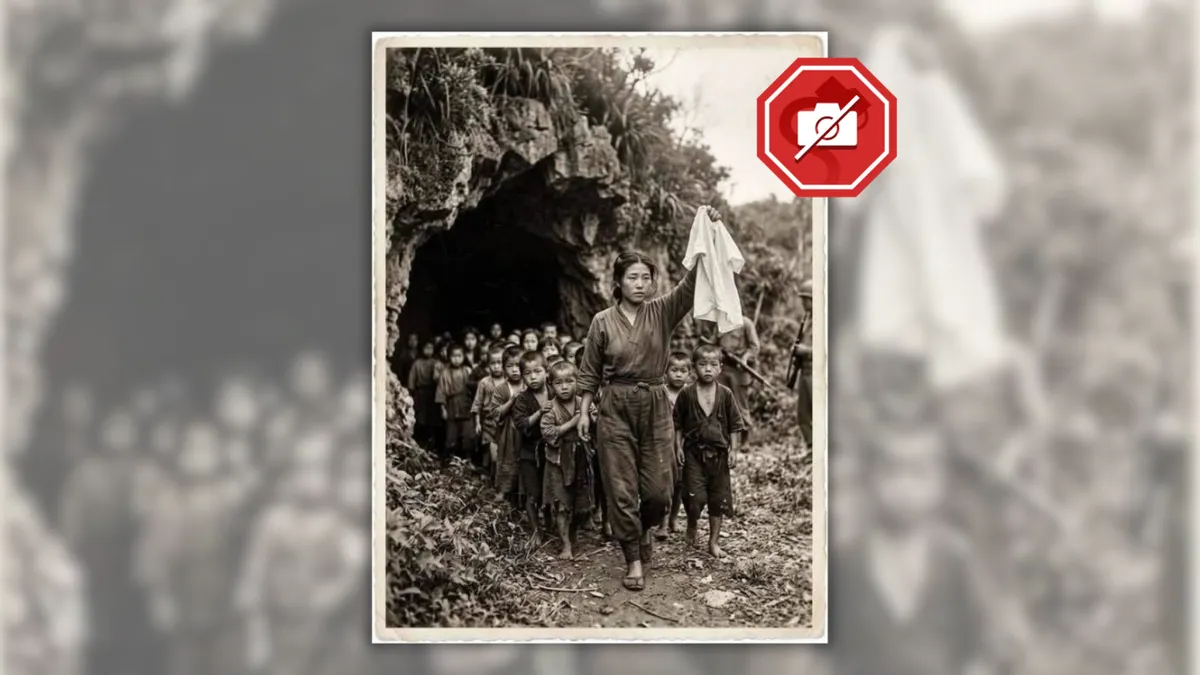
The post included an image that allegedly showed Mori holding a white garment in the air while leading a group of children out of a cave.
Other examples of the claim appeared on Facebook (archived), Instagram (archived) and TikTok (archived), and Snopes readers contacted us to ask whether the rumor was true.
The rumor was fictional. We found no credible reports about the claimed monument in Okinawa honoring Mori (archived, archived, archived). Such a monument would have come up in online searches if it existed. According to Pangram, a highly regarded artificial intelligence detector for images and text, both the text and image accompanying the story were created by AI. Given the above, we’ve rated this claim false.
Snopes could not determine the rumor’s source.
Fake image and article helped spread false rumor
According to Google Gemini’s chatbot, “most or all” of the image that claimed to show Mori and her students that circulated alongside the story’s text had been generated using Google’s AI tools. Google’s AI tools add SynthID, an invisible watermark, to their creations, and tools like Gemini can identify if the watermark is present.
Let us note here: AI detection tools are fallible. Snopes cautions people against using them for definitive answers on media’s authenticity without supporting evidence.
Additionally, one post that spread the false rumor about Mori and the students included a link in the comment section to a long, advertisement-filled article about Mori’s alleged actions.
Pangram also identified a section of this article as having been generated by AI. The article was written almost entirely in short, one-line sentences and the same page also contained an article about singers Dolly Parton and Miley Cyrus. It’s unlikely an authentic news outlet would have put those two stories together on the same page.
Rumor reflects grim WWII history
Despite evidence that the story about Mori was false, the tale could have been inspired by real events. According to an article in the peer-reviewed Asia-Pacific Journal: Japan Focus, Japanese authorities disseminated “disinformation about the motives and behaviour of the invading Americans” during 1945, which led people in Okinawa to believe it was better to die by their own hands than be killed or captured by American soldiers.
The journal article included the eyewitness account of Miyahira Haruko, who reportedly told a Japanese newspaper that a Japanese soldier on an island that is part of Okinawa Prefecture gave her a grenade and told her to take her own life rather than be captured by American forces in early 1945.
Haruko reportedly said her mother and sister committed suicide together during this period. The journal article said that some Japanese people committed suicide in “dugouts and caves.”
Ultimately, the fictional story about Keiko Mori resembled glurge, which Dictionary.com defines as “stories, often sent by email, that are supposed to be true and uplifting, but which are often fabricated and sentimental.”
Creators of such content capitalize on social media users’ willingness to believe and share the made-up stories, profiting from advertising revenue on external websites to which the posts link. (Snopes has previously reported on the business strategy.)
For further reading, Snopes often investigates rumors to do with World War II.
If you or someone you know is experiencing a mental health crisis or suicidal thoughts, call or text the 988 Suicide and Crisis Lifeline (formerly known as the National Suicide Prevention Lifeline) or use its online chat services to connect with a trained crisis counselor.
