


Critics often slate the Brics as a motley collection of emerging markets that agree on little and achieve even less.
But when faced with US President Donald Trump’s tariffs, his war in Iran and his attacks on international co-operation, leaders of the 10-nation bloc had little difficulty in uniting this weekend to express their opposition.
China’s Xi Jinping, Russia’s Vladimir Putin and summit host Narendra Modi of India were among the leaders who agreed a 45-page statement on Saturday blasting protectionism and economic sanctions and calling for peace in the Gulf.
“What you’re seeing this weekend in Delhi at Brics . . . is growing frustration with Trumpism,” said Ashok Malik, head of India at the Asia Group consultancy.
“Brics is not a political bloc or a trade organisation but this statement . . . is about the closest the Brics has got to taking a common political position. And in a sense, Trumpism has invited it upon itself.”
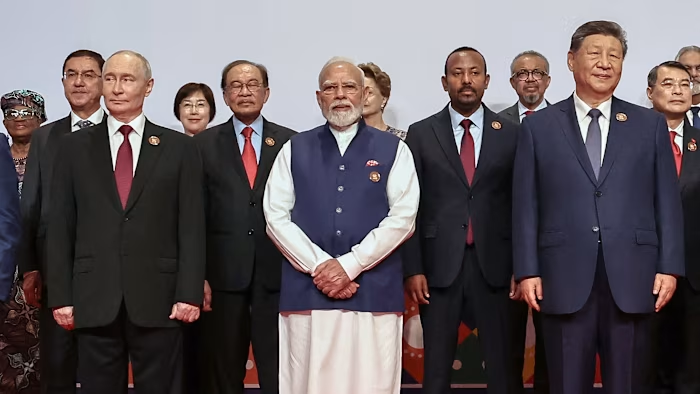
Attendees said the optics of Xi, Modi and Putin smiling broadly and holding hands at the summit contrasted with disarray in the west, where Trump is isolated and Europe preoccupied with domestic problems such as rising debt and rows over immigration.
Xi spoke of a “golden decade” ahead for the Brics, with China due to take over leadership from India next year. Beijing sees the bloc and other groupings, such as the Shanghai Cooperation Organisation of Eurasian countries, as alternative forums to reshape the world order, reduce US influence and establish its leadership in technology such as AI.
“Brics is a vital platform for the co-ordination between China and other global south countries,” said Zhao Minghao, professor at the Institute of International Studies at Fudan University in Shanghai.
The summit provided an important opportunity for Xi and other Brics leaders to discuss issues such as the Iran war ahead of the Chinese president’s expected meeting with Trump later this month, noted Amit Ranjan of the National University of Singapore.
“Just the fact of the Brics leaders coming together is very important at a time when the world is so unstable and there are big challenges to multilateralism,” Brazil’s foreign minister Mauro Vieira, who was representing President Luiz Inácio Lula da Silva at the meeting, told the FT. “Practically all the Brics heads of state are here.”
Divisions between the bloc’s key nations were papered over for the New Delhi meeting, with longtime rivals China and India managing a tentative rapprochement after several years of tension following a border clash. The pair are economic competitors, with India trying to lure foreign investment in manufacturing.
Russia, seen by Europe as a major security threat, projects itself within the Brics as a partner offering oil, fertiliser and metals to developing nations worried about supplies amid disruption from the US-led Gulf war.
Putin, who was making his first in-person appearance at a Brics summit outside Russia since Moscow’s full-scale invasion of Ukraine in 2022, endorsed calls for a new world order tilted towards the south and the east and attacked those who were “unwilling to accept the changing reality and are trying to contain growing competitors in every way possible”.
Xi pushed for new “initiatives” on AI “to illuminate the path to shared prosperity”, according to Chinese state media outlet Xinhua, as Beijing seeks to promote its homegrown AI models in developing countries.
Much of Saturday’s declaration was phrased in deliberately broad language to secure consensus from the group and there were few specific initiatives. While the Brics’ economic power has sharply increased since the leaders of the original four members — Brazil, Russia, India and China — first met in 2009, its political and diplomatic clout remains incipient.
Underlying tensions within the bloc were not addressed, such as whether the Brics should extend their co-operation into defence and security, as China and Russia would like. Modi’s call for urgent reform of global institutions such as the UN and the IMF masked deep divisions over how this should be achieved.
But the Indian prime minister’s insistence on putting human development at the forefront of the Brics agenda and aiming for practical outcomes appeared to resonate with members such as Ethiopia, as well as the additional 10 Brics partner nations who attended.
Modi said in a speech to the summit that “we must work to transform the global south from being rule-takers into rule-shapers”, adding that it was in “the front row of global crises but in the back row when it comes to decision-making” — popular slogans with Brics members.
Nirupama Rao, a former Indian foreign secretary, said India had scored a “significant diplomatic success” in securing a unanimous declaration on the summit’s first day, despite sharp differences between Brics members Iran and the United Arab Emirates. The statement called for increased dialogue and diplomacy to resolve the Gulf conflict and “maximum restraint” from all parties.
In a further fillip for Brics diplomacy, Iranian President Masoud Pezeshkian attended the summit and met Abu Dhabi Crown Prince Sheikh Khaled bin Mohamed bin Zayed al-Nahyan on the sidelines, as well as holding bilateral meetings with other leaders. It was not clear whether any progress was made in the talks towards lessening hostilities in the Gulf.
Chilamkuri Raja Mohan, a visiting professor at the Institute of South Asian Studies in Singapore, said the New Delhi summit’s main achievement was to underline that “a more fragmented world requires more, not less, practical co-operation among major nations”.
“The emphasis is on reforming the international order, not demolishing it,” he said.
