


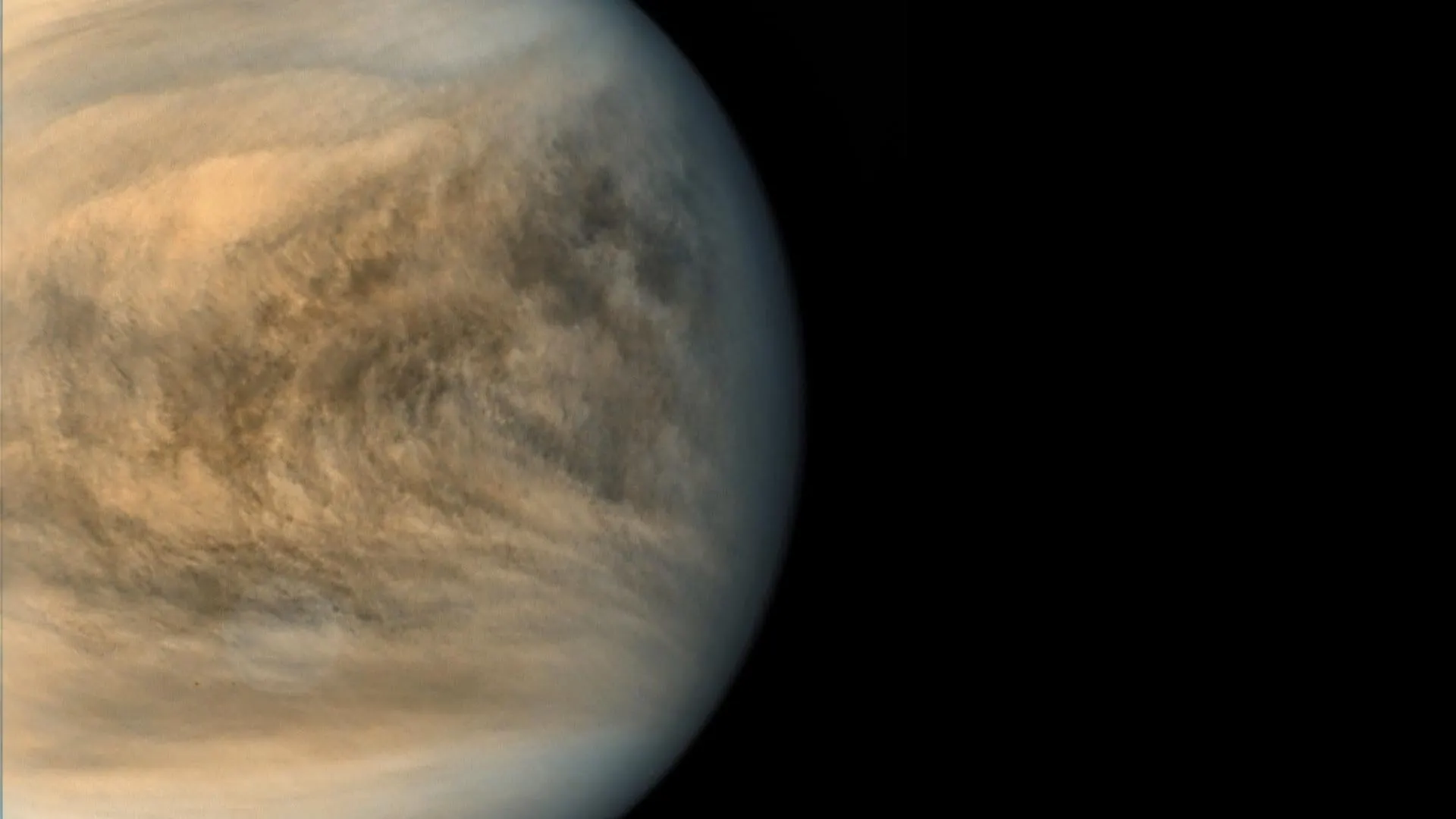
Venus looks pale yellow in ordinary visible light, but the view changes dramatically in ultraviolet wavelengths. There, dark and bright features sweep across the planet’s upper sulfuric acid clouds. Scientists have observed these patterns for about a century, yet the substance producing them, known as the “unknown absorber,” has never been identified.
Now, an international team of researchers has placed new numerical limits on what this mysterious material must be like. Using observations of Venus together with radiative-transfer modeling, the scientists estimated how strongly the liquid inside the planet’s cloud droplets would need to absorb ultraviolet and blue light to match what spacecraft and telescopes observe.
Reimagining Venus’s Clouds in the Lab
The study, published in Astrobiology, examined the problem in an unusual way. Lead author Dr. Jan Spacek asked what Venus’s cloud material might look like if the droplets could somehow be collected into a spectrometric cuvette and studied as a bulk liquid.
That distinction matters because a cloud can look very different from the material that actually makes up its particles.
Cigarette smoke offers a familiar example. Smoke can appear white because its sub-micrometer particles scatter light extremely effectively. But if those particles are collected inside a flask, they form a dense suspension of burned tobacco — a tar-like sludge.
Venus’s clouds may behave according to a similar optical principle because their particle size distribution is comparable to that of cigarette smoke. As a result, clouds that look pale yellow from far away could contain liquid that appears surprisingly dark when concentrated.
“Our model effectively asks what would happen if we could collect that cloud material into a cuvette and put it into a laboratory spectrometer,” said lead author Jan Spacek of the Foundation for Applied Molecular Evolution, USA. “This is important, as light absorption in a bulk liquid may be correlated with the concentration of light-absorbing material in the solution.”
Measuring How Strongly the Mystery Material Absorbs Light
To make that comparison possible, the researchers combined observations of Venus with a radiative-transfer model that tracks how light is repeatedly scattered and absorbed by cloud droplets and atmospheric molecules.
They then converted the astronomical measurements into something commonly used in laboratory UV-visible spectroscopy: the absorption coefficient of the liquid making up the cloud droplets.
“The key is that Venus’s cloud particles scatter sunlight very efficiently, so the brightness observed from space cannot be directly compared with the absorption of a bulk liquid measured in the laboratory,” said Dr. Yeon Joo Lee of the Planetary Atmospheres Group within the Institute for Basic Science (IBS), S. Korea, who performed the radiative-transfer model calculations in the study. “By accounting for the scattering and absorption by the cloud particles and atmosphere, the model allows us to estimate how strongly the liquid of cloud droplets itself must absorb light.”
Across the modeled wavelength range of 365-455 nm, the required decadic absorption coefficient reaches about 1,278 cm-1 at 375 nm.
That is a demanding requirement. It means the unknown absorber must either be extremely effective at absorbing light, exist at a very high concentration inside the droplets, or satisfy both conditions.
Could Carbon-Based Molecules Explain It?
One possible class of substances capable of such strong absorption is highly absorbing conjugated organic molecules. In this context, “organic” simply means carbon-based and does not indicate that the material came from life.
For molecules with absorption strengths similar to efficient porphyrinoid pigments, the required concentration would be roughly 10 grams per liter.
The researchers emphasize that they are not suggesting chlorophyll, heme, or any particular biological pigment is responsible for Venus’s dark ultraviolet features. Instead, those compounds are useful reference points because they are familiar examples of molecules that absorb light very efficiently.
The shape of Venus’s absorption spectrum adds another important clue.
Simple organic compounds placed in concentrated sulfuric acid can react to form dark and chemically complex “tar-like” mixtures. But those mixtures usually absorb light broadly across the visible spectrum, giving them a brown or black appearance.
That behavior does not fit the pattern inferred for Venus, where absorption falls sharply between 365 and 455 nm.
“If the observed light absorption is due to conjugated organic matter, the relatively sharp absorption profile is consistent with a chemically defined absorber that resists conversion into the tar-like mixture we typically observe with organics dissolved in concentrated sulfuric acid,” Spacek said.
New Constraints Make the Venus Mystery Harder
Rather than immediately identifying the unknown absorber, the results make the list of plausible candidates more restrictive.
“Paradoxically, by placing additional constraints on the unknown absorber, we might have made the mystery even more intriguing,” said Janusz J. Petkowski of Wroclaw University of Science and Technology, Poland.
Inorganic explanations also face challenges.
“The model places a demanding constraint on any proposed absorber,” said Paul B. Rimmer of the University of Cambridge, UK. “Many of the proposed inorganic candidates would need to be present at very high concentrations to match the required absorption.”
Importantly, the findings do not show that life exists in Venus’s clouds, and they do not establish that the mysterious absorber is organic.
Instead, the research defines specific quantitative requirements that any proposed material, whether organic or inorganic, must meet. These include how efficiently it absorbs light, how concentrated it must be, where it is distributed in the atmosphere, and whether it can realistically exist within the observed range of cloud-particle sizes.
Future Missions Could Test the Mystery Directly
Scientists can now test these constraints in laboratory experiments and eventually compare them with measurements made directly inside Venus’s atmosphere.
The Morning Star Missions to Venus initiative is developing in situ techniques for studying the chemistry of Venus’s clouds. Those efforts include searches for complex organic molecules and measurements that could help identify the unknown absorber.
One planned instrument, the Autofluorescence Nephelometer, is designed to examine Venus’s cloud particles for fluorescence we expect to be associated with organic molecules. It is planned for a Rocket Lab mission to Venus.
By linking observations from afar with laboratory chemistry and future spacecraft measurements, the research provides a new path toward solving one of Venus’s longest-standing mysteries.
