


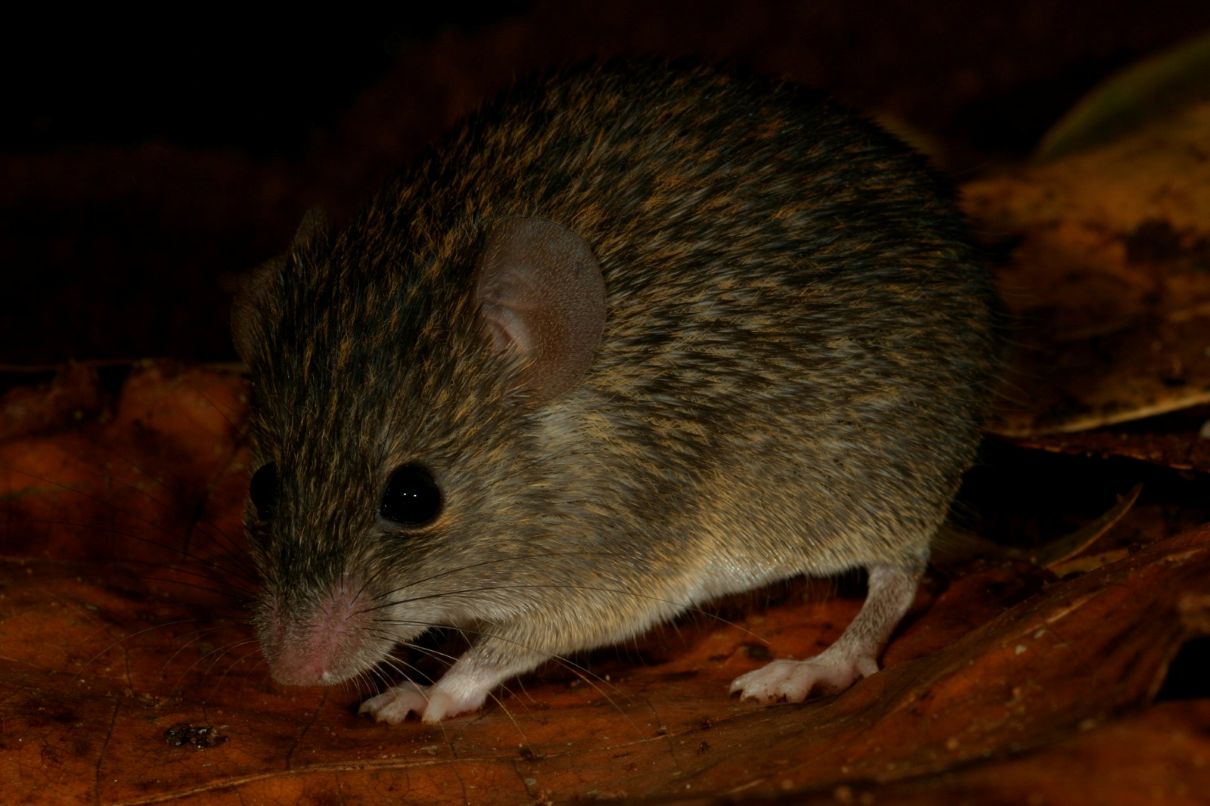
- Scientists have formally described Mus dumbara, a new species of spiny mouse from Sri Lanka’s Dumbara or Knuckles Mountain Range after years of waiting.
- Collected for the first time in 2004, it took more than two decades of morphological and genetic analysis to establish it as a distinct species from the other spiny mouse species found in Sri Lanka.
- Subsequent efforts to find fresh specimens of the elusive mouse proved unsuccessful, despite around 1,900 trap nights in the area, leaving scientists with limited information about its current population and distribution.
- Found only from a small area of the Knuckles Range so far, the discovery highlights the island’s overlooked biodiversity of small mammals and the need for further surveys to understand the species’ ecology and conservation needs.
COLOMBO — As dusk settled over the paddy fields at Puwakpitiya, a village on the northern edge of Knuckles Mountain Range locally known as Dumbara mountains in Central Sri Lanka, researchers began laying traps along the uneasy boundary between farmland and forest.
They were targeting small terrestrial mammals moving through the landscape. On the ground, drift fences were created to lead animals to pitfall traps, while box style Sherman live traps were baited with feed. But the usual rodent lure — peanut butter — failed to attract the mice in Sri Lanka, so the researchers instead turned to something more familiar to the local mice — pieces of burnt coconut.
On March 11, 2004, one of the pitfall traps caught a small mouse that looked different. Six days later, a second specimen was caught in a baited trap. Both were females, not larger than a child’s palm, with fulvous-gray pelage broken by spiny guard hairs and a slender, naked tail longer than the head and body. Externally, the animal resembled Mayor’s mouse (Mus mayori), a species endemic to Sri Lanka’s highlands, but differed in tail length and head shape, offering initial clues about a new species.
The two mice remained a scientific mystery for more than two decades, but careful genetic and morphological evidence finally confirmed what researchers had suspected all along, and they soon introduced a species new to science. It’s been named Mus dumbara, commonly known as the Dumbara valley’s spiny mouse, a name that links the rodent to its locality.
Sri Lanka is home to 16 species of rats and mice with six of them endemic. The new discovery adds another endemic mammal to Sri Lanka’s list.
An elusive new rodent
“The Dumbara spiny mouse looks elusive,” said study lead author Suyama Boyagoda, current head of the department of zoology and chairperson of the board of study in zoological sciences at the Postgraduate Institute of Science (PGIS), University of Peradeniya. At the time of discovering the spiny mouse, Boyagoda was researching shrews in Sri Lanka for her Ph.D.
“In 2014 and 2015, I returned to the same locality and setup a number of traps, but despite the investment of 1,900 trap nights employing the same trapping methods, we failed to find a mouse similar to the first specimen,” Boyagoda told Mongabay.

The new species belongs to the subgenus Pyromys and can be distinguished from its closest Sri Lankan relatives, Mus fernandoni and Mus mayori, by a combination of physical characteristics, she said. Its tail is distinctly longer than its head-and-body length. Its hind feet have pinkish-white toes, while the remaining dorsal surface is covered by a mixture of fulvous-brown, gray and white hairs.
The skull provided additional clues as M. dumbara has a moderately prominent ridge above the eye socket, known as a supraorbital ridge. The strongest evidence came from the DNA showing more than 11.7% genetic divergence between M. dumbara and the other two species, Boyagoda noted.
Sri Lanka and India’s Western Ghats together form one of the world’s most recognized biodiversity hotspots. Although temporary land connections across the Palk Strait linked the island with southern India during Pleistocene glacial periods, Sri Lanka’s wildlife has remained isolated for long enough to evolve along a distinct path.
This is particularly evident in the island’s wet-zone and montane forests, where exceptional levels of endemism have developed, said Madhava Meegaskumbura, a Sri Lankan evolutionary biologist and researcher at Guangxi University in China.

Meegaskumbura, a co-author of the new study, was among the initial research team and, in fact, collected the first specimen of this elusive mouse along with Sri Lankan biologist Mohammed Bahir.
Less researched small mammals
“In recent decades, scientists have described numerous new species of frogs, lizards and freshwater crabs. Mammals, however, have produced comparatively few such discoveries, partly because they tend to be larger and more readily detected. The discovery of Mus dumbara adds another species to this relatively short list of recently recognized Sri Lankan mammals,” Meegaskumbura said.
So far, M. dumbara has been recorded from just one valley in the Knuckles Range, leaving considerable uncertainty about its true distribution and population size. The species may occur in other forest fragments that have not been surveyed, or survive at very low densities, or may have experienced a decline since the first specimens were collected, Meegaskumbura noted.
Even though Knuckles Range is a UNESCO World Heritage Site with formal protection, less conspicuous mammals can easily be overlooked in conservation planning. Habitats along the forest margins remain particularly vulnerable to road construction, land clearance, encroachment and the expansion of plantations.

For a species apparently restricted to a limited elevational range, these pressures could be compounded by climate change, which may reduce the availability of suitable habitat and potential refuges, Boyagoda added. Given the limited information currently available, Meegaskumbura added that M. dumbara should be treated cautiously as a species potentially at risk of extinction until further surveys establish its actual distribution and population status.
“Very little research has been carried out on Sri Lanka’s small mammals, and several important gaps remain, where we need extensive island-wide surveys to understand their distributions and habitat associations and to determine whether undescribed or overlooked species like Mus dumbara remain,” said Sampath Goonatilake, a researcher with IUCN Sri Lanka who studies small mammals. “One of the biggest needs is a comprehensive taxonomic revision, using both classical taxonomy and modern phylogenetic approaches, to clarify the identity, classification and evolutionary relationships of the species we currently recognize.”
“The lack of research is partly because studying small mammals is demanding and expensive as researchers may have to spend weeks or even months in forest habitats to obtain enough samples, creating substantial logistical and fieldwork costs, Goonatilake told Mongabay.
There are also relatively few up-to-date identification guides for Sri Lanka’s small mammals, which makes accurate field identification more difficult. At the same time, these animals tend to attract less attention from researchers and students than larger or more charismatic mammals. Addressing these gaps will require sustained funding, as a comprehensive taxonomic and island-wide research program could cost several million rupees, so collaboration among Sri Lankan universities, government agencies, museums and international research institutions, supported by external research grants and international funding, will be essentia.
Banner Image: The newly described Dumbara spiny mouse (Mus dumbara) has a distinctive appearance, with soft fulvous-gray fur and elongated spiny guard hairs. Image courtesy of Suyama Boyagoda.
Citation:
Boyagoda, S.H., Meegaskumbura, M. … Manamendra-Arachchi, K. (2026). Mus (Pyromys) dumbara, a new endemic species of spiny mouse (Mammalia, Rodentia, Muridae) from Sri Lanka. ZooKeys, 1280,265. doi: 10.3897/zookeys.1280.163907

