


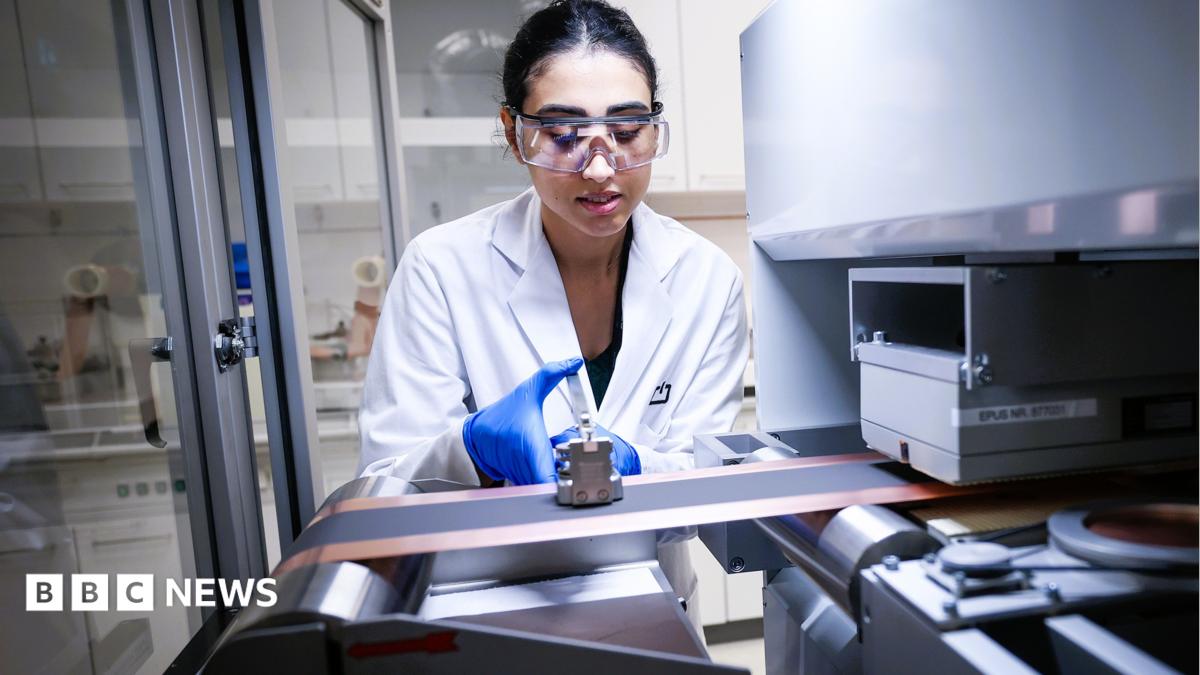
Neither LeydenJar nor Powall are trying to build an entire battery, and both have commercial relationships with customers in Asia.
But Christian Rood of LeydenJar says companies like his can fortify Europe’s position in what has become a global contest.
“The easy comparison is with semiconductors, where there’s really a race for the best chip technology.
“[Dutch tech giant] ASML is not producing chips; it focuses on a critical step in the production of chips, and in that way, has a seat at the table when it comes to the whole semiconductor battle.
“This is our ambition as well – to have a position where our battery anode is so unique that we have an important position in the supply chain.”
So, how do these ambitions play into Europe’s goals in the battery industry?
Alexander Brown is a senior analyst at the Berlin-based independent think-tank the Mercator Institute for China Studies (Merics).
“I think having one part of the supply chain based in Europe is great and if that can be a very advanced technological part, which offers the opportunity for high margins, that’s fantastic,” Brown tells me.
But he cautions that while “there can be collaboration as well as competition at the same time”, China in particular will continue to work to reduce its dependence on other regions.
“China is working very hard to develop local alternatives for technologies, including these niche technologies.
“It’s no secret that China would love to replace ASML – they’re working very hard to do that, and it’s not unforeseeable that they will achieve that goal eventually.
“So, I think Europe has traditional strengths in developing very exquisite high-quality products, which can find markets all over the world.
“But I also think it’s important for that not to be the only strategy [from the continent’s policy makers].”
The challenges of working in such a specialised field are not only technological.
LeydenJar has already reached commercial scale, but Rood says that raising funds within Europe is not always easy.
“There is sufficient financing in Europe, but the risk attitude is quite different than in Asia and in the US,” says Rood.
“That means for a company like us that you have to work with different sources of funding at the same time,” Rood explains.
He lists government grants, debt financing, help from the European Investment Bank and investors willing to buy a share of the business.
“They set a lot of challenging conditions, and they all want to do their own due diligence. It’s hard work,” Rood says.
Powall’s Colen says Europe, and the Netherlands in particular, is an “innovation powerhouse”, and battery technology offers a chance for the continent to make an impact, if the appetite for the risk is there.
“It’s a relatively young industry where factories are being built left, right and centre. They’re searching for the right tech. So that’s where you can play a big role, because the volumes are huge.”
Perhaps Europe’s place in that business lies not in building huge battery gigafactories, but at the other end of the scale altogether.
As Colen puts it, “small changes make big differences.”
