


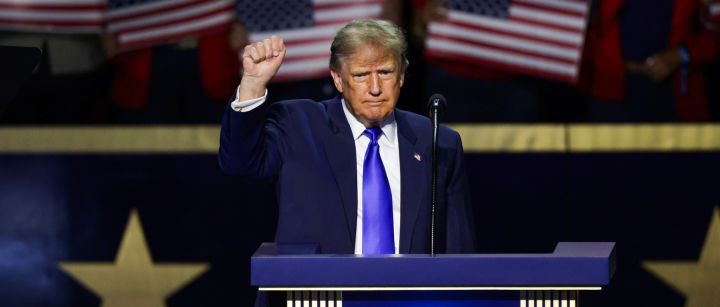
In a nearly two-hour speech at the first Republican midterm convention, President Donald Trump promised to pay Americans if Republicans won, and he repeatedly said communists could take over Congress if they didn’t, among other familiar claims.
- Trump said every adult citizen would get a “dividend” of $5,000 if Republicans won the House and Senate. He suggested his tariff policies would pay for that, but it would take more than six years for tariffs to cover the $1.2 trillion price tag.
- Democratic socialists are not the same as communists, despite Trump conflating the two and warning that Congress could be “controlled by a communist caucus.” Democratic socialists make up a small minority of congressional candidates.
- The president repeated the unsupported claim that an unprecedented $20 trillion has been invested in the U.S. from “outside countries and companies.” Trump’s number is nearly double the figure provided by the White House, whose number is itself speculative and dubious.
- He made false and misleading claims about the One Big Beautiful Bill’s tax reduction. It wasn’t the “largest” tax cut in history. Trump said Democrats voted against no taxes on tips, overtime and Social Security, but the lawmakers’ opposition stemmed from the tax cuts for the wealthy and reductions in Medicaid spending to pay for the legislation.
- Trump twisted the facts in order to indirectly blame North Carolina Senate candidate Roy Cooper for the murder of a woman on train in 2025.
- Trump boasted that more people are working than ever before “by a lot.” About 800,000 more people are working now than in January 2025, but that is largely because the population has also grown. When factoring that in, the labor market is doing slightly worse than when Trump started.
- He falsely claimed that “food prices and almost every other item are rapidly going down.” With some exceptions, prices have gone up, rising even faster than during the latter part of the Biden administration.
- The president claimed that Americans now “pay the lowest prices in the entire world for prescription drugs,” thanks to his policies. There’s no evidence that’s the case.
- Trump made several exaggerated or misleading claims related to immigration. Though the number is low, he wrongly claimed that “zero illegal aliens have entered our country from the southern border in the last 15 months.” He claimed 25 million immigrants poured into the country illegally during the Biden administration. That’s vastly inflated. And he wrongly claimed the Biden administration “allowed” in 11,888 murderers.
- He again falsely suggested that the U.S. became the world leader in oil and gas production during the current administration.
- Trump sought to link Michigan Senate candidate Abdul El-Sayed to a 2019 remark by left-wing commentator Hasan Piker that “America deserved 9/11.” El-Sayed has specifically disavowed those comments.
- The president claimed children “born into poverty or families with very little money … will be potentially rich when they turn 18 or 21” due to the new, so-called Trump accounts. Financial experts say it’s unlikely poor parents could contribute enough to such accounts to make that happen.
Trump gave the keynote speech on the first of the two-night convention, which he held to encourage Republican voters. “Please pretend that I’m running and get out and vote on Nov. 3 or sooner,” he said.
The president continued to push the falsehood that he “won the presidency three times,” claiming that “numerous people on the other side are actually admitting it.” Trump lost the 2020 election, and some of his own aides in his first term told him that his claims of election fraud were baseless.
Dubious ‘Dividend’ Math
Trump promised every American adult a $5,000 check if Republicans win in November, framing it as a “dividend” from his administration’s economic policies.
“Because of our tremendous strength and success economically, I will issue a dividend to every adult citizen in the United States of America for $5,000” if Republicans win both the House and Senate this year, Trump said.
Trump did not say exactly how he planned to pay for that proposal, though he suggested the money would come from tariffs.
“The reason the Democrats can’t do that is because they don’t do tariffs, they don’t take in money,” he said. “All they know is poverty and how to ruin our country. But we’re making a fortune. So if the Republicans win, you win with us and you get $5,000. It will be called the Trump dividend.”
He also said people would have to “spend the money in the United States of America,” but did not offer details about how that would be enforced.
There are around 245 million U.S. citizens over the age of 18 in the country, according to Census data. Sending each one of them a $5,000 check would cost around $1.2 trillion.
Revenue from tariffs has certainly increased under Trump — but the levies are not bringing in “trillions of dollars,” as he claimed elsewhere in the speech.
The U.S. brought in $264 billion in net tariff revenue in 2025, up from $79 billion in 2024, according to an analysis of Treasury statements by the Bipartisan Policy Center, a D.C.-based think tank. However, that doesn’t account for refunds issued this year after the Supreme Court held that a number of Trump’s tariffs exceeded his authority. This year, factoring in money paid out in refunds for invalidated tariffs, net tariff revenue came to about $64 billion through July, according to the Treasury Department’s monthly statements.
Trump’s tariffs “are generating less than $200 billion a year,” Marc Goldwein, senior vice president and senior policy director at the nonpartisan Committee for a Responsible Federal Budget, told us in an email. “It would take 6+ years of tariffs to fund one year of these checks, and then the money wouldn’t be available for deficit reduction (or to partially offset [the One Big Beautiful Bill Act]) as intended.”
Nor is there evidence of a “tremendous” economic boom filling government coffers.
“The economy has been growing around 2% a year – consistent with recent trends,” Goldwein said. “With some weak spots, the economy is strong overall – but it isn’t surging.”
A trillion-dollar payout “would almost certainly worsen inflation and lead to higher interest rates,” he added.
Similarly, Robert McClelland, a senior fellow at the Tax Policy Center, told us the proposal would “substantially increase the federal government’s budget deficit” and likely increase inflation.
“I do not see a basis for the idea that current tariff revenue or total revenue from all sources could support this,” he said. “So far in FY 2026, the government has spent about $1.8 trillion more than it has collected.”
Trump has previously promised Americans checks that never materialized, including a $2,000 tariff “dividend” he floated last November. The “Trump dividend” proposal would likely need congressional approval, and at least some Republicans are skeptical, according to Politico.
The proposal could also raise legal questions, as federal law outlaws offering money in exchange for votes. Some election-law experts, however, told The New York Times that Trump’s promise is probably close enough to a pledge to cut taxes or enact other economic policies that will financially benefit voters to pass muster; a 1982 Supreme Court decision considers such promises protected political speech. Democrats running in Georgia’s Senate runoff in January 2021, for example, pledged to vote for $2,000 stimulus checks.
No ‘Communists’ Running for Congress
Trump claimed that if Democrats retake control of Congress, the federal legislature would be run by “crazed” democratic socialists, who he said are really “communists.” The president said the word communist or communism 15 times in his speech.
“In state after state, the Democrat establishment has been overthrown and replaced by crazed lunatics and radicals. They call themselves democrat socialists, but actually, they’re communists,” Trump said in his remarks. He later said, “If they win, the greatest legislative body in history will, for the first time ever, be controlled by a communist caucus.”
But democratic socialists and communists are not one and the same. And democratic socialists make up a small minority of congressional candidates.
In their remarks at the convention, Reps. Steve Scalise and Tom Emmer also raised the prospect of “communists” getting elected among democratic socialist candidates.
“Communists are figures who support the Marxist, Leninist and later Maoist models of social organization,” Matthew McManus, an assistant professor of political science at Spelman College, told us in an interview. “Typically, what that means is a dictatorial or authoritarian party that’s in control of the political apparatus of society and that organizes the economy on a command economic basis. So, everything is centralized from the state downward.”
“Democratic socialists refer to a much different ideology,” he said. “By and large, democratic socialists were committed to achieving socialism through reformism, working within the apparatus of liberal democratic states, and they also tended to be much more pluralistic in terms of the economic and social models they were willing to accept.”
McManus said in the 19th century, people, such as the famous German philosopher Karl Marx, would simultaneously refer to themselves as communists and socialists. But he said that changed in the early 20th century, when “social democrats” began to distance themselves after the Bolsheviks, under Vladimir Lenin, won power in the Soviet Union and quickly instituted an authoritarian state, horrifying Western socialists.
The modern political organization known as the Democratic Socialists of America says it advocates replacing capitalism, a free market economic system, with a system of democratic socialism in which there is collective ownership of “the key economic drivers that dominate our lives,” including energy production and transportation. “We believe that working people should run both the economy and society democratically to meet human needs, not to make profits for a few,” the organization says on its website.
McManus called it a “very long-standing trope” for conservatives to refer to democratic socialists as communists. “Conservative discourse intentionally, in many cases, obscures the distinctions between liberals, social democrats, democratic socialists, communists, by trying to conflate them all together and suggest that they’re all part and parcel of the same thing,” he said.
There are few democratic socialists already in Congress, and they are also a small minority of Democratic congressional candidates. But Trump said if just 10 are elected this fall, “that’s enough to control Congress,” suggesting that a Democratic majority would have to bend to the will of those new members to implement a legislative agenda.
In an August analysis, Brookings Institution researchers said they identified 64 DSA-endorsed congressional candidates, only 19 of whom won their Democratic primaries – with two races undecided as of Aug. 12. One DSA-endorsed candidate, Gregory Levy, a socialist running for U.S. Senate in Ohio as an independent, advanced directly to the November general election.
Reps. Alexandria Ocasio-Cortez of New York and Rashida Tlaib of Michigan are two well-known DSA members already in Congress. Meanwhile, Sen. Bernie Sanders of Vermont also identifies as a democratic socialist but is not a member of the DSA.
As for communists, Joe Sims, co-chair of the Communist Party USA, told PolitiFact for a July story that there are no communists in Congress and that he knows of none running for the House or Senate.
Overstated Investments
As he does in most speeches — in ever-increasing amounts — Trump claimed that since he took office, more than $20 trillion has been invested in the U.S. from “outside countries and companies.” Trump has never provided a full accounting for this claim, and the data that has been provided by the White House is far less than the figure Trump cites — and is highly speculative.
The White House has a webpage dedicated to “The Trump Effect” that purports to list “total U.S. and foreign investments” of $11.2 trillion.
Most of it is from announced investments from domestic companies, many of which have nothing to do with Trump’s policies and are routine expansion plans stretching over years or decades. Experts have warned us that many of the announcements are speculative or vague promises and may never happen.
“Unfortunately, announcements are not even commitments, much less investments,” Alan Reynolds, a senior fellow at the libertarian Cato Institute, wrote in February when Trump repeated a version of the investments claim. Reynolds called the president’s boast “totally imaginary.”
A little more than half of the total on the White House webpage, $6 trillion, comes from foreign investments from eight countries and the European Union. But as Derek Scissors, a senior fellow at the conservative American Enterprise Institute, points out, the alleged investments don’t appear to be showing up in Department of Commerce data on foreign direct investment in the U.S., which showed an increase of about $266 billion in 2025 compared with 2024. That’s nearly equivalent to the roughly $260 billion increase in President Joe Biden’s last year in office.
Consider the big-ticket foreign investment pledges listed by the White House: $1.4 trillion from the United Arab Emirates, $1.2 trillion from Qatar and $1 trillion from Japan. Those countries increased their investments in 2025 by $3.5 billion, $20 million and $26.7 billion, respectively, according to foreign direct investment data from the Bureau of Economic Analysis. Foreign direct investment in the U.S. jumped 50% in the first quarter of 2026 compared with the previous quarter, $92.2 billion (though it was slightly higher in the third quarter of 2023 under Biden.) But even at that higher pace, Scissors notes, “it would take until 2041 to achieve $6 trillion.”
Attack on North Carolina Senate Candidate
Trump twisted the facts in order to indirectly blame North Carolina Senate candidate Roy Cooper for the murder of Iryna Zarutska, who was stabbed to death on a train in Charlotte in August 2025.
Trump claimed that as governor, Cooper “worked with anti-police radicals to release thousands and thousands of dangerous criminals and murderers all over the once safe streets and countryside of beautiful North Carolina.” That’s a reference to a court settlement to release prisoners during the COVID-19 pandemic. To describe it as “worked with” distorts the facts.
As we have written, Cooper resisted calls early in the pandemic to release prisoners to ease safety concerns. He was sued by the American Civil Liberties Union and other activists. After a judge issued a preliminary injunction in favor of the ACLU and called on the state to come up with a plan to reduce the prison population, Cooper reached a settlement to allow the release of 3,500 prisoners.
Trump went on to say that Zarutska “would be alive today if North Carolina had a different governor, because that animal [the man accused of murdering Zarutska] would’ve been in prison or worse. He wouldn’t have been let go to be on the streets and be in a train sitting right behind that beautiful young lady.”
The murder suspect, DeCarlos Brown Jr., was released from prison on Sept. 20, 2020, after serving more than five years for robbery with a dangerous weapon. Fox News reported that Brown’s inmate ID number was among those listed in the settlement record, though it did not determine whether his release was part of the settlement or not. But Trump’s account distorts the facts of the situation.
Brown was released from prison five months before the settlement was reached. A spokesman for the Department of Corrections in North Carolina told PolitiFact in February that Brown’s release was “entirely unrelated” to the settlement, and that Brown “was not released early or paroled. With credit for jail time served before conviction, he served 100% of his minimum sentence.”
Although Brown was released prior to the settlement, he was able to be retroactively counted toward the settlement’s requirement to adjust the sentences of 3,500 inmates because Brown was given credit for time served while awaiting sentencing, state prison officials told the Charlotte Observer. But even if he had not gotten credit for the time served, he would have been released years prior to Zarutska’s murder.
OBBBA Tax Cuts
The president made some false and misleading claims about his signature tax law and Democratic opposition to it.
Not the “largest” in history. Trump claimed that the One Big Beautiful Bill Act, which he signed into law in July 2025, amounted to “the largest tax cuts in the history of our country.” While it was a “big” bill, the legislation was the sixth largest tax cut, according to the Tax Foundation, when measured as a percentage of gross domestic product, economists’ preferred measure. The OBBBA is projected to reduce tax revenue by $5 trillion over 10 years, or 1.4% of GDP. That puts it behind the 1981 tax cuts (2.89% of GDP), as well as tax measures in the 1940s, 2012 and 1964.
Factoring in Trump’s higher tariffs on imported goods, which economists consider a tax on consumers, would put the president’s combined policies further down the list, the Tax Foundation said. The foundation’s latest estimate, as of August, is that Trump’s imposed and scheduled tariffs are an average tax increase of $820 in 2026 per household.
Impact of tax cuts. The president described the 2025 tax law as putting “thousands of dollars into the pockets of working families.” Depending on how one defines “working families,” that could be the case over time or even in a given year for some families. Overall, the OBBBA was an estimated average individual income tax cut in 2026 of nearly $2,300 or $2,900 per taxpayer, according to Tax Foundation and Tax Policy Center estimates, respectively. But the average was skewed by much larger tax benefits for upper-income earners.
The Tax Policy Center estimated last summer that households earning nearly half a million to $1 million would see an average tax cut of $21,000 in 2026, and those earning less than about $35,000 would get an average benefit of $150. “Middle-income households,” earning between $67,000 and $119,000, would get an average tax cut of about $1,800.
To be clear, the OBBBA extended the expiring tax cuts in Trump’s 2017 tax law, so some of the practical impact for families was that their taxes didn’t go up, as opposed to an additional tax decrease.
Democratic opposition. The skewed impact of the OBBBA, as well as the 2017 tax law, for upper-income taxpayers garnered Democratic opposition. But Trump said Democrats were opposed to some of the popular aspects of the law for certain groups of taxpayers. “And every single Democrat in Congress voted against our tax cuts,” Trump said. “They voted against no tax on tips. They voted against no tax on overtime. They voted against 100%. No tax on Social Security for our great seniors.” He went on to say that Democrats wanted to “raise your taxes” on tips, overtime and Social Security.
These weren’t the provisions in the law that Democrats voiced overwhelming opposition to — instead they repeatedly framed the tax cuts as benefiting the wealthy. As we’ve written, each party has misleadingly emphasized only certain aspects of the law, which benefited all income groups on average, with most of the tax gains going to the top earners. Democrats also objected to the way the OBBBA paid for its tax cuts — by making cuts to Medicaid, the joint federal-state healthcare program for those with low incomes, and reductions in spending on federal food benefits. The Medicaid spending reductions led Republican Sens. Susan Collins and Thom Tillis to vote against the final legislation.
The tips, overtime and senior provisions Trump highlighted all expire after 2028. A future Congress would need to act to extend them. The tips measure — while criticized by economists because it taxes people with similar levels of income in unequal ways — is politically popular with both parties, particularly in a service-industry-heavy swing state like Nevada. Democrat Kamala Harris proposed the same policy in her 2024 presidential campaign.
These provisions provide tax deductions up to certain limits; a deduction reduces the total income subject to taxes. The overtime measure applies to the extra 50% income earned on time-and-a-half overtime, up to a limit. The Tax Policy Center estimated that “3 percent of taxpayers benefit from the tips deduction, with an average tax reduction of about $1,480 among those who benefit, and that 10 percent of taxpayers benefit from the overtime deduction, with an average tax reduction of about $1,200.”
The Social Security provision is a tax deduction, too — $6,000 for those age 65 and older, whether they get Social Security benefits or not, and it phases out for those earning $75,000 or $150,000 for couples filing jointly. The Tax Policy Center found that the deduction “would benefit fewer than half of older adults,” with seniors earning $80,000 to $130,000 benefiting the most. They get an average tax cut of about $1,100, TPC said, in 2025.
Jobs
In discussing employment, Trump repeated a favorite brag, saying, “Right now, in the United States of America, we have more people working than we have ever had before by a lot.”
According to the Bureau of Labor Statistics, as of August, a little over 159 million people are working in the U.S. This is up about 807,000 from when Trump started in January 2025. But as we’ve noted before, this impressive-seeming claim is almost meaningless, since with population growth, there are almost always more people working than ever before unless there is a recession. Trump has been spinning his employment achievements this way since 2017.
Better measures of how the labor market is doing include the employment-population ratio, which, at 59.1%, is down a full percentage point from January 2025, or the labor force participation rate, which is also down a percentage point to 61.6%. The “prime-age” labor force participation rate is largely holding steady.
The latest jobs report, which exceeded expectations, showed an increase of 162,000 jobs in August. Generally, however, job growth has been lower under Trump than Biden. For the last 18 months of the Biden administration, ending in December 2024, about 2.4 million jobs were added, an increase of 1.6%. Since February 2025 — a similar period under Trump — the U.S. gained 765,000 jobs, a rise of 0.48%.
The unemployment rate has also ticked up from 4.0% in January 2025 to a high of 4.5% last November, before falling back to 4.1% last month.
Affordability
Trump addressed affordability, calling it “fake” because, he said, Democrats were the ones that “caused the affordability — to use their word — crisis.”
“I’m bringing the prices way down, way, way down,” he continued. “They caused the price. But we’re fixing it. We’re fixing it.”
“We got eggs down lower than during my administration,” he added later. “And food prices and almost every other item are rapidly going down. And by the way, oil will be going down as soon as we win the war with Iran, which is taking place right now.”
Egg prices have declined under Trump, but not to a price lower than his last administration. They are $2.19 a dozen as of July, per the Bureau of Labor Statistics, about the same as they cost in November 2023. This is down from $4.95 in January 2025 and a peak of $6.23 in March 2025. Those sky-high egg prices were in large measure due to outbreaks of avian influenza, or bird flu, which required killing chickens to prevent viral spread and resulted in a shortage of eggs.
Most other groceries and many other goods and services have increased in price. As we recently explained, the Consumer Price Index, which captures average prices for consumer goods and services, is up 3.4% over the last 12 months ending in July — higher than the annualized 3.0% that Trump inherited.
While certain grocery items, such as bacon and bread, have decreased, many more have increased. Average grocery prices between January 2025 and July have gone up 3.35%, more than the 2.58% increase in the last year and a half of the Biden administration. Energy costs have risen 14.7% in the last year, including a 24.6% increase for gasoline.
Drug Prices
Trump made the unsupported claim that “we went from the highest prices by far in the world, and now we pay the lowest prices in the entire world for prescription drugs,” attributing the drop to his administration’s actions. “I think it’s one of the biggest things to happen medically, healthcare-wise, in history,” he said. “I’m giving you the largest prescription drug price cuts in history, with differences of 400%, 500% and even 600%.”
Trump’s policies do not mean Americans now pay the lowest prices in the world for drugs. And there isn’t evidence Trump’s prescription drug deals have led to a dramatic reduction in the prices Americans pay, although they may have led to lower prices in certain situations.
The administration has made temporary “most favored nation” deals with pharmaceutical companies, giving them three years of tariff relief in exchange for prices that are more comparable to the prices paid in other high-income countries, specifically the second-lowest price out of a set of eight high-income nations, after adjusting for gross domestic product per capita. The U.S. has long paid far more for brand-name prescription drugs than peer countries.
As we explained previously, the impact of these deals is more limited than Trump’s statements imply. While some individuals may be able to save money on certain drugs, such as pricey GLP-1 obesity drugs, many people can already get lower prices using their insurance.
Trump also claimed that “we will make our most favored nation agreements on prescription drug prices permanent,” but that seems unlikely. Rena Conti, a health economist at Boston University Questrom School of Business, previously told us that the notion the policy would be codified was “hypothetical at best, as there is no movement in Congress to pass legislation.”
Trump’s claims of “differences of 400%, 500% and even 600%” appear to refer to how much higher a drug’s list price — which people rarely pay — is compared with its price on TrumpRx, the website the administration launched to promote direct-to-consumer MFN prices. This, of course, is not the discount percentage, which cannot be more than 100%.
Regardless of how one does the math, it’s clear that drug prices overall have not fallen as dramatically as Trump claimed.
Consumer price data from the Bureau of Labor Statistics showed a 3.1% drop in drug prices between July 2025 and 2026, based on a measure of prices people and insurers pay to pharmacies. Trump has claimed his policies are behind this decline. But experts told us other factors, such as drugs losing patent protection and increased competition among costly obesity drugs, are likely behind most of the reduction. The Inflation Reduction Act, passed under former President Joe Biden, which allows for price negotiation for some Medicare drugs, may also be a contributing factor.
Immigration
Illegal immigration has dramatically declined since Trump took office in January 2025, and the Trump administration has also stepped up interior enforcement and deportations. But the president exaggerated several points to contrast his record with Biden’s.
Trump wrongly claimed that “zero illegal aliens have entered our country from the southern border in the last 15 months.” As we wrote in our latest “Trump’s Numbers” story in July, there was a 91% decrease in the number of immigrants apprehended attempting to illegally cross the southern border over the last year, compared with the last year under Biden. In July, 9,295 people were apprehended trying to cross the border illegally, the third highest monthly figure since Trump took office.
Because it’s hard to know exactly how many people successfully sneak into the country illegally, we have used those apprehension figures as a proxy to measure illegal border crossings. U.S. Customs and Border Protection keeps, but does not often publicly release, figures on so-called gotaways, immigrants who are detected via electronic surveillance crossing the border but evade apprehension. Rosario “Pete” Vasquez, chief of the U.S. Border Patrol, reported on social media that there were 2,123 gotaways in May 2025 and 986 in June 2025. Data obtained by the Cato Institute via a Freedom of Information Act request indicated another 6,491 gotaways in the following three months.
We asked the administration for more recent data, but did not get a response. In any case, even using that older data, it is not accurate for Trump to say “zero illegal aliens have entered our country from the southern border in the last 15 months.”
What Trump may have meant to say — and as Customs and Border Protection announced on Aug. 13 — is that there have been no releases at the border over the last 15 months, meaning no one caught crossing the border illegally was temporarily released into the U.S., for example, to apply for asylum. On his first day in office, Trump enacted a policy effectively barring asylum applications.
Trump’s estimate that 25 million immigrants poured into the country illegally and unchecked during the Biden administration is also vastly inflated. We calculated in June 2024 that the figure would be about a third of that, including an estimated 2 million “gotaways” who evaded capture by Border Patrol and about 3 million people released with notices to appear in immigration court or report to Immigration and Customs Enforcement in the future, or other classifications, such as parole.
In August 2025, the Pew Research Center estimated the unauthorized immigrant population at a record-high 14 million in 2023. That’s nearly 4 million more than 2019, and Pew estimated the growth of the overall unauthorized immigrant population “continued to grow at a record pace” in 2024. But that would still not get anywhere near the president’s claim of 25 million more.
Finally, the president claimed the Biden administration “allowed” in 11,888 murderers. As we have written repeatedly, there were about that many noncitizens who had been convicted of murder but were not in ICE custody as of September 2024 — a list known as the agency’s non-detained docket. But the “vast majority” of them entered the country prior to the Biden administration and had their custody status determined “long before this Administration,” the Department of Homeland Security told us in September 2024, noting that many were in prison. Also, the noncitizens include those who entered the country legally, such as green-card holders. Some of them may also have been deported.
Oil and Natural Gas Production
When talking about energy production, Trump suggested that the U.S. became the world leader in oil and gas production during his current administration – which isn’t accurate.
“With the help of our great energy workers here in Texas, our country is producing more oil and gas today than ever before,” Trump said. “Now listen to this, more than Russia and Saudi Arabia combined.”
Later, he added, “We’re now the biggest in the world. We were nowhere near that. Now you’re – we’re the biggest in the world.”
The U.S. is producing more oil and natural gas than ever before, but that was also the case under Trump’s predecessor. The U.S. has had record crude oil production each year since 2023, during the Biden administration, according to U.S. Energy Information Administration data. There has also been record natural gas production annually since 2021, which was Biden’s first year as president. Generally, U.S. production of oil and natural gas has been increasing for many years.
We’ve also written before that the U.S. being the global leader in oil and natural gas production was not a recent achievement. It became the world’s No. 1 producer of petroleum, which includes both crude oil and refined petroleum products, such as gasoline, in 2013, and it has produced the largest amount of crude oil, including lease condensate, since 2018. The International Energy Agency said as far back as 2012 that the U.S. was expected to become “the largest global oil producer” by “around 2020” because of advances in shale extraction technology.
In addition, the U.S. has been the leading producer of natural gas production since 2009, overtaking Russia. In fact, the U.S. has produced more natural gas than Russia and Saudi Arabia, together, in all but one year since 2014.
Individually, the U.S. surpassed Saudi Arabia and Russia in petroleum and crude oil production years ago. But it only began producing more petroleum than both combined in 2024, and Russia and Saudi Arabia, together, still produce more crude oil than the U.S.
El-Sayed Disavowed Streamer’s 9/11 Remark
Trump also sought to link Michigan Senate candidate Abdul El-Sayed to a remark by left-wing commentator Hasan Piker that “America deserved 9/11.” El-Sayed has specifically disavowed those comments and says he has no plans to keep campaigning with Piker.
During his speech, Trump said El-Sayed “campaigns with a Marxist agitator who says that America deserved 9/11.”
As we wrote last month, Piker, a popular Twitch streamer, made those remarks during a 2019 livestream while responding to a prior comment from a Republican congressman that American involvement in the Middle East was not the reason for the 9/11 attacks. Piker later walked back his remark.
El-Sayed, who did appear with Piker at campaign events earlier this year, disavowed Piker’s statement about 9/11 when asked about it in an April interview on “Fox & Friends.”
“Of course I don’t think 9/11 was justified,” El-Sayed said. “Because you appear with somebody, doesn’t mean you agree with them on everything.”
El-Sayed told Semafor in August that he has “no plans” to campaign with Piker again.
Trump Accounts
Trump claimed that “children, and many of them born into poverty or families with very little money or future, will be potentially rich when they turn 18 or 21” due to the establishment of so-called Trump accounts, new federal investment and savings accounts for children.
As we’ve explained before, as part of the One Big Beautiful Bill Act, the federal government will seed new accounts with $1,000 for children born between Jan. 1, 2025, and Dec. 31, 2028, who have a valid Social Security number. Parents can open accounts for other kids, but they won’t get the seed money. In addition, the first 25 million children under the age of 10 and residing in a ZIP code with a median income of $150,000 or less will receive an additional $250, which was funded by Michael and Susan Dell’s donation of $6.25 billion to these investment accounts.
The seed money would grow to several thousand dollars by the time a child reaches adulthood. Trump has previously said that the accounts “could grow to hundreds of thousands of dollars” by the time children turn 18, but that’s the only case if additional yearly contributions are made.
Parents, relatives, friends, employers, state governments, philanthropic organizations and individuals can contribute up to a total $5,000 annual combined limit per account. The White House Council of Economic Advisers estimated that the $1,000 seed money, if supplemented by the maximum annual contributions, could grow to more than $300,000 at age 18, assuming an average annual return of 10.3%.
But financial experts said it’s unlikely that parents in low-income households would be able to afford to contribute enough for their children’s accounts to reach such balances.
According to an analysis by the Urban Institute, “Without additional deposits into the accounts of kids from families with low incomes, children of wealthy parents will primarily benefit” from the program.
Editor’s note: FactCheck.org does not accept advertising. We rely on grants and individual donations from people like you. Please consider a donation. Credit card donations may be made through our “Donate” page. If you prefer to give by check, send to: FactCheck.org, Annenberg Public Policy Center, P.O. Box 58100, Philadelphia, PA 19102.
