


- A new study from Kerala, India, shows how climate disasters deepen inequalities and increase risk for people with disabilities.
- The findings are not unique to India, however; parallels are drawn with Sierra Leone, where more than 9% of the population lives with a disability.
- People with disabilities can face physical, social, economic and institutional barriers, including inaccessible early-warning systems, evacuation routes and shelters, limited access to healthcare and much more.
- People with disabilities are also finding ways to adapt and support each other when disaster strikes.
When climate-related hazards like floods, storms, extreme heat and landslides strike, roads can become impassable, homes unsafe and communities begin looking for ways to escape. But for persons with disabilities, the danger can be greater. An inaccessible route can become an impassable barrier. A warning delivered only through sound can leave a deaf person uninformed, while a shelter without accessible toilets, adequate space or support can turn a place of safety into another barrier.
A new study from Kerala, India, shows how climate-related disasters can expose these barriers and deepen inequalities faced by persons with disabilities. The study, published in Global Environmental Change, examines how people with disabilities experience and respond to climate change. Researchers conducted 72 semi-structured interviews with persons with disabilities, caregivers and institutional stakeholders between February 2023 and June 2024.
Although the research centered on Kerala, it offers insights that can extend to sub-Saharan Africa and possibly beyond.
Katherine Lofts, the study’s lead author and a doctoral researcher at McGill University in Canada, told Mongabay that the team wanted to understand lived experiences of disability in the climate crisis and examine what increases or reduces vulnerability during climate-related disasters.
The research found that policies do not automatically remove barriers on the ground.
The study found that climate vulnerability among persons with disabilities is shaped by physical, social, economic and institutional barriers, including inaccessible early-warning systems, evacuation routes and shelters, limited access to healthcare and assistive devices, poverty, inadequate housing and discrimination. For example, a wheelchair user may struggle to evacuate because of inaccessible routes or shelters, while people with different disabilities may face difficulties when warnings and emergency information are not provided in accessible or appropriate formats.
These challenges are not unique to India, however. Similar concerns have emerged in Sierra Leone, more than 5,000 miles away. A 2025 study by the international NGO Sightsavers involving young people with disabilities found that climate events such as floods and landslides can reduce their ability to evacuate, while inaccessible public information systems, evacuation routes and emergency assistance create additional risks. Participants also identified health, livelihood and mental-health impacts, with the study noting that extreme heat can increase seizures and cause severe skin damage, particularly among people with albinism.
Such issues surface in the Kerala research as well, raising important questions for other countries, like Sierra Leone, which are ranked among the countries most vulnerable to climate change.

Disability multiplies risk
Brima Abdulai Sheriff, chairperson and chief commissioner of the National Commission for Persons with Disability (NCPD) in Sierra Leone, told Mongabay that climate-related hazards do not affect everyone equally.
“For persons with disabilities, the risk is often multiplied because an environmental hazard interacts with existing physical, communication, institutional, economic and attitudinal barriers,” he said.
In Sierra Leone, where approximately 9.3% of the population lives with a disability, according to the 2021 Population and Housing Census, limited accessible infrastructure can make it difficult for people with physical disabilities to move through flooded roads or access transportation. Deaf people may not receive warnings delivered only through sound or radio, while blind people may face difficulties when information is communicated only visually.
“The risk is created or intensified by barriers,” he said, adding that the NCPD’s position is that disability itself is not the disaster risk.
One of the clearest problems identified by the Kerala study is communication. An emergency warning is useful only if people can receive, understand and act on it, according to the study. The research found barriers when disaster and weather information was not provided in accessible formats, as well as insufficient information about where persons with disabilities live and what assistance they may need.
In comparison, Sheriff said Sierra Leone’s emergency warning systems are “not inclusive.” He called for warnings through multiple channels, including sign language, text alerts, audio, radio, television, SMS, social media, community networks and face-to-face communication.
He also stressed that persons with disabilities should participate in testing warning systems before disasters occur.
“Accessibility should be tested by the people who will actually use the system,” he said.

The Kerala study highlighted similar challenges, including barriers to evacuation routes, transportation and emergency shelters. It also found that responders often lacked training on how to rescue and transport people with disabilities and their assistive devices.
Sheriff said Sierra Leone faces similar concerns. A shelter may have an accessible entrance but still exclude someone if its toilets cannot be used, information is inaccessible, medication cannot be secured, personal assistance is unavailable or assistive devices cannot be accommodated, Sheriff said.
“The objective should therefore be not simply to evacuate persons with disabilities, but to ensure their safety, dignity, independence and continuity of essential services throughout the emergency,” Sheriff said.
According to the Kerala study, climate vulnerability cannot be separated from everyday economic conditions. Poverty affected participants’ ability to access transportation, food, care and services. Researchers also documented problems that people with disabilities face, such as accessing healthcare, assistive devices, vocational support and public services.

How vulnerability is produced
Francis Darko, researcher at Australia’s College of Humanities, Arts and Social Sciences at Flinders University, Adelaide, who was not part of the Kerala study, told Mongabay that the research moves beyond portraying persons with disabilities simply as a vulnerable population and shows how vulnerability is produced through inaccessible infrastructure, inadequate services, exclusion from decision-making and discriminatory attitudes. However, he said that Kerala cannot be treated as directly representative of every African country because it has stronger social development indicators and more developed disability and disaster-management frameworks than many countries in the Global South.
“But this makes the findings significant. If substantial barriers remain even in a developed policy environment, challenges could be greater where disability inclusion in climate governance remains limited,” he added.
Amid the challenges the researchers of the Kerala study documented, they also found that people with disabilities were developing ways to adapt, support one another and respond to emergencies.
Participants used mobile technology and social media to access and share information, shared knowledge about disability-specific rescue techniques and relied on family, friends and neighbors. These forms of knowledge and mutual support highlight some of the ways through which vulnerable communities cultivate climate resilience.
Darko said African governments should take the same lesson seriously. Persons with disabilities should not only be consulted after policies are developed. They should participate in designing climate adaptation measures from the beginning.
Sheriff echoed this position. He said the principle of “nothing about us without us” should apply to climate action and disaster-risk reduction, with persons with disabilities involved in risk mapping, preparedness planning, early-warning systems, emergency response and post-disaster assessments.
The Kerala researchers argue for universal design: Creating systems that take different needs into account from the beginning rather than trying to make them accessible later.
Both Darko and Sheriff agree that Sierra Leone needs to prioritize disability inclusion when developing climate, disaster-risk reduction and national adaptation plans, including accessible evacuation routes and shelters, multi-channel warning systems, training for emergency responders, disability-disaggregated data, and access to essential supplies such as assistive devices and medication during emergencies.


Freetown flooding
The need for such measures was evident on Aug. 3, 2026, when flooding hit Regent village in Freetown. Narrating his ordeal to Mongabay, 39-year-old Abubakarr Sesay, a person with a disability, said the flooding made it difficult for him to move to safety. “Moving around was difficult, and I struggled getting to safety. For persons with disabilities, disasters like this can be much harder because we need assistance to move.”
The Kerala study calls for more research across geographical and cultural settings to understand how people with disabilities experience climate risks and to develop adaptation strategies that strengthen their agency and resilience.
As climate hazards intensify, the question for Sierra Leone — and many regions — is not simply whether persons with disabilities will be protected during the next disaster. It is whether they will be involved when the systems intended to protect them are designed.
When climate-related hazards strike, the first challenge may be the immediate danger. But for persons with disabilities, the challenge goes beyond the hazard itself.
Researchers say climate resilience cannot be complete if it leaves part of the population behind.
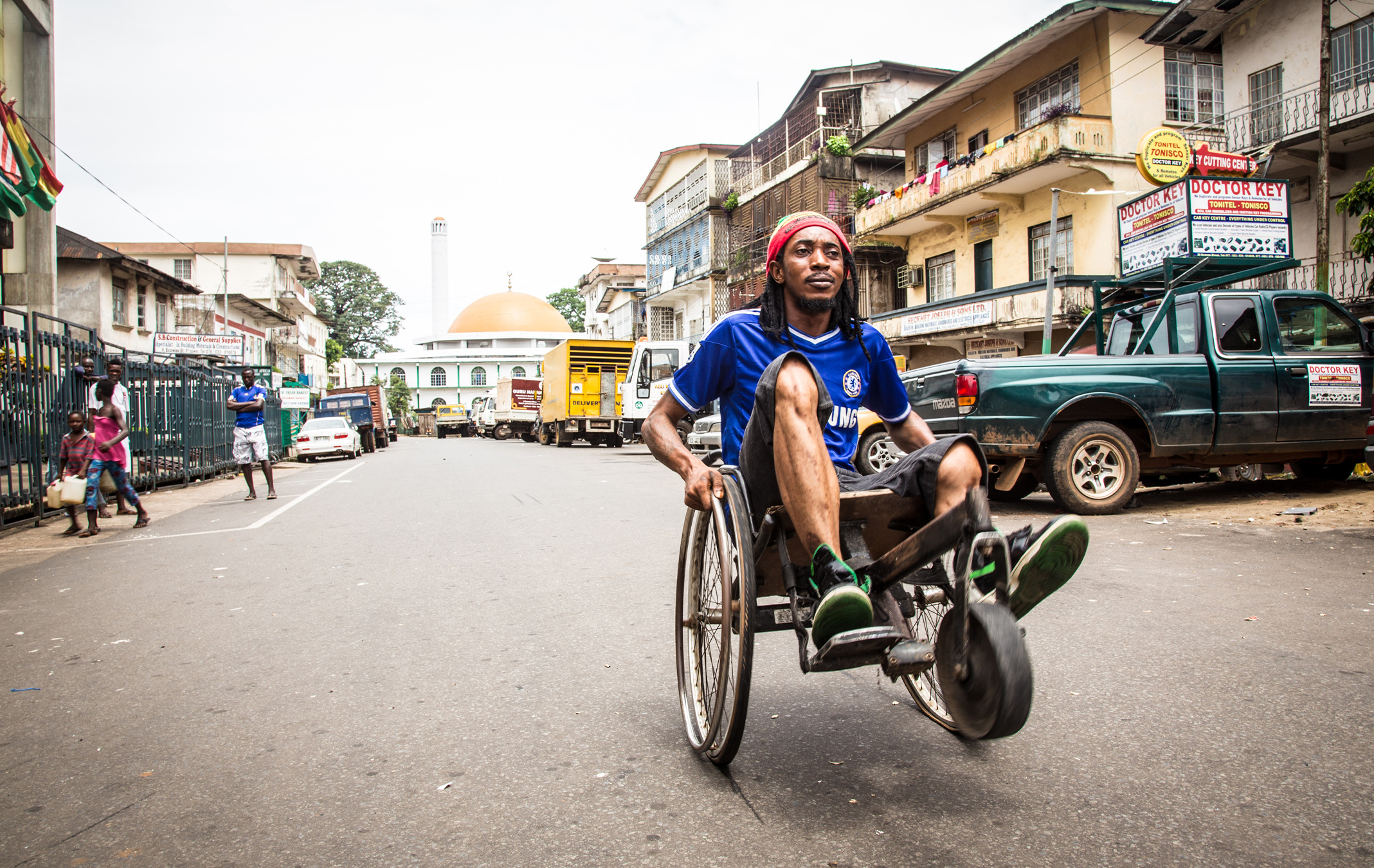
Banner image: A man travels along a street in his wheelchair in Freetown, Sierra Leone, in this 2014 image. New research examines climate-related hazards and the barriers that people with disabilities face. Image by AP Photo/Michael Duff.
Six things to know about Asia’s heatwave and the health impacts
Global warming already impacts daily lives around the globe, study finds
Citation:
Lofts, K., Belal, F., Jodoin, S., Thampi, B. V., Hunt, M., Lencucha, R., … Ramanujam, N. (2026). Understanding the climate vulnerability and resilience of people with disabilities: Insights from a case study in Kerala, India. Global Environmental Change, 99, 103183. doi:10.1016/j.gloenvcha.2026.103183
Cite this article
Patricia Sia Ngevao (2026). When climate-related hazards rise, so do barriers for people with disabilities. Mongabay Conservation news. DOI: https://doi.org/10.66709/news-329268

