


More than eight years ago, when Rajeev Y.* first heard about a job in the US from a local contractor in the western Indian state of Rajasthan, the stone carver was thrilled.
“When we heard about the work opportunity, we thought it would be great – a good job outside India, a better life. It sounded like a dream,” said the stone worker who asked for his name to be changed for fear of retaliation and to protect his family in India.
But Rajeev’s American dream soon turned into a nightmare.
He was one of many Indian workers, mostly Dalits from the lowest rungs in India’s social hierarchy, who would go on to file a class action lawsuit in a US court against the Bochasanwasi Akshar Purushottam Swaminarayan Sanstha (BAPS). The Hindu sect made headlines in France this week when Eiffel Tower staff went on strike to protest the removal of female employees from the Paris landmark during a private visit by BAPS religious leaders and members.
Back in 2018, when Rajeev landed in the US, little was known in the West about the conservative Hindu sect whose fortunes – and opulent temples – have flourished since Indian Prime Minister Narendra Modi came to power.
Read moreEiffel Tower row over Hindu temple unites French politicians – but divides Indian diaspora
By 2021, American audiences would be better informed as US media detailed allegations of forced labour, abuse, trafficking and violations of immigration laws against BAPS. The Hindu sect has consistently and strenuously denied the charges.
While public awareness has now increased, Rajeev is still seeking justice. Since he arrived in the US eight years ago, the 35-year-old father of three has not been able to hold or play with his children in India. For his kids, “Dad” has turned into a virtual figure on video calls, the one who is working hard abroad, and often against the odds, to provide them with a better life.
‘Just stones, stones, stones’
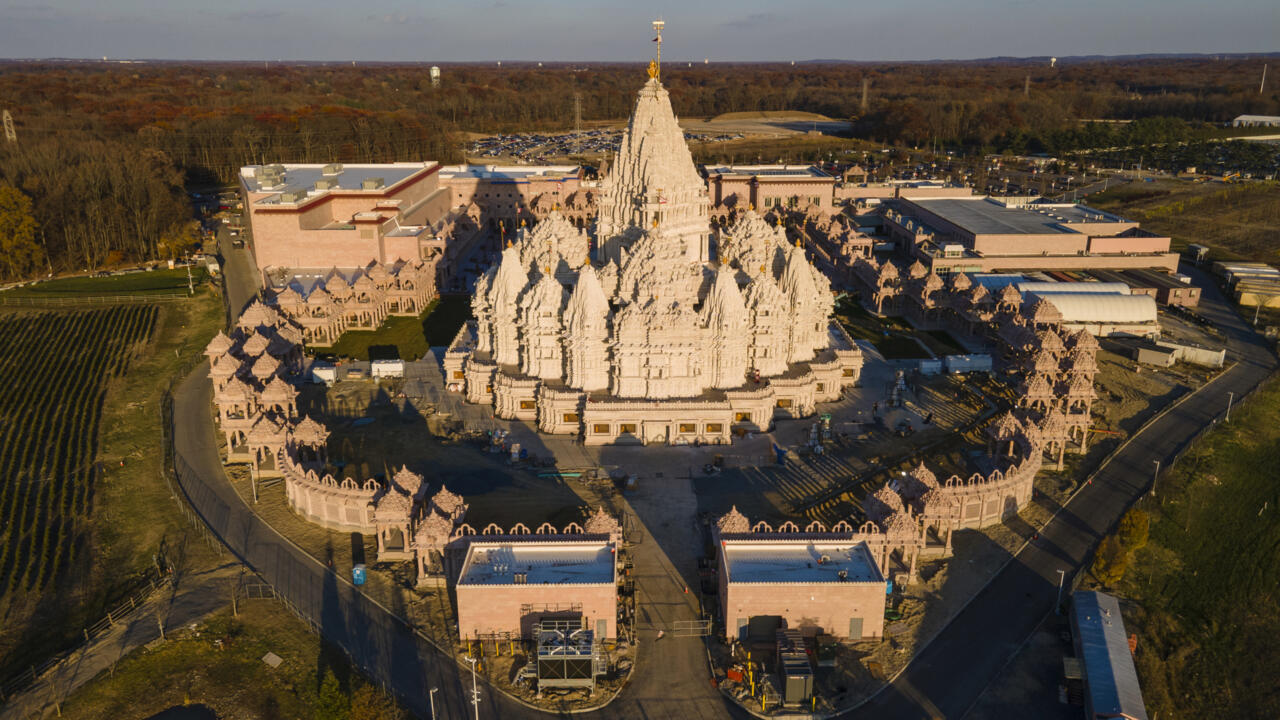
Rajeev’s American nightmare began shortly after he arrived at a massive BAPS temple construction site in Robbinsville, New Jersey.
“First, they took our passports. Then they told us that if we ever try to go out of the compound, and if we get in trouble, without our passports the police will take us away and put us in prison,” he said in Hindi during a phone interview from the US.
The temple site, though, was a “central prison” for the workers, said Rajeev, using the term in English. “The life in America looked very nice. But not for us. Our work was within the temple, no going out, no talking to people. We had no freedom – only do the stonework, just stones, stones, stones.”
The state of Rajasthan is renowned for its skilled stone carvers. Its sandstone hills in varying shades of ochre ranging from salmon pink to deep red provide colour and grace to some of India’s most iconic landmarks. The capital, Jaipur, also called “the Pink City”, is a walled city on the UNESCO World Heritage List with spectacular structures such as the Hawa Mahal, or “Palace of Winds”. For centuries, Rajasthan’s stone carvers have excelled at jali, or latticework, that gives stone the appearance of the finest lace. The carving expertise and skills are passed on within families through the generations, making Rajasthan a hiring ground for temple constructors.
It’s a skillset in high demand for BAPS, a religious institution renowned for its mega temples across the world built in the traditional style. The BAPS temple in a Paris suburb, which was inaugurated over the weekend, is just one of more than 1,300 temples and more than 5,025 centres managed by the Hindu sect across India, North America, Europe, West Asia, Africa and Australia.
But there is a darker side to the production of these stones of wind and light. India has high rates of silicosis, a deadly respiratory disease caused by exposure to fine silica dust. Most of the victims are workers from impoverished, marginalised communities toiling in quarries, mines and the construction industry, according to numerous studies.
Health problems, many of them undiagnosed, chronically plague these workers. It was a health crisis on the New Jersey temple construction site that caught the attention of US authorities, according to rights groups.
A death and an FBI raid
In October 2020, a stone worker named Mohan Lal died in the temple premises. Rajeev, now a member of the Indian Stone Workers Alliance of America (ISWAA), remembers those dark days clearly.
“He was already sick, you know, but he was never admitted in a proper hospital or anywhere outside the construction site,” recounted Rajeev. “He was kept in a trailer that they used for sick people. They used to give us Indian medicines, but the medicines were not working. Mohan Lal kept saying, ‘I need treatment, put me in hospital’. But they never did that,” he said.
The workers – who spoke little or no English and were confined to a work site in an unfamiliar new country – watched with growing anxiety as Lal’s condition deteriorated.
When Lal passed away, “everyone got very scared. We were all thinking, what’s happening here? What if something like this happens to us?” said Rajeev.
BAPS’ attempts to downplay the incident fueled worker unrest, ultimately leading to a May 2021 FBI raid of the premises that rescued more than 100 workers, according to rights groups.
Shortly after the FBI raid, six workers filed a lawsuit in a New Jersey court accusing BAPS of luring them from India, confining them to the temple grounds and paying them the equivalent of about $1 an hour to perform grueling labour in near servitude.
The 42-page class action suit took particular note of the workers’ low caste status. BAPS “recruited workers from the Scheduled Caste, also known as Dalit, and other marginalized communities in India”, it reported. “At the temple in New Jersey, temple leadership did what they could to remind these marginalized workers of their place in the social hierarchy.” The workers were paid the equivalent of around $450 per month in Indian rupees. But they were only paid $50 in cash, with the rest deposited in accounts in India, the complaint said.
BAPS officials denied the charges. “I respectfully disagree with the wage claim,” Kanu Patel, the chief executive of BAPS, told The New York Times. A BAPS spokesman also disputed the accusations, saying the men did complicated work connecting stones that had been hand-carved in India. “They have to be fit together like a jigsaw puzzle. In that process, we need specialized artisans,” he told the newspaper.
Months later, lawyers for the Indian workers filed an amended lawsuit with the New Jersey federal court increasing the number of plaintiffs and expanding the scope from the Robbinsville site to other temples near Atlanta, Chicago, Houston and Los Angeles.
‘We don’t follow their god’
Following the FBI raid, the workers rescued from the New Jersey site were housed in hotels for a month before their cases were assigned to various service provider agencies and social welfare agencies across the US.
“It was 100 times better than what we were facing at the temple,” said Rajeev. “Back home in India, we had to work hard, but we had our families, we could see them. We earned money and we could spend it. Here we were stuck, with no freedom.”
The lawsuit claimed the temple workers were presented to US immigration officials as religious volunteers trained to do specialised work, qualifying them for religious, or R-1, visas.
Rajeev scoffs when asked about his “volunteering” for BAPS. Like most of the workers, he had signed forms and documents in English that he didn’t understand.
“My passport says I’m Hindu. But I follow Bodh dharm,” he said emphatically, using the Hindi words for Buddhism. “We are Dalits, we don’t follow their god,” he added, referring to BAPS members. “We never worship Swaminarayan,” he maintained, referring to the Hindu sage venerated by BAPS. “We make temples. That’s our work. The temple is for them. For us, we were given a separate tent for our worship. The temple is not for us, we were not allowed to worship inside.”
Qayam Masumi, advocacy and programme director for Dalit Solidarity Forum (DSF), a US-based NGO working on Dalit rights, questions how underpaid, subsistence workers could even afford to volunteer their services. “It was a whole scam to bypass labour laws, protections, insurance. They were actually working as daily wage labourers. And they were paid around $1.20 per hour, way below the minimum wage rate.”
A case dropped, but the fight continues
With NGOs and lawyers now on the workers’ side, Rajeev and his fellow plaintiffs felt assured that the criminal case was making its way through the legal process – until they received news of a setback.
In September 2025, months after President Donald Trump’s second inauguration, the US Department of Justice (DOJ) closed the workers’ criminal case.
BAPS North America welcomed the move, noting in a statement that the US government’s “decision to end this investigation sends a clear and powerful message” that their temple is “a place of peace, service, and devotion”.
Masumi says the Dalit Solidarity Forum, which was helping the workers, heard about the case closure from a BAPS lawyer, not the DOJ. “We got to know that the criminal investigation got closed without filing any charges. And there was still no statement, no public document available from DOJ explaining why there were no charges filed,” he explained.
Like many activists following the case, Sunita Viswanath, co-founder of Hindus for Human Rights, criticises the decision to drop the case. “This is the same Trump administration under which the DOJ, for instance, exonerated Eric Adams,” she said, referring to the former New York City mayor whose criminal corruption case was dropped last year, sparking the resignations of Manhattan’s top federal prosecutor and six other Justice officials. “We don’t believe that the dismissal of this case means that the BAPS temple is exonerated. They haven’t made any kind of statement that apologises for their treatment of the workers,” Viswanath noted.
In a joint statement released with five other US-based NGOs, the Dalit Solidarity Forum expressed “deep concern over reports that the US Department of Justice (DOJ) has closed its criminal investigation” and demanded “full accountability and justice for these workers and their families”.
While the criminal case was dropped, a civil wage theft case, however, “remains fully intact and is actively moving forward,” the statement added.
Since the FBI rescued more than 100 workers from the New Jersey temple site, many of them have returned to India due to family emergencies and personal issues. Following their rescue, the workers were granted T visas for victims of “severe” human trafficking. Since T visa-holders face extensive paperwork if they leave the US and want to return, many of the workers over the past five years have opted to return to lives and families in India.
But Rajeev and a few other workers remain in the US for a cause. “We want justice, that’s what we want,” he said simply.
When asked if he and his fellow stone workers had heard about the Eiffel Tower controversy surrounding BAPS, Rajeev was vague about the news, but clear about the interests of his loved ones.
“I don’t pay much attention, we did hear about the news in France. But no one from my family and my village worked on that site,” he said. “Those are other workers, they need to earn a livelihood, they have no other option,” he said. “But me, I will never work for BAPS.”
*Name changed
