


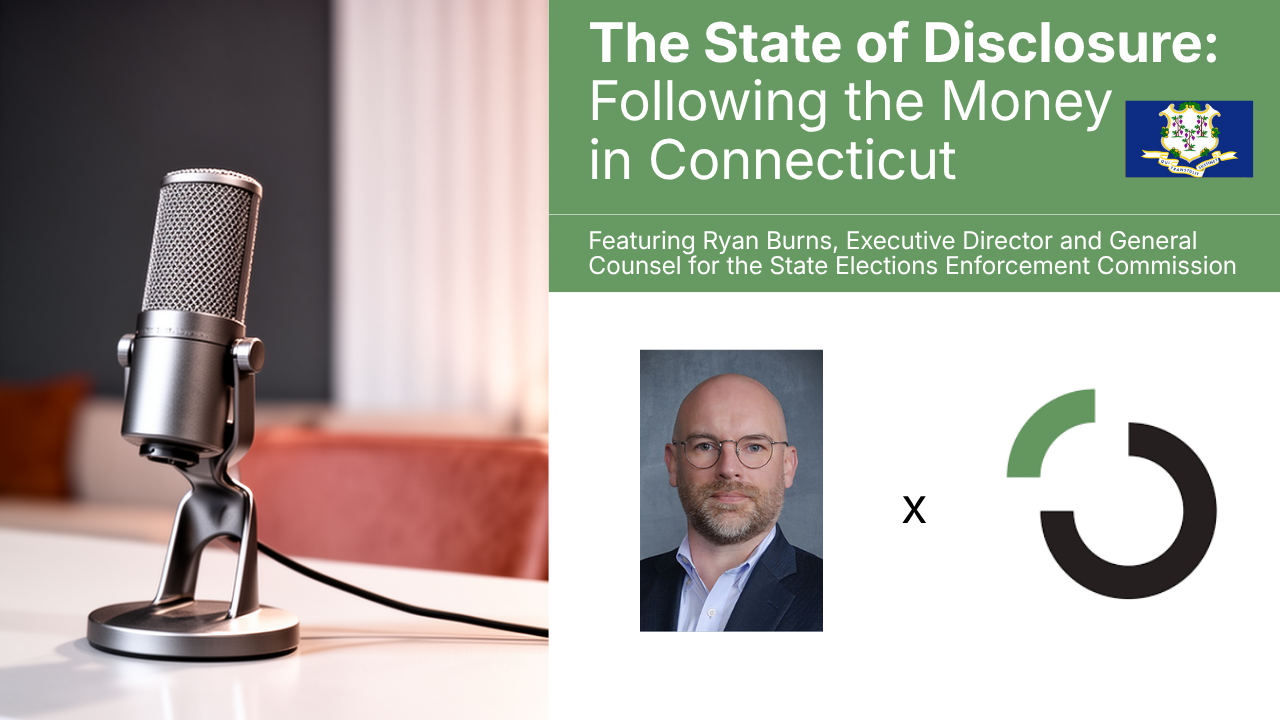
While the Federal Election Commission has responsibility for enforcing federal campaign finance laws, 50 different agencies handle those duties at the state level. This interview is part of a series – “The State of Disclosure: Campaign Finance Enforcement Across America” – examining how the officials responsible for transparency in each state handle those duties.
Ryan Burns is executive director and general counsel for Connecticut’s State Elections Enforcement Commission, where he leads one of the nation’s most robust campaign finance enforcement and public financing systems.
He works closely with a team of 36 to oversee statewide elections and enforce campaign finance laws.
“It is the best-kept secret in Connecticut politics that we have really clean, fair elections and a really great system to run it,” Burns says. He adds that “the decisions that are being made by the legislators are because they are on behalf of their constituents, not on behalf of special interest or large donors.”
Burns holds a bachelor’s degree in public policy and psychology from Hamilton College and a J.D. from Fordham University. Early in his career, he worked as a construction attorney before transitioning into public service. He spent seven years as a staff attorney at the commission before moving into management roles in other government agencies. In December 2025, he was named executive director of the commission, and since then has overseen its campaign finance enforcement and public financing programs.
Ahead of the commission’s busy season, Burns and I discussed the strengths of Connecticut’s campaign finance system, its role in promoting transparency and accountability, and his hopes for strengthening enforcement around how campaign finance funds are used.
