


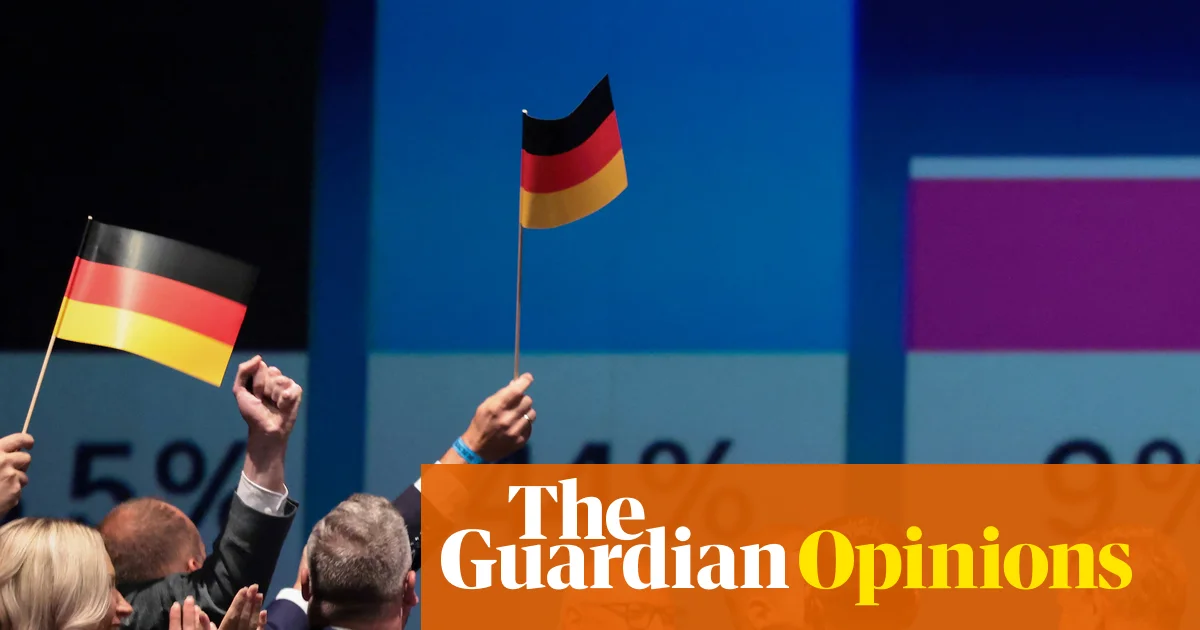
The far-right Alternative für Deutschland (AfD) narrowly failed to secure an outright majority in state elections in Saxony-Anhalt. But nobody should take comfort from that. The party still won by a landslide. Decades of far-right election gains have made them seem normal to the point where only the biggest victories are deemed newsworthy. But 44% of the vote for a party that is officially classified as “extreme right” is not normal. It is a black day for European democracy, even if it occurs in a small east German state.
While Saxony-Anhalt (and Germany itself) may have dodged the worst outcome because the AfD won’t automatically fulfil its ambition of forming the first far-right state government in Germany since the Nazi era, there is no reason to assume it will be so lucky at the next election. Neither will other German states, such as Mecklenburg-Vorpommern in two weeks’ time, or other countries, such as France next year. No country is immune from the far right and, perhaps even more worryingly, no far-right party or politician is too extreme for political success (as the US has shown). We must therefore update our analyses and strategies.
Although Saxony-Anhalt, and east Germany in general, is an extreme case, it reflects similar trends in the rest of Europe. Far-right parties are going from strength to strength, with old dominant parties decimated, and party systems fragmented. Consequently, coalition formation is becoming increasingly complicated, particularly if we want to keep the far right out of power. In many countries, provinces and cities, most democratic parties are having to govern together to exclude the far right. This often leads to inefficient and unstable coalitions, in turn feeding yet more political dissatisfaction and far-right support.
Sunday’s results will only intensify an ongoing debate in Germany about the so-called Brandmauer (a firewall maintained by mainstream parties against cooperating with the AfD). Actually, Germany is one of the few EU countries to still have a far-right cordon sanitaire. Throughout Europe, from Italy to Sweden, far-right parties have been normalised and integrated into the political mainstream. In most cases, the (rightwing) parties that collaborate with the far right claim that the latter have moderated and are now “conservative” – a claim that is factually wrong, but increasingly popular with the electorates and members of these parties, and much of the media.
This will remain almost impossible to claim in Germany. The AfD is among the most extreme parties in Europe, and its most successful branches, including the one in Saxony-Anhalt, are among the AfD’s most extreme. This will not prevent some rightwing politicians from claiming that the AfD is less of a problem than the left, and there is even a fear that some parliamentarians from the conservative CDU in Saxony-Anhalt will defect to give the AfD a majority in the state. On the other side of the political spectrum, calls for an AfD ban will become even louder, and while this might be legally possible, it could create a massive popular backlash, going well beyond Saxony-Anhalt.
Both approaches share a too-limited interpretation of the problem. The idea of maintaining the Brandmauer is that the only (or main) problem is outside the system. Yet the system is falling apart as it is. Yes, the AfD (and the far right in general) is a fundamental threat to liberal democracy, but so is the fact that a sizeable and growing part of the population no longer feels represented by its politicians. While many still come out to vote for democracy, they increasingly vote against a party rather than for one.
Even worse, most mainstream politicians have accepted that they are unpopular and try to remain in power by arguing that they are the lesser evil and mobilising people to come out to vote against the far right. Ultimately, this is unsustainable. If democratic parties do not develop inspiring manifestos for what they want to achieve in government, liberal democrats will refuse to come out to vote and the far right will win a majority of votes – even if they represent only a minority of the population.
Developing such manifestos will require realism from politicians, but also from the media and voters. In fragmented party systems with large far-right parties, no party will be able to implement most of its preferred policies. There are no majorities for social democratic, Christian democratic or Green parties and policies. But this should also not be the main concern at this moment. When the far right gets close to governing alone, or dominating coalitions, the main goal should be to strengthen liberal democracy – in terms of institutions and values. This should be something that all liberal democratic parties can agree on.
This does not simply entail strengthening democratic institutions – the judiciary and regulating social media, for example – and promoting inclusion and tolerance. It also means listening to the many concerns and preferences of the majority of voters who do not vote for the far right. In other words, mainstream politicians need to go beyond crime and immigration and focus also on such things as increasing housing provision and public spending, limiting economic and income inequality, fighting the climate crisis and strengthening European integration. And it means accepting that you don’t get everything you want – now or in the near future.
after newsletter promotion
Of course, many countries are not as close to a far-right majority as Saxony-Anhalt is. But we should not forget that in the state’s 2021 election, the AfD had “only” 20% – and the average score of the far right now is roughly 25% across Europe. In other words, there may not be much time left. And, as we can see in countries such as Hungary and the US, the democratic struggle becomes harder and less fair once the far right establishes power.
Democratic politicians must therefore realise that today’s key fight is for democracy, rather than for party or power. This requires both fighting the far right and strengthening democracy. Neither the banning nor the normalisation of the far right can achieve this. Democracy neither be strengthened in isolation, nor by the politics of fear. It requires a collective effort from democratic politicians, citizens and journalists, who must show realism, resilience and restraint. And the time for that fight is now.
