


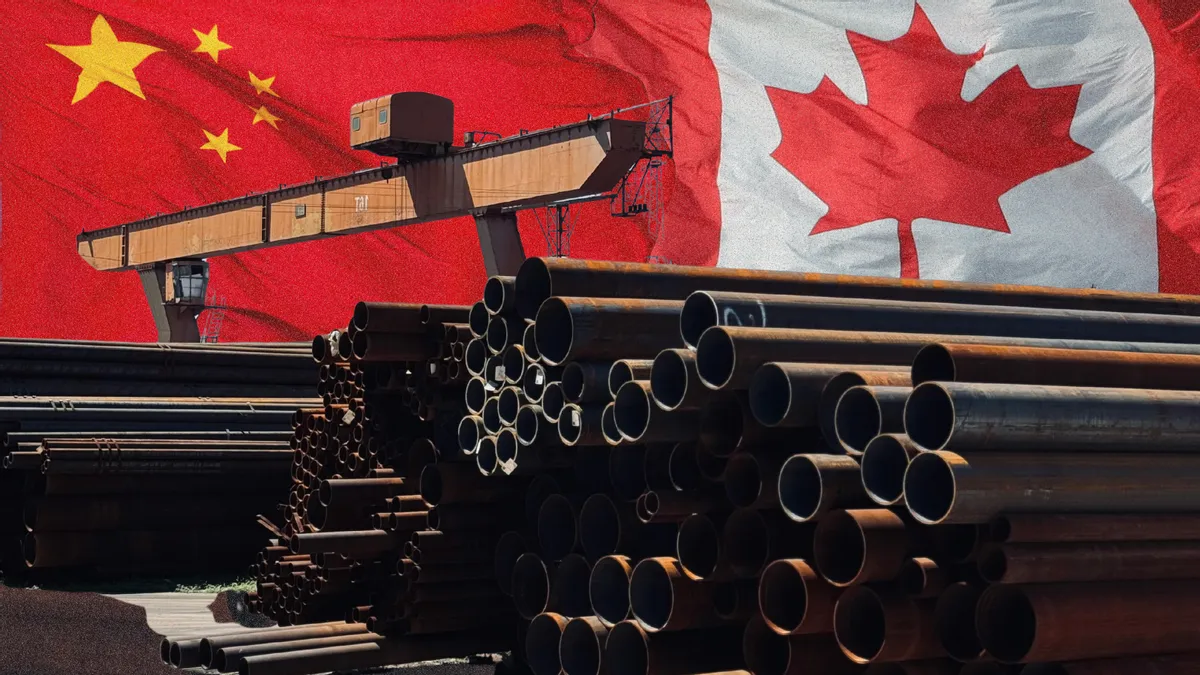
- The claim that Canada assisted China in avoiding U.S. tariffs by reselling Chinese steel as Canadian is still under investigation.
- U.S. businesses and the U.S. government have accused Canadian companies of acting as a “backdoor” funneling Chinese steel into the United States. President Donald Trump’s administration also has accused Canada of being one of China’s “biggest enablers” in efforts to avoid tariffs in general.
- In May, the Department of Justice reached a settlement with two Canadian companies accused of falsely labeling Chinese steel as Canadian to avoid customs duties. However, the companies did not admit fault as part of the settlement.
- Some trade experts have expressed skepticism that Canada is enabling Chinese efforts to avoid tariffs on steel. Canada’s government also has enacted a number of measures in an attempt to prevent Chinese steel from flooding the Canadian market.
- We have not rated this claim due to a lack of verifiable evidence. We reached out to offices of the U.S. and Canadian trade representatives and will update this story if we hear back.
In the fall and summer of 2026, social media users claimed that Canada resold Chinese steel as Canadian to help China avoid U.S. tariffs.
The rumor spread on Facebook and X (screenshot, screenshot). Snopes readers also contacted us to investigate its legitimacy.
It is true that American businesses have accused Canadian companies — not the country’s government — of skirting tariffs by selling Chinese goods, including steel, as Canadian. In an August report, Trump’s administration also accused Canada of being one of “China’s biggest enablers” in helping evade tariffs in general through “transshipment,” or the shipment of goods from one country to another via a stop in yet another country.
In May, the Department of Justice reached a $19 million settlement with two Canadian companies over allegations that they “knowingly and improperly” failed to pay duties owed on steel manufactured in European and Asian countries, including China. The defendants denied the allegations and the settlement is not an admission of fault, but it also does not mean the United States’ allegations were unfounded, according to the court documents (Page 2).
Snopes relies on independent verification and primary evidence for all of our conclusions. As of this writing, the courts have not determined that any Canadian company or government official has attempted to evade tariffs or help China avoid tariffs through this supposed scheme. Furthermore, there is not enough publicly available evidence that such a scheme has happened or is happening. As such, we have not rated this claim.
We reached out to U.S. Trade Representative Jamieson Greer and Canada’s trade minister for the U.S., Dominc LeBlanc, for more information and await a response.
It is also worth noting that the claims connected these allegations to the breakdown in U.S.-Canada trade talks in late summer 2026. That may be because Greer reportedly raised concerns to Canadian officials about the transshipment of Chinese steel through countries Canada is seeking new free-trade deals with.
Here’s what we know about the allegations:
US businesses accuse Canadian firms of avoiding tariffs
In December 2025, American industry leaders accused Canadian and Mexican firms of using cheap Chinese materials in ways that undercut U.S. businesses during a public hearing on the future of the U.S.-Mexico-Canada trade
For example, here’s what Brandon Farris, vice president of the Steel Manufacturers Association, said, according to Page 135 of the official transcript for the Dec. 4, 2025 hearing:
Some producers of steel-intensive goods in both countries continue to rely on steel sourced from non-market, excess capacity nations such as China. From 2020 to 2024, Mexico’s steel imports from China rose by 59 percent, while Canada’s increased by nearly 75 percent. Just as Canada and Mexico have experienced rising imports from countries with chronic excess steel capacity, the U.S. has faced its own surge of steel products from both neighbors.
Michael Salmon, CEO of Specialty Steel Works in Indiana, said that “China in particular continues to use Mexico as back door access to key U.S. markets, including steel” (Page 139). And Bob Wahlin, CEO of Stoughton Trailers, an American trailer manufacturer, said the United States must “close loopholes in the agreement” allowing “highly subsidized” Chinese steel to “enter the U.S. market from Canada and Mexico” (Page 244).
DOJ, US government accusations against Canada
The best publicly available evidence that at least some Canadian firms may be skirting tariffs on Chinese steel appears to be the previously mentioned Department of Justice settlement with two Canadian companies, Farjess and Royal Canadian Steel.
According to the Justice Department’s complaint, the same people oversee Royal Canadian Steel and Farjess. Royal Canadian Steel imported steel into Canada and supplied that steel to Farjess (PDF pages 4 and 5).
The DOJ alleged that Farjess and/or Royal Canadian Steel personnel removed labels on steel referencing a Chinese company in order to conceal the origin of the steel from customs officials (PDF pages 13 to 15). Allegedly, the companies replaced the Chinese labels with their own. Evidence submitted in court included scans of those labels (see Exhibits 7 and 8).
While this scheme may have helped Chinese companies avoid tariffs, the Justice Department’s allegations focused on the benefits to the two Canadian firms — specifically, that they experienced “windfall profits” from the allegedly fraudulent activity (PDF Page 22).
Skepticism of US claims and Canada’s response
CBC reported in 2025 that Eric Miller, an expert on Canada-U.S. trade policy with the Canadian Global Affairs Institute, said Canada is “nowhere near as much of a back door for Chinese steel as the American companies make it out to be.”
Miller reportedly said Canada is “quite militant” about prevention of Chinese transshipment because it wants to protect its own access to the U.S. market.
“Any objective look at Canada’s track record would say that repeatedly over the last decade, Canada has seriously put in place measures to try to control imports of Chinese steel,” the CBC quoted Miller as saying.
Indeed, in July 2025, Canadian Prime Minister Mark Carney announced measures to restrict and reduce foreign steel from entering the Canadian market amid fears from Canada’s steel industry that it would be overwhelmed by an influx of Chinese steel newly subject to U.S. tariffs.
