


Reading Time: 2 minutes
A judge in Milwaukee County has tossed out a trespassing citation a Shorewood man received last year for walking past a public beach along Lake Michigan’s shoreline, saying the action was protected by the public trust doctrine.
Milwaukee County Circuit Court Judge J.D. Watts on Thursday reversed the decision of a municipal judge, who found Paul Florsheim guilty of trespassing. Florsheim, with the help of the nonprofit Midwest Environmental Advocates, appealed that decision, saying he hoped the case would make its way to the Wisconsin Supreme Court so the court could weigh in on public beach access in the state.
“It was very gratifying to read the decision,” Florsheim, a professor emeritus at the University of Wisconsin – Milwaukee, said in an interview with WPR. “I did feel vindicated.”
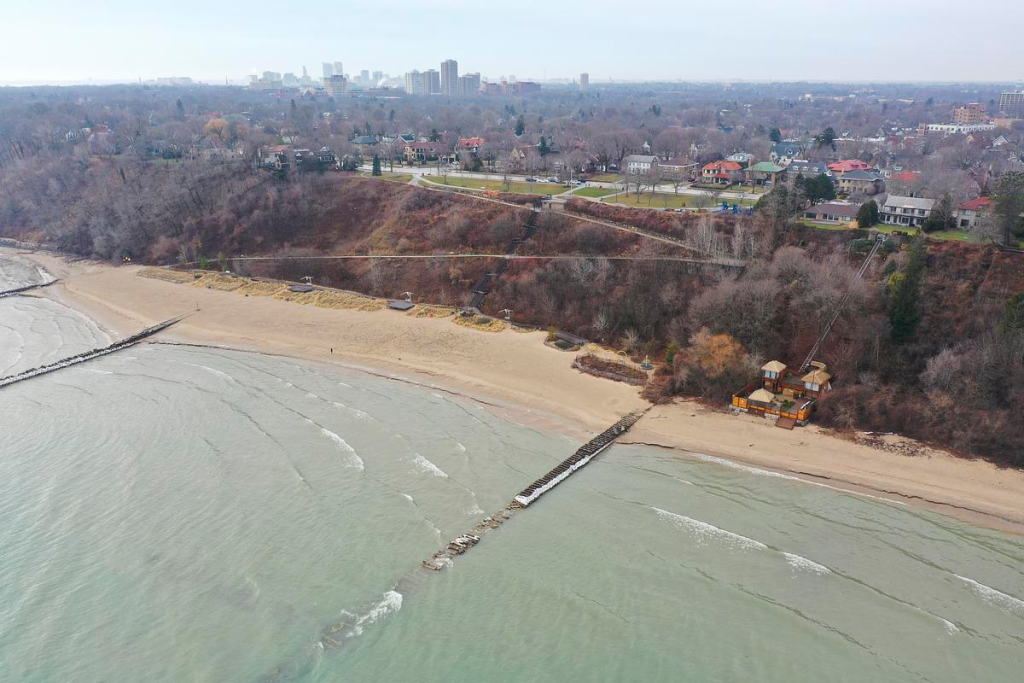
Florsheim received a $313 trespassing ticket from the Shorewood Police Department after he walked along the shoreline past Atwater Beach last summer. He represented himself during a municipal court hearing, arguing the part of the beach where he was walking was public land, and he was allowed to be there.
The state’s public trust doctrine protects the public’s rights on navigable waterways in Wisconsin. Florsheim argued the doctrine protects his right to walk along the shoreline up to the ordinary high water mark.
But Shorewood Municipal Judge Margo Kirchner ruled against Florsheim, citing a 1923 Wisconsin Supreme Court ruling, Doemel v. Jantz, that found the public cannot walk on the area of the shoreline between the ordinary high water mark and the edge of the water. It said private property owners have exclusive rights to that area.
On its website, the Wisconsin Department of Natural Resources says the ordinary high water mark is defined as, “the point on the bank or shore of a waterway up to which the presence and action of the water is so continuous as to leave a distinct mark either by erosion, destruction of terrestrial vegetation or other easily recognized characteristic.”
Watts, in his decision, wrote, “the strip of land below the (ordinary high water mark) is lakebed owned by the state of Wisconsin,” and that the state’s property extends to that point along Lake Michigan.
Watts said Florsheim walking along the shoreline of Lake Michigan, below the ordinary high water mark, was a “recreational activity.”
The 1923 Wisconsin Supreme Court decision related to a dispute along Lake Winnebago, an inland lake. In his decision, Watts said Doemel v. Jantz, “may guide decisions in cases involving tort actions for trespass on inland lakes but provides little guidance for this case.”
The judge found the walk was protected under the public trust doctrine and “did not infringe on any riparian landowner’s rights.”
A Thursday press release from Midwest Environmental Advocates said the decision from Watts, “did not overrule Doemel.”
In a statement, Michael Greif, an attorney with Midwest Environmental Advocates, said, “The dismissal affirms that the shore of Lake Michigan is public land, and, while the direct impact of the decision is limited to the dismissal of Paul’s ticket, we believe the principles affirmed in this case should be broadly applied.”
This story was originally published by WPR.
Milwaukee County judge overturns trespassing citation in Lake Michigan beach access case is a post from Wisconsin Watch, a non-profit investigative news site covering Wisconsin since 2009. Please consider making a contribution to support our journalism.
