


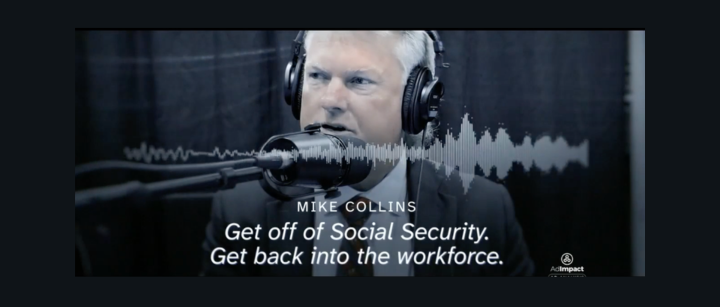
In the Georgia Senate race, Democratic Sen. Jon Ossoff has been running TV ads that take a sound bite from his opponent about Social Security out of context.
In a radio interview last year, Republican Rep. Mike Collins made the case for the tax cuts in President Donald Trump’s One Big Beautiful Bill Act, claiming that cutting taxes would spur economic growth and provide an incentive for people to “get off of Medicaid, get off of Social Security, get back into the workforce.”
Collins, June 5, 2025: It’s just business 101. You’ve got spending and you’ve got revenue, and you set it up to where you can increase your revenue. And you do that by lowering taxes and making it more advantageous for people to work and to get off of Medicaid, get off of Social Security, get back into the workforce. And, and that decreases it on that side of the equation as well — on the mandatory side.
But two Ossoff ads currently airing use only a snippet of the Collins interview — when he says, “get off of Social Security, get back into the workforce” — to claim that “he wants to push you off Social Security.” The ad shows images of older adults with gray hair when making that claim.
The ads ignore that Collins also mentioned Medicaid, and, while his mention of Social Security is confusing, he wasn’t talking about pushing people off these programs, but rather “making it more advantageous for people to work.”
One of the ads repeats the truncated audio clip for emphasis. “Listen again. ‘Get off of Social Security, get back into the workforce,’” that ad says. (See the ad below.) The Ossoff campaign has spent more than $2.8 million on the ad since it first aired on Aug. 8, according to AdImpact, an advertising tracking service.
The Ossoff campaign defended its use of the clip, saying in a memo to us that its ads don’t imply that Collins would use coercion or force to get people off Social Security. Rather, “Collins makes it clear he wants to exert influence and pressure to push Social Security beneficiaries into the workforce,” the campaign memo said.
In an interview, an Ossoff campaign spokesperson told us, “We are taking the quote as he said it, and he did not provide additional context.”
But the full quote from the interview does provide some additional context, although getting off of Social Security to rejoin the workforce isn’t easy. And it can be costly.
Social Security recipients can work and receive benefits. They can also withdraw their benefits application – but only within the first 12 months after being approved for Social Security payments. Those who do withdraw from Social Security must repay whatever they received in Social Security and Medicare benefits during the 12-month period.
It’s also possible to temporarily suspend benefits between full retirement age and age 70, as AARP explains.
We asked the Collins campaign what the Republican congressman meant when he said “lowering taxes” would make it “more advantageous for people” on Medicaid and Social Security to “get back into the workforce.” Sam Densmore, a spokesperson for the Collins campaign, said the candidate “misspoke” about Social Security.
“In that interview, Rep. Collins misspoke and did not intend to make that statement. Instead, he was referring to getting off of Medicaid and onto their employer’s health insurance,” Densmore said. “He corrected himself immediately afterward, but his opponent clipped the remark short intentionally to mislead the voters.”
Collins did not correct himself in the interview, which was a little more than 15 minutes long. We asked Densmore when and where Collins “corrected himself,” but we did not get a response.
Regardless of what Collins meant to say, the Ossoff campaign took the quote out of context to claim that Collins said “he wants to push you off Social Security and back to work.”
The ad above ends by saying that Collins is “attacking your retirement.”
More on Social Security
Both Ossoff ads also claim that “Collins voted to gut Social Security,” citing his vote in March for a balanced budget amendment to the U.S. Constitution. The House resolution would have been the first step in a long and difficult process to amend the Constitution – but it failed, as many other proposed balanced budget amendments have in the past.
It’s true that the balanced budget amendment – however unlikely to ever take effect – potentially could have made the program’s financial situation worse, if Congress didn’t do anything else.
As it is, the federal government has had to borrow to cover full Social Security retirement benefits every year since 2010, the Social Security Board of Trustees said in its 2026 report to Congress. That’s because the total cost of the program exceeds non-interest revenue – which includes Social Security payroll taxes, income taxes on Social Security benefits and general fund reimbursements, the report said. Under current law, Social Security retirement benefits will have to be cut by 22% in 2032, if Congress doesn’t act, the trustees’ report projected.
The House resolution made no exception for Social Security and made it more difficult for Congress to raise revenue by requiring a two-thirds majority to raise taxes. Unless Congress raised taxes or exempted Social Security from the balanced budget amendment, Social Security benefits would likely have to be reduced earlier than 2032.
We asked the Collins campaign to respond to the ads’ claim that the balanced budget amendment would “gut Social Security.” Densmore, the campaign spokesperson, said only that Collins “has always supported Social Security … and that will not change” in the Senate.
In its memo to us, the Ossoff campaign provided additional support for its claim that Collins would “gut Social Security.” The campaign document said Collins has a long history of voting to “jeopardize” the nation’s retirement program, dating to his first House campaign in 2014 when he advocated raising the retirement age for full Social Security benefits. Collins is also a member of the conservative Republican Study Committee, which has repeatedly proposed budgets that would gradually raise the retirement age, the Ossoff campaign noted.
Raising the full retirement age from 67 to 69 for future retirees, as proposed by the RSC in its 2025 budget proposal, would reduce lifetime benefits for “[a]ll people affected by such an increase,” the Congressional Budget Office said in a September 2024 letter to the ranking Democrat on the House Budget Committee.
But raising the retirement age would also shore up the program’s finances. In 1983, Congress and President Ronald Reagan agreed to “significant reforms” that “put the program on a stable footing for decades,” including raising the retirement age for full Social Security benefits and increasing taxes on Social Security benefits, as explained in a Brookings Institution report.
The Ossoff campaign also cited Collins’ vote for the One Big Beautiful Bill Act, saying the new law “accelerated Social Security’s insolvency.” That’s accurate. In its 2026 report, the Social Security trustees projected that the new law will “have a substantial effect on Social Security’s financial status,” because the program “will receive lower levels of revenue in the future from income taxation of Social Security benefits.”
Health Insurance
The Ossoff ad in heavy rotation that has been airing since Aug. 8 also criticized Collins on health insurance.
“Collins voted with Trump to double health insurance premiums for more than a million Georgians,” the ad says, citing Collins’ vote against a Democratic bill that would have extended more generous Affordable Care Act subsidies for three years. The House bill passed Jan. 8 but didn’t become law, and out-of-pocket premiums for ACA plans went up.
But how much did premiums increase for Georgians? The Ossoff campaign cited a KFF analysis published last year that said without the enhanced subsidies, premiums on average would “more than double what subsidized enrollees currently pay annually for premiums—a 114% increase.” Because of the higher costs, many have dropped their ACA coverage, as we’ve explained, and others shopped for lower-premium plans.
KFF, a health policy research organization, published an updated analysis in May that said premium payments in 2026 have increased by an average of 58%.
“This is lower than the 114% increase KFF projected if everyone had stayed in the same plan because many people bought down to higher-deductible plans and because those just past the subsidy cliff with the steepest increases dropped ACA coverage at higher rates,” KFF said. “Additionally, the 114% increase was among people receiving a tax credit whereas the 58% increase is among all consumers, including the most number who did not receive a tax credit in 2025.”
KFF also said that more than 1.3 million Georgians signed up for health insurance on the ACA marketplace this year, down about 187,000 from 2025’s open enrollment, but we don’t know how many of them have seen or would have seen their premiums double. An Ossoff campaign spokesperson told us that it didn’t know, either. Instead, the spokesperson said there are about 350,000 fewer state residents who now get their insurance on the ACA marketplace, citing a report in the Atlanta Journal-Constitution based on state data this spring.
“We are focusing on 300,000 have already lost their insurance,” the spokesperson told us.
We don’t know how many of those may have obtained insurance from another source.
The Georgia Senate race, which is rated “lean Democrat” by the Cook Political Report, is critical to the Democrats’ chances of regaining control of the Senate, where the Republicans hold a 53-47 advantage.
Ossoff, who had no primary opponent, so far has raised and spent more money this campaign cycle than any other congressional candidate, according to the Federal Election Commission.
Editor’s note: FactCheck.org does not accept advertising. We rely on grants and individual donations from people like you. Please consider a donation. Credit card donations may be made through our “Donate” page. If you prefer to give by check, send to: FactCheck.org, Annenberg Public Policy Center, P.O. Box 58100, Philadelphia, PA 19102.
