


In committing to provide a safe swimmable place within 15 minutes of every home by 2035, London Mayor Sadiq Khan has set a measurable, time-bound goal that cannot be met through a single program or line item on the budget. Instead, it requires a public mission capable of mobilizing all ministries and shaping markets.
LONDON—Had you visited a London pool during this sweltering summer, you would have found it quieter than expected. Since the COVID-19 pandemic, the city’s public swimming amenities have moved to booking systems that favor those who can plan days ahead, pay upfront, and spare an adult for the afternoon. Many Londoners fail that test.
But London Mayor Sadiq Khan has committed to making the city swimmable. His Clean Rivers and Waterways Plan, launched in July, seeks to widen access across ten strategic locations by 2036, with partners committing around £1.8 billion ($2.4 billion) by 2030. Still, the plan’s success will depend on whether its 48 projects are governed as one portfolio with a single overarching objective, as opposed to featuring 48 projects with 48 separate owners. That is the difference between a program and a mission.
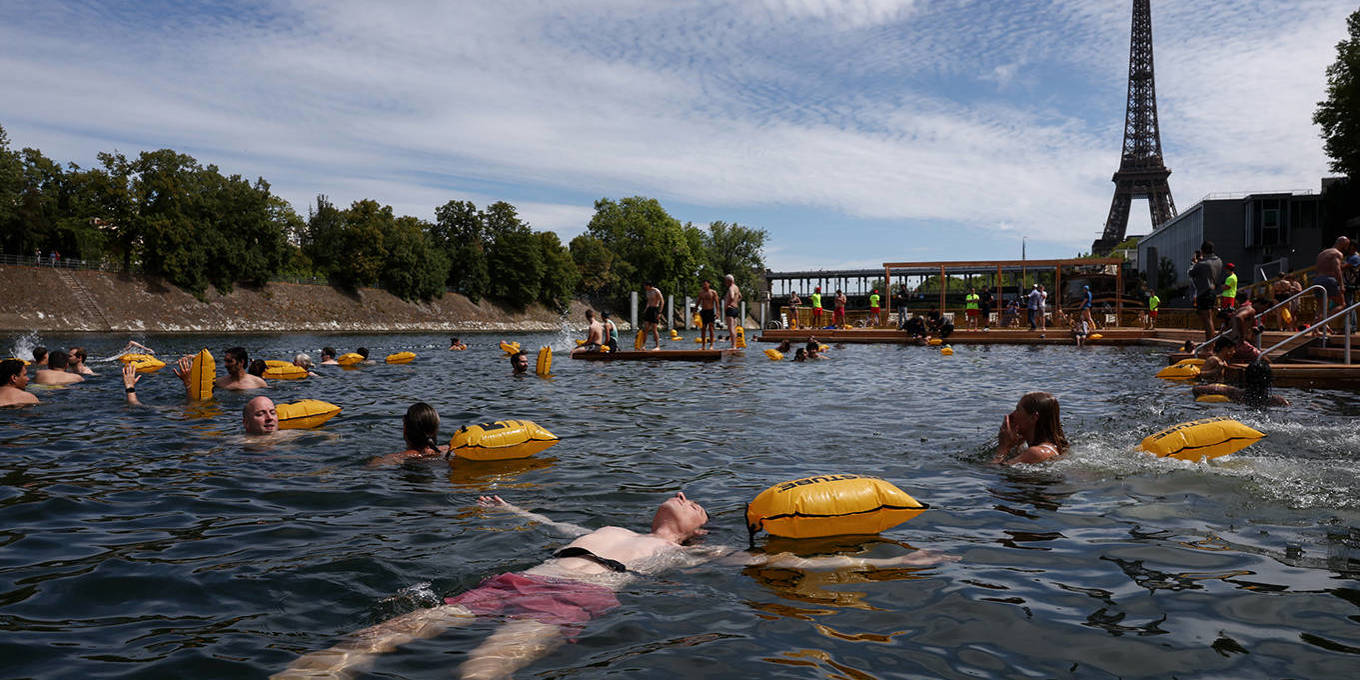
Cities around the world are recognizing pools and other “blue spaces” as critical forms of climate infrastructure. After modernizing its sewers and treatment facilities through the 1990s, Copenhagen opened its first harbor bath at Islands Brygge in 2002, lending momentum to a model that has since been exported to Oslo and New York City. Paris spent €1.4 billion ($1.6 billion) cleaning up the Seine, which now offers public-access, lifeguarded bathing sites—the first legal swimming in the river since 1923. These cities all share the same level of ambition, and they now have an opportunity to develop a shared method of delivery.
Doing so would unlock both social and economic benefits. Sport England’s Active Lives survey shows that 82% of children from affluent households can swim 25 meters (82 feet) unaided, against 39% of those from lower down the economic ladder. Similarly, 47% of children attending school in the most deprived geographic areas can swim the same distance, against 69% in the least deprived areas. The Black Swimming Association reports that 96% of Black adults in England do not swim regularly, though the equivalent figure for white British adults is 90%. What the children priced and planned out of water access have in common is income and postal codes.
But access to swimming is not just a social issue. Restoring a river is also a productive activity that requires someone to design the wetland, lay the sustainable drainage, build and run the treatment and reuse facilities, monitor water quality, maintain the banks, staff the swimming areas and teach children to swim. Public spending on that scale requires a full procurement pipeline, and procurement pipelines shape markets.
Organizing the plan as a mission is key. Providing a safe swimmable place within 15 minutes of every home by 2035 is a measurable, time-bound goal that requires health, environment, education, and transportation ministries to work together with local governments and water regulation authorities.
Five elements are needed to complete such a mission. The first is governance, specifically a cross-ministerial board with authority over decision-making sequencing and budget alignment (as opposed to a forum that merely shares information and defers decisions upward). Someone must own the outcome. Melbourne, for example, started by identifying which work streams its council actually controls, then built a coalition to secure commitments on the rest.
The second element is procurement. Public purchasing power remains one of the most underused market-shaping instruments governments hold. Working with Camden Council, my team at University College London has shown that outcomes-oriented procurement—judging contracts by the public value they deliver rather than by cost savings—can reshape how an authority commissions everything from housing to leisure services. And in New YorkCity, Mayor Zohran Mamdani has brought the same insight to bear on the provision of food, using public demand to build supply where private markets have not.
The third element is finance. Green-blue bonds issued at the national level would spare councils from competing against one another for small, short-term grant funding; staff could focus on delivery instead of paperwork. There is already a precedent here. In 2019, the European Bank for Reconstruction and Development raised $700 million through the first dedicated climate-resilience bond, and the United Kingdom’s own green gilt program has financed a substantial share of the Environment Agency’s flood investment.
The fourth element is strong conditionalities. When public finance, concessions, and discharge permits flow to water companies and contractors, they should carry obligations on pollution reduction, reuse, apprenticeships, and reinvestment. Jon Cunliffe’s independent review of the water sector identified chronic underinvestment and high shareholder payouts as central to the sector’s failure. Public support should always come with terms attached.
Finally, there is co-creation. This element is often reduced to mere consultation after a plan’s design is already fixed; but when done properly—as Mexico City did by establishing large public centers with pools and sports facilities for residents in the city’s most neglected boroughs—it changes what gets built and who maintains it.
The Global Commission on the Economics of Water, which I co-chaired, estimated that failing to pursue more sustainable water management could cost 8% of GDP in high-income countries, and up to 15% in lower-income countries, by 2050. Since water moves across catchments, borders, and sectors, we argued that it should be governed not as a local commodity but as a common good, through missions spanning agriculture, energy, industry, and urban resilience.
In this respect, cities are further ahead of states. Rotterdam and Utrecht, alongside Amsterdam’s water authority, signed the Swimmable Cities Charter in 2024, and the Dutch water ministry supports a national dialogue on what officials there call swimmability. Paris treats urban swimming as a public service. And a global alliance now spans 255 organizations across 121 cities in 39 countries, supporting more than 55 municipalities and water authorities on five continents. Last month, mayors met in Basel to hear how that city made the Rhine swimmable. Practical lessons are being shared from city to city, rather than through national governments.
Missions do not begin as budget line items. They start with a goal ambitious enough that no department can claim it alone, and concrete enough that citizens can judge whether it has been met. A child being able to swim safely in her local river by the end of this decade is a good test. Passing it would mean that London had refurbished its catchments, built the firms and skills to keep them clean, and settled the question of who the city’s rivers, pools, and ponds belong to. Climate resilience is usually invisible until it fails, but here we have a form of it that people can see, use, and defend.
