


At this point, it should be clear that AI is a choose-your-own-adventure book where every option ends in disaster. Exploding carbon emissions and ecological collapse? Turn to page 37. Other outcomes include some or all of: the bubble bursting and an ensuing financial crisis; mass unemployment via automation; the end of democracy and the rise of authoritarian surveillance states; raving cults who believe the pattern-matching algorithm is a consciousness; terrorists who create devastating bioweapons; nation states that deploy autonomous weapons systems that act on non-human timeframes; nation states or terrorists that hack all the myriad systems we depend on; or an AI that, conscious or not, pursues directives that are at odds with human wellbeing.
Imagining that people such as Elon Musk, the OpenAI boss, Sam Altman, Palantir’s Peter Thiel and the Trump administration tech adviser Marc Andreessen will lead us to a utopian future of flourishing environmentalism, social harmony and endless leisure requires hallucination and sycophancy so great that that choose-your-own-adventure scenario could only have been written by ChatGPT.
There is a growing, if wildly delayed, realisation that we are heading for calamity, with accompanying calls to slow down, regulate or even put all of this on pause while we wrap our minds around it. These calls are coming not only from activists, but from a collection of politicians, experts and big-tech insiders too ecumenical to dismiss, from Bernie Sanders to Bill Gates, who wrote recently that “if someone had a credible plan for slowing down AI advances globally, I would likely support it”. He is merely the latest insider to acknowledge the reality that AI company Anthropic did earlier this summer, when it called for a “brake pedal”. Industry self-restraint will not work. A pause, if there is to be one, must be imposed from the outside.
Despite this, an international agreement is sadly unlikely. AI is analogous to nuclear weaponry, and follows the same logic: each individual actor is incentivised to run this foolish race, with the sole justification that it does not want to be at the mercy of whoever wins. The best chance of inducing a slowdown, it seems, would be for a single actor to control a choke-point, and have an incentive to close it. Curiously, the EU holds such a card – and even has an incentive to play it, should it dare.
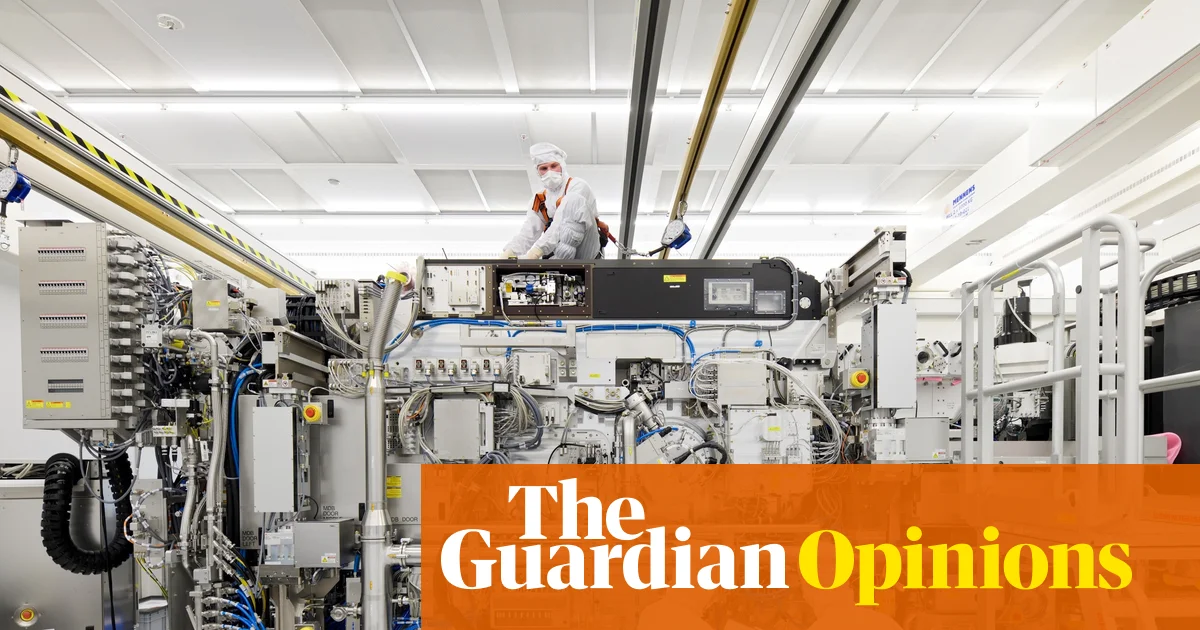
The Dutch tech company ASML is Europe’s most valuable company, thanks to its production of extreme ultraviolet (EUV) lithography machines. These underlie the most advanced chip-making in the world, and as such are one of few possible choke-points on the entire AI industry. ASML has mastered the technology and intricate supply chain to make the $400m per unit machines needed to etch patterns on to silicon, where light is focused to a 13.5 nanometre wavelength (about 1/10,000th of the width of a human hair). Without its machines, there are no chips; without the chips, there are no more datacentres. That means everything from Taiwanese chip-maker TSMC’s $265bn investment in future fabrication facilities (known as “fabs”), to the $7tn-worth of datacentres that the industry is expected to build globally (though primarily in the US) by 2030. Without more datacentres using these current and next-generation chips, AI’s progression along an exponential growth (and risk) curve would come to a halt.
This is why the US government imposes extraterritorial export controls on ASML, blocking exports of its most advanced EUV machines to China in an effort to slow down its advanced chip-fabrication abilities. In imposing those restrictions on ASML, the US has revealed its own vulnerability to this choke-point: as much as Europe is dependent on (ultimately replicable) financial and software services from the US, the future of all chip-based technology is wholly dependent on ASML. A straight ban on exports of ASML’s machines would force the global AI industry to in effect tread water, to jog in place.
The resulting chip shortage and slowdown in the development of AI would give regulators time to catch up with the technology, give lawmakers time to update everything from copyright law to tax law, and give societies time to have real debates about what role we want AI to play in our lives.
Why would the EU do such a thing? Not merely for humanist reasons, but for self-interested ones. In the best case, a flat export ban would result in a reorganisation of the supply chain, and bring more crucial decisions under EU jurisdiction – where it would be subject to the regulatory oversight of the only player that has shown it will regulate AI extensively. Of course, the best case is a far-fetched one: it is more likely that the US would retaliate by blocking ASML’s access to US-based suppliers. But even if this happened, it would still be in the EU’s interests to provoke such a showdown, based on the narrow logic of pure economic and geopolitical self-interest, in that the EU would cease to fall behind in relative terms in AI models and the datacentre “compute” (processing power) needed to run them.
Europe’s own AI-boosters agree – even though what concerns them is the EU’s relative disadvantage, rather than AI’s vast panoply of risks. The Europe 2031 project is a techno-political forecast – compiled by a group of industry experts – of what might happen to the EU in a scenario in which AI radically transforms the economy, and the EU lags far behind the US. They argue that Europe must throw hundreds of billions into the AI arms race before both frontier models and “compute” become what TSMC and ASML are today: beneficiaries of a gap too large for any competitor to close.
after newsletter promotion
In their scenario, sometime in the near future the EU will be forced to put access to ASML on the table in order to secure access to the US-controlled models and compute that its economy and security will come to depend on – only to find that ASML’s supremacy has weakened over time. (The more EUV machines that get exported, the more fabs get built elsewhere, and the more time China and the US have to replicate ASML’s technology.)
Nuclear-weapons theorists worry that, if the unspeakable were to happen, states would be pushed towards launching because of a “use it or lose it” calculation. The exact same calculation applies to the one thing that can halt the breakneck development of the AI industry: the EU can use the leverage that ASML gives it at present or risk losing the chance entirely. It’s rare that disparate groups all arrive at a similar conclusion: there is one single European card to play, and that it must be played. Instead of racing towards folly, let’s just halt the race. Right now, and for everyone.
