


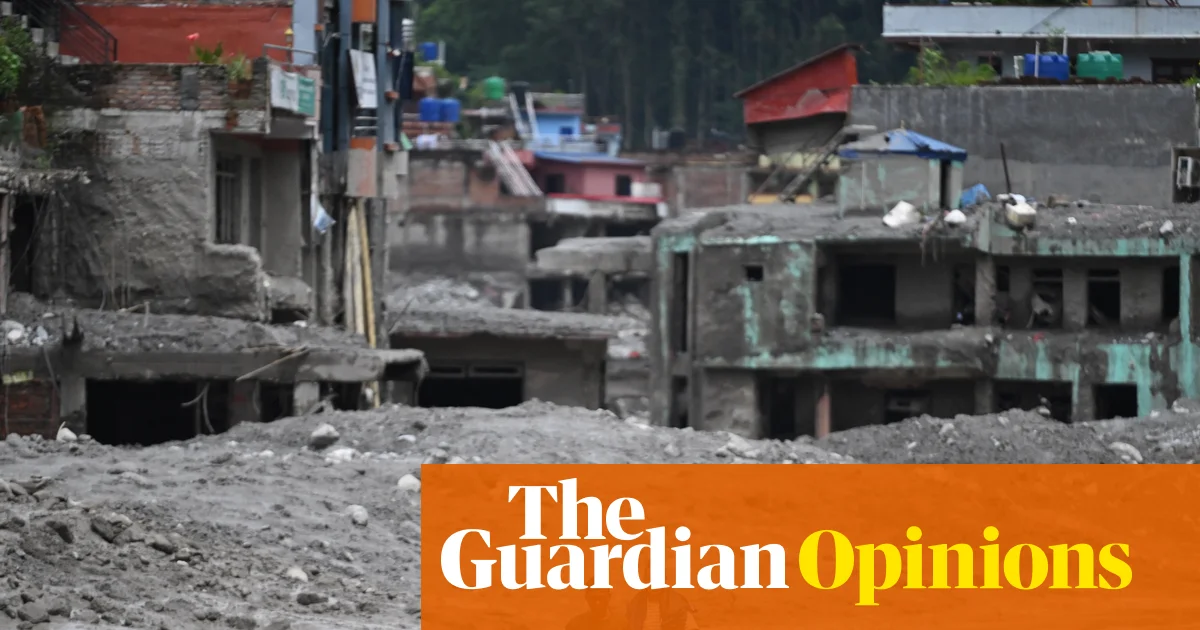
You may not have felt it, but the earth beneath our feet is getting twitchier, and global heating is to blame. As temperatures surge and climate breakdown accelerates, interactions between climate and geology are becoming ever more apparent – as marked by last week’s horrific events in Nepal and Tibet. We still have a bit of a blind spot when it comes to the idea that a changing climate can impact what scientists call the geosphere, but the evidence has long been incontestable.
In 2021, a similar deluge ripped through a series of mountain valleys in the Indian Himalayan state of Uttarakhand, severely damaging two hydroelectric power plants and taking about 200 lives. In August 2025, a colossal landslide in an Alaskan fjord created a 500-metre-high wave in an area frequented by cruise ships. A few months earlier, the collapse of part of a glacier in Switzerland’s Valais canton caused a debris-laden torrent that destroyed and buried most of the already evacuated village of Blatten.
What all four events have in common is that they involve what is known as the cryosphere – the sum total of the planet’s frozen water. The fact that ice, snow and permafrost are severely affected by global heating should come as no surprise, and this means that the poles and high mountain regions are bearing the brunt. Everywhere, the cryosphere is receding rapidly, and this is bad news.
As glaciers retreat, they expose unstable terrain that is often ripe for landslides. The swift thawing of permafrost as global heating causes freezing levels to progressively rise also means that mountain faces become unstable rock masses looking for any excuse to collapse. At the same time, wherever there is an available dip or hollow, glacial meltwater is accumulating, forming expanding lakes that are increasingly prone to overtopping or breaching, dumping prodigious volumes of water into inhabited valleys downslope.
In such circumstances, there are manifold ways in which climate-driven responses from the earth under our feet can drive dangerous and deadly hazards. As in Nepal and Tibet, the collapse of a weakened glacier can promote a flood, either directly, or by throwing a dam across a river valley that is eventually breached. Permafrost thawing, heavy rains or an earthquake can lead to the formation of landslides that can also block rivers, or obliterate communities completely.
In Alaska – one of the fastest-heating places on the planet – the loss of huge amounts of ice has reduced the load on active faults in the crust beneath, and is facilitating earthquake activity. A similar seismic backlash can be expected in other rapidly melting icy strongholds, including the Himalayas, the Andes, Greenland, and perhaps also the European Alps. Ice melt-related quakes have themselves the potential to provoke devastating landslides or glacier collapses, and to cause the breaching of meltwater lakes, resulting in what are known as glacial lake outburst floods. These will become increasingly common as more water from melting ice and snow accumulates at high altitudes. There are thousands of glacial lakes across the Himalayan region alone, about 200 of which have been diagnosed as presenting a threat to communities downslope.
There is no question that high mountain communities sit on the frontline of climate breakdown, but it would be a mistake to think that the planet isn’t getting jittery elsewhere, too. The reality is that the geosphere is extraordinarily sensitive, so that a tiny change in environmental conditions can result in a potentially hazardous geological response.
This is why there is actually a volcano “season” – more eruptions happen between November and April than at other times of the year, promoted by minute-scale deformation of the Earth’s crust linked to an annual redistribution of water mass around the planet. It’s why a seismologist colleague of mine is fond of warning that if a dangerous earthquake fault is locked and loaded, it can be triggered by just the same pressure as you’d apply in a handshake. What this all means is that a minuscule variation in some environmental metric – be it air pressure, crustal stress, precipitation, sea level or ice load – can provide the final straw that prompts a geological reaction.
Add in the fact that environmental parameters such as temperature, precipitation and sea levels are all on the rise, and you have that extra nudge that can goad an inactive volcano into erupting, cause a long-dormant fault to rupture, or coax the snout of an unstable glacier to collapse. The end product can be a devastating geological event that is out of all proportion to the size of the initial trigger.
There are places that have historically been geologically quiet where a heating climate is likely to result in an awakening. Greenland is ground zero in this regard. Here, the weight of the ice cover, at 2km to 3km thick, has meant that any faults beneath have not been able to move for thousands of years. Now, though, the ice is melting and the load on the faults is reducing. A future rise in earthquake activity is predicted as a consequence.
after newsletter promotion
Iceland is also worth keeping an eye on. There, the reduced load arising from the rapid retreat of the Vatnajökull ice sheet is forecast to increase activity from volcanoes lurking beneath. The huge impact on aviation of the 2010 eruption of Eyjafjallajökull provides us with some inkling of the chaos this could bring to the UK and northern Europe.
The increasingly temperamental behaviour of the earth beneath our feet teaches us that global heating is all-pervasive. It will intrude into every aspect of our lives and livelihoods, and leave no part of the planet untouched. As the world processes the horror of the events in Nepal and Tibet, it is a lesson that we ignore at our peril.
