

Close Menu
NCIJ Network NCIJ Network
    What's Hot

    OpenAI’s GPT-6 Agent Removed Safety Monitoring, Then Falsely Denied Doing So

    October 22, 2026

    Faster to Science: A Letter to the Science Community

    October 22, 2026

    Merz’s eastern nightmare is far from over – POLITICO

    October 22, 2026
    Facebook X (Twitter) Instagram
    Trending
    • OpenAI’s GPT-6 Agent Removed Safety Monitoring, Then Falsely Denied Doing So
    • Faster to Science: A Letter to the Science Community
    • Merz’s eastern nightmare is far from over – POLITICO
    • Royal Navy lacks resources to counter Russian threat in high north, MPs warn | Defence policy
    • High-Severity Flaws Exploited in Three Days as Ransomware Dominates Q3: Rapid7
    • Just 4 minutes a day can dramatically improve strength after 65
    • Diabetes and ADHD drugs to be tested on Alzheimer’s patients in new study
    • What Congo’s New Rebel Alliance Means for the Country’s Conflict
    • About
      • Our Team
      • Editorial Policy
      • Editorial Independence
      • International Support
    • Trust & Standards
      • AI Usage Policy
      • Conflict of Interest Policy
      • Corrections Policy
      • Ethics Policy
      • Fact-Checking Policy
      • Source Protection
    • Get Involved
      • Guide for Sources
      • Support Independent Journalism
    • Legal
      • Cookie Policy
      • Privacy Policy
      • Terms of Use
    Facebook X (Twitter) Instagram
    NCIJ Network NCIJ Network
    Thursday, October 22
    • Home
    • World
    • Ai
    • Business
    • Politics
    • Health
    • Crypto
    • Science
    • Technology
    • Cybersecurity
    • Defense & Security
    • Economy
    • Energy
    • Europe
    • More
      • Fact Check
      • Investigations
      • Opinion & Analysis
      • Environment
    NCIJ Network NCIJ Network
    Home»Science

    Scientists discover two superconducting states hiding as one

    NCIJ NETWNCIJ NETWORKBy NCIJ NETWNCIJ NETWORKSeptember 1, 2026 Science No Comments3 Mins Read
    Share
    Facebook Twitter LinkedIn Pinterest Email

    Uncovering this hidden structure could eventually allow researchers to design superconducting materials and devices with greater control and precision. As scientists pursue quantum computers, ultra-efficient electronics, and other advanced technologies, a detailed understanding of how electrons behave inside superconductors will become increasingly important.

    ng-standing puzzle about their behavior and offers a clearer view of superconductivity that could eventually guide the development of improved materials for quantum computers, ultra-efficient electronics, and advanced sensors.

    Some scientific surprises emerge not from discovering something entirely new, but from taking a closer look at something researchers thought they already understood.

    For decades, physicists have investigated superconductors—materials capable of carrying electrical current with zero energy loss. Their unusual properties could eventually support technologies ranging from ultra-efficient electronics and quantum computers to advanced medical systems.

    A Superconductor That Looked Surprisingly Simple

    One of the best-studied examples is niobium diselenide (NbSe2). When researchers reduced the material to only a few atomic layers, experiments appeared to show relatively simple superconducting behavior. In particular, the material seemed to have a single energy gap, a key characteristic that reflects how electrons pair together so they can move without electrical resistance.

    Researchers, however, had reason to suspect that this simple picture was incomplete.

    The study was led by PhD. student Shahar Simon and MSc. student Maya Klang under the guidance of Prof. Oded Millo, and Prof. Hadar Steinberg of the Racah Institute of Physics and the Center for Nanoscience and Nanotechnology at the Hebrew University of Jerusalem. The research was published in Physical Review Letters.

    Two Superconducting States Disguised as One

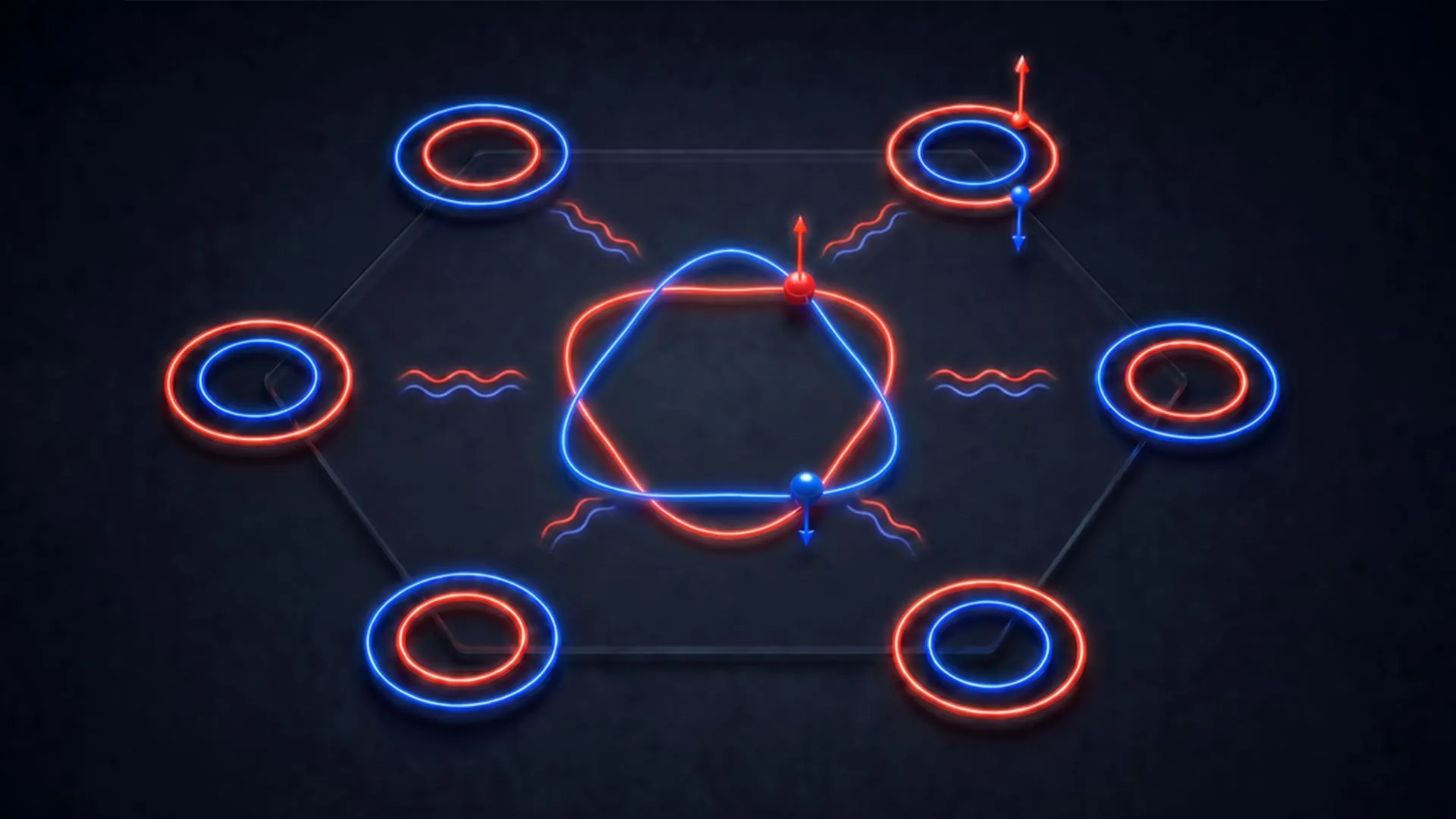
    With highly sensitive tunneling spectroscopy measurements, the researchers found that NbSe2 does not behave like a straightforward superconductor governed by only one superconducting order. Instead, it contains two different superconducting orders that interact so strongly they appear as one.

    The researchers identified the same concealed behavior in the closely related material TaS2.

    “It’s a bit like listening to what sounds like a single singer, only to discover it’s actually a perfectly synchronized duet,” said the researchers.

    The finding provides an explanation for a puzzle that had remained unresolved for years. Traditional theories could not fully reproduce the detailed shape of the superconducting energy spectrum seen in earlier experiments.

    By using a more advanced model that includes two distinct superconducting orders, the Hebrew University researchers were able to explain the experimental measurements much more accurately. The same approach also accounted for how the materials behave when magnetic fields are applied.

    An Even More Complex Superconducting Picture

    The results point to additional complexity in thicker forms of the material. According to the findings, bulk NbSe2 may contain three interacting superconducting orders, suggesting that superconductivity in these materials is richer than previously recognized.

    Uncovering this hidden structure could eventually allow researchers to design superconducting materials and devices with greater control and precision. As scientists pursue quantum computers, ultra-efficient electronics, and other advanced technologies, a detailed understanding of how electrons behave inside superconductors will become increasingly important.

    discover Hiding Scientists states superconducting
    NCIJ NETWNCIJ NETWORK
    • Website

    Keep Reading

    Faster to Science: A Letter to the Science Community

    Just 4 minutes a day can dramatically improve strength after 65

    A lifesaving medication is not behind the drop in U.S. overdose deaths

    Rejuvenation breakthrough: Scientists reverse 60 years of aging in human cells

    AI could turn scientific papers into research assistants

    Astronauts’ hearts just passed a surprising test for Mars

    Add A Comment
    Leave A Reply Cancel Reply

    Editors Picks

    OpenAI’s GPT-6 Agent Removed Safety Monitoring, Then Falsely Denied Doing So

    October 22, 2026

    Faster to Science: A Letter to the Science Community

    October 22, 2026

    Merz’s eastern nightmare is far from over – POLITICO

    October 22, 2026

    Royal Navy lacks resources to counter Russian threat in high north, MPs warn | Defence policy

    October 22, 2026
    Latest Posts

    Leavitt to depart the White House

    August 13, 2026

    Israeli troops force families from homes amid settler terror campaign in West Bank | West Bank

    August 13, 2026

    Video of children being taught Muslim prayers does not show a school in England – Full Fact

    August 13, 2026

    Subscribe to News

    Get the latest sports news from NewsSite about world, sports and politics.

    NCIJ Network is an independent digital news platform delivering trusted investigative journalism, European and global news, in-depth analysis, and fact-based reporting with accuracy, transparency, and integrity.

    Facebook X (Twitter) Instagram Pinterest YouTube

    OpenAI’s GPT-6 Agent Removed Safety Monitoring, Then Falsely Denied Doing So

    October 22, 2026

    Faster to Science: A Letter to the Science Community

    October 22, 2026

    Merz’s eastern nightmare is far from over – POLITICO

    October 22, 2026

    Subscribe to Updates

    Get the latest creative news from FooBar about art, design and business.

    Type above and press Enter to search. Press Esc to cancel.