


Welcome back to World Brief, where we’re looking at the United States’ attack on Iran’s Larak Island, a rising flood death toll in Nepal, and Greece’s multibillion-dollar defense deal with Israel.
Targeting the Islands
U.S. and Iranian forces exchanged fire on Sunday and Monday for the first time since late July, once against casting doubt on the White House’s repeated claims that the monthslong conflict is nearing its end.
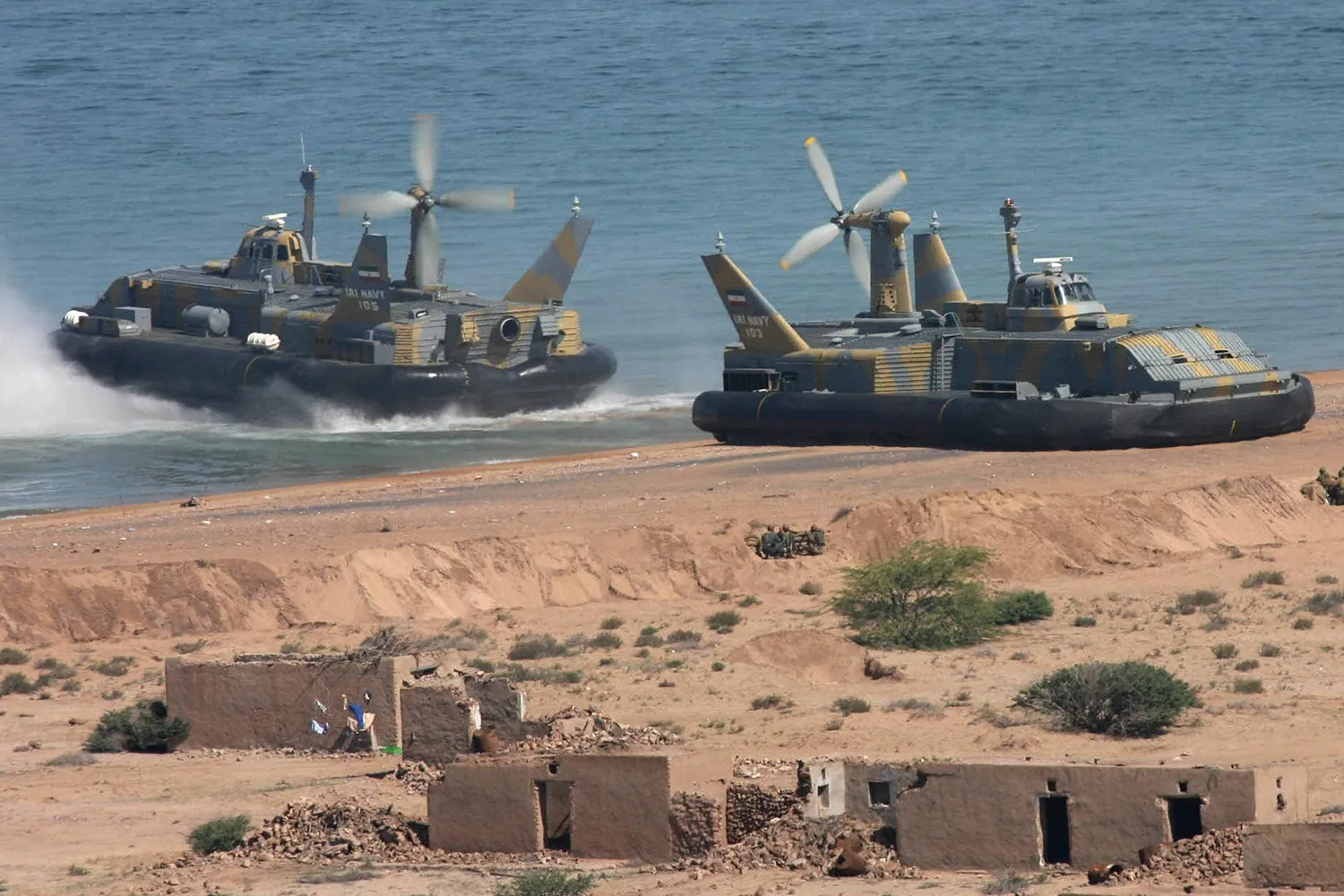
According to a U.S. official, the United States struck Iran’s critical Larak Island on Sunday, damaging two rocket launchers. The official said that Iran’s Islamic Revolutionary Guard Corps (IRGC) was “observed preparing to launch rockets with sea mines into [the] Strait of Hormuz.” Local authorities claimed that the U.S. attack killed at least two people and wounded several others.
Hitting Larak, the closest island along the Strait of Hormuz, carries strategic significance, as the IRGC has used it to host military activity, monitor global shipping, and exert influence over the thoroughfare. The United States has previously targeted other Iranian islands—such as Qeshm, Kharg, and Greater Tunb—in a bid to undermine Iran’s maritime authority and deny the regime access to valuable military and economic hubs.
Also on Sunday, U.S. President Donald Trump posted an artificial intelligence-generated video on social media depicting a fictional incident in which U.S. forces attack Kharg Island. Vice President J.D. Vance said on Monday that the video was an effort by Trump to send a message to Tehran to stop shooting at commercial shipping “or there are going to be some consequences.”
In response to the Larak strike, Iranian forces launched ballistic missiles at two U.S. military bases in Jordan on Sunday. Tehran will “not hesitate to exercise the inherent right of legitimate defense and will respond decisively to any military aggression,” the Iranian Foreign Ministry said on Monday.
Jordan confirmed that its military had intercepted at least eight Iranian missiles, while the United Arab Emirates also claimed to have struck down an Iranian drone over its waters. “This dangerous escalation constitutes a blatant violation of the UAE’s sovereignty, security, and stability, and a direct threat to the safety of its citizens and residents,” the country’s Foreign Ministry said in a statement.
Trump similarly condemned Iran’s retaliation, telling Fox News on Monday that Washington was “going to hit them hard” in response.
Active fighting had ebbed in recent weeks as foreign mediators pushed the United States and Iran to adhere to a June memorandum of understanding (MOU) that included a cease-fire deal. However, repeated violations of the text as well as Monday’s return to active conflict have further soured hopes that this framework could be effective.
“The state of neither war nor peace cannot be a sustainable solution,” Anwar Gargash, a senior Emirati official, wrote on social media on Monday, arguing that the June MOU “failed to outline a practical and acceptable road map” for ending the war. Gargash instead echoed calls for the drafting of a new agreement that returns the embattled Strait of Hormuz to its prewar status.
Meanwhile, G-20 finance ministers convened in Washington on Monday to discuss global economic pressures, including the new U.S. effort to further financially isolate Iran (dubbed “Operation Economic Outcast”). Officials were expected to discuss best strategies to reinforce supply chains, increase international investment, and address rising costs from the Iran war. But although U.S. Treasury Secretary Scott Bessent appeared eager to use the two-day conference to garner greater support for the operation, unifying the G-20 may prove to be too challenging, especially as several U.S. allies are battling their own trade wars with Washington.
Today’s Most Read
The World This Week
Tuesday, Sept. 1: Zambian President Hakainde Hichilema is sworn in for another term.
Wednesday, Sept. 2: Estonia holds an indirect presidential election.
Russian President Vladimir Putin separately meets with Mongolian Prime Minister Nyam-Osoryn Uchral and Chinese Vice Premier Ding Xuexiang.
Thursday, Sept. 3: British Prime Minister Andy Burnham hosts French President Emmanuel Macron.
Sunday, Sept. 6: European Commission President Ursula von der Leyen and Danish Prime Minister Mette Frederiksen begin a two-day trip to Greenland.
The German state of Saxony-Anhalt holds legislative elections.
Monday, Sept. 7: U.S., Japanese, and South Korean forces begin the five-day Freedom Edge annual military exercise.
What We’re Following
Rising death toll. Rescue teams bolstered efforts on Monday to evacuate hundreds of people believed to be trapped inside 11 hydropower project tunnels in Nepal’s Rasuwa and Nuwakot districts following a catastrophic flash flood in the region last week. “A large amount of debris has been deposited, and that is posing us a big challenge to open the tunnels,” Nepali Army spokesperson Raja Ram Basnet said. Chinese and Indian experts are working with Nepali authorities to reach the nearly 1,000 individuals believed to be trapped.
But with every hour that passes, the flash flood’s death toll also goes up. On Monday, Nepali officials confirmed 903 deaths and more than 4,200 others unaccounted for since a glacial collapse triggered the flood on Wednesday. That includes around 590 missing foreign nationals from 39 countries. In Tibet, Chinese authorities estimate that 16 people were killed and 546 others are missing, though it is unclear if those numbers overlap with Nepal’s figures.
With hopes dwindling that rescue operations will find survivors and tens of thousands of people still in need of relief, Nepal has turned to mass graves to deal with the influx of deaths. In the city of Bharatpur, for instance, destroyed infrastructure has made it nearly impossible to preserve the number of bodies that have washed up onto its riverbanks.
Achilles Shield. Greece signed a roughly $3.5 billion defense deal with Israel on Monday. Dubbed “Achilles Shield,” the agreement gives Athens a multilayered air defense system using Israeli technology, among other advanced arms. The deal is expected to help Greece modernize its military capabilities amid long-standing territorial disputes with its NATO neighbor, Turkey, which has the second-largest standing military in the alliance.
According to Israel, Monday’s deal is the first time that Israel will provide another country with a complete array of defensive weapons to counter everything from drones to ballistic missiles. Israel’s weapons exports reached a record high of more than $19 billion last year, surpassing the United Kingdom in its share of global arms exports to become the world’s seventh-largest supplier, according to a report released in March by the Stockholm International Peace Research Institute.
Experts say that foreign governments buy Israeli weaponry because its arms are battle-tested. However, that real-world experience is among the biggest criticisms of such purchases as global condemnation grows over Israel’s conduct in its wars against Hamas and Hezbollah.
Two key referendums. Voters in Iceland rejected a government proposal over the weekend to reopen talks to join the European Union. In a closely contested referendum held on Saturday, Icelanders voted 52.8 percent against versus 47.2 percent in favor of restarting the accession process, demonstrating that the majority of citizens prioritize territorial and economic sovereignty over protection from Trump, who has repeatedly threatened to expand U.S. influence over the Arctic.
Icelandic Prime Minister Kristrun Frostadottir took the loss on the chin, telling reporters that her center-left government will respect the public’s decision and instead work to strengthen existing ties with the EU. However, an EU official told Reuters on Saturday that the result is “a clear setback for Brussels,” which had hoped that Iceland’s membership would strategically enhance the bloc’s influence in the mineral-rich Arctic.
In another critical referendum over the weekend, Guinea-Bissau voted on whether to approve a new constitution ahead of the country’s general election in December. If passed, the new constitution would transform the country’s political system from a parliamentary to a presidential one by reducing the number of seats in the National People’s Assembly and giving the executive branch the ability to dissolve parliament. Results are expected to be announced on Tuesday.
Opposition leaders urged voters to boycott the referendum, arguing that it would make Maj. Gen. Horta Inta-A Na Man more powerful. Inta-A seized power during a military coup last November, a day before the official results in a disputed election between then-President Umaro Sissoco Embaló and opposition leader Fernando Dias were due to be revealed. Both Embaló and Dias had claimed victory in that vote.
Odds and Ends
Fans of Son Goku, get ready for an immersive, adventure-packed experience. Last week, France and Saudi Arabia agreed to build a $7 billion themed amusement park near Paris based on the Dragon Ball Z franchise. The idea was spawned during Macron’s trip to Riyadh last year, during which he and Saudi Crown Prince Mohammed bin Salman realized that they shared a love for the popular Japanese anime show. The project is expected to create around 22,000 jobs, according to the French government, and construction will likely take several years.
