


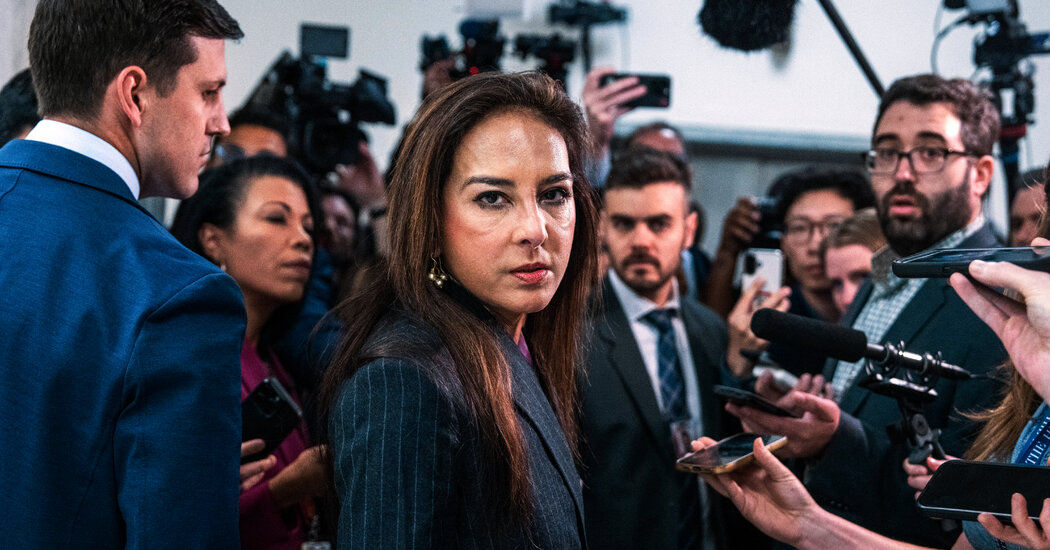
Harmeet Dhillon offered a four-word summation of her four-decade campaign to tear down the ramparts of liberal academia during a private gathering last September.
“I’m going after Harvard,” said Ms. Dhillon, the head of the Justice Department’s civil rights division, according to audio of the event in New Haven, Conn., obtained by The New York Times.
Ms. Dhillon, 57, has repurposed a unit created to address Jim Crow injustices into a battering ram against the elite left. In part, it represents the culmination of a mission she began as an undergraduate at Dartmouth College — to impose conservative change on liberal institutions she still views as the entrenched establishment.
Ms. Dhillon, a gladiatorial Republican lawyer from California who has emerged as a Washington power player, has gone after more than 100 schools, extracting agreements, cash and personnel moves from big institutions over their diversity and antisemitism policies. In one instance, her pressure prompted the president of one high-profile school, the University of Virginia, to take early retirement.
“Harvard wished they never heard her name,” Mr. Trump said about Ms. Dhillon last year.
Harvard is apparently not alone. Ms. Dhillon has antagonized enemies and colleagues alike with a confrontational approach and a habit of beefing with co-workers that might hurt her chances of moving higher in the department, current and former department officials said.
Yet the issue that could most define Ms. Dhillon’s tenure looms just over the horizon: the division’s role in monitoring the administration of the midterm elections, as Republicans face the prospect of losing the House and perhaps the Senate and Mr. Trump reprises his falsehoods about election fraud to undermine unfavorable results.
Ms. Dhillon’s much-publicized deployment of election monitors during the 2026 primary season has alarmed some local Republicans. She has also filed a salvo of federal lawsuits to demand confidential Social Security and drivers’ license data from states.
Democratic officials have resisted, combating what they say is a dangerous intrusion into their right to conduct elections.
She has lost every single one. Her record is now 0 and 23.
Ms. Dhillon, in a statement, denied that she had been impelled by any motive other than fairly enforcing federal law, including Title VI of the Civil Rights Act of 1964, which bans discrimination by any recipient of federal funding. Her actions on higher education, she wrote, have been based on an evenhanded examination of admissions data, “not personal animus toward elite universities.”
Since taking over in April 2025, she has scrapped environmental justice settlements and shredded deals over policing reform reached with Minneapolis and Louisville after the George Floyd and Breonna Taylor killings.
Ms. Dhillon has also stepped back from the department’s recent role of investigating civil rights violations by law enforcement, declining to scrutinize the killings of two protesters, Renee Good and Alex Pretti, by homeland security officers in Minneapolis in January.
Not everything has changed in the division. Ms. Dhillon has moved ahead with more than 40 investigations of misconduct by law enforcement officials, including the recent prosecution of a former U.S. marshal for brutalizing an inmate. She has pursued cases involving sexual harassment by landlords and discrimination against non-Christians, and recently doubled down on a Biden-era suit over Louisiana’s illegal detention of inmates.
But her overall approach — articulated in an April 2025 memo ordering officials to pursue “the priorities of the president” — prompted a mass exodus of career workers that cut staffing levels by half or more and that has only recently stabilized, according to former officials.
“Harmeet is not just ignoring the reasons the division was created and the laws it is tasked with enforcing, she is using its enforcement authority against the very people whose rights the division was created to protect,” said Vanita Gupta, a former head of the division who served as associate attorney general during the Biden administration.
“She has corrupted its mission,” Ms. Gupta added.
Ms. Dhillon has articulated a different one: delivering a counterstroke against woke.
In an interview last fall, she asked herself a rhetorical question: What is the defining civil rights issue of our time?
“It’s not even in the Bill of Rights,” Ms. Dhillon explained. “It’s the fact that Americans feel like they have to lie every day to get through the day. They have to lie about pronouns. They have to lie about the person in the cubicle next to them being qualified if they aren’t. They have to pretend to laugh at and like certain types of jokes.”
A Hard-Charging Conservative
Ms. Dhillon is a striking figure in the Trump administration, a Sikh woman whose public displays of pride in her heritage have provoked attacks from white supremacists.
Her intellect is formidable, her personality vivid and paradoxical. It manifests in a restless social media feed that modulates between threats (investigating a cafe owner who would not serve a pro-Israel congressman), policy announcements (the decision to deploy 1,000 election monitors at polling places), Edenic photos (bees at dawn, dahlias, zinnias), and many, many, many images of her knitting projects.
A post to her 1.6 million followers in mid-August captured the split screen.
“It is a crime to knowingly allow noncitizens to vote in federal elections. We have notified all 50 states of these federal election laws,” she wrote, sharing a clip of a recent appearance on a podcast in which she wore a tangerine-hued pullover.
She then reposted it with the comment: “I knit that sweater! This summer — pure cashmere.”
Ms. Dhillon, whose husband died in 2024, seeks the tranquillity at home that she often eschews at work, living quietly among the liberals in her leafy Washington neighborhood.
It works. Kind of. On one side of her fenced-in garden, a neighbor sometimes signals discreet dissent, posting protest signs that change with the news — like the green-and-gold George Mason University yard sign that sprung up when the school was targeted.
Work-life boundaries are not Ms. Dhillon’s thing anyway.
“You’re not supposed to look at the phone in bed, but I do,” Ms. Dhillon said at an event in Colorado in early August. “Before I’ve gotten to work, a half-dozen people are already at work implementing my messages.”
Ms. Dhillon was born in India and immigrated to the United States at the age of 2 when her father, a physician, moved to North Carolina. Her parents helped establish the state’s first Sikh temple.
After starting Dartmouth College at 16, she joined an established group of campus conservatives centered on The Dartmouth Review, whose alumni included Dinesh D’Souza and Laura Ingraham.
By 1988, Ms. Dhillon had become an editor and sued the college after three white staff members were suspended following a confrontation with a Black professor. A few months later, she published a satirical column comparing the school’s Jewish president to Hitler.
After being confirmed to lead the civil rights division, Ms. Dhillon perused the U.S. News & World Report rankings of top undergraduate, law school and medical school programs, dispatching demands for admissions data, including applicants’ gender, race and test scores.
She concluded that medical schools at U.C.L.A and Yale were discriminating against white and Asian applicants. (Each school expressed confidence in its admissions practices.) At least 15 other top medical schools are under investigation.
Ms. Dhillon’s decades running her law firm in the Bay Area, where she brought cases against Google and other tech giants, gave her a tactical insight: The bigger the target, the more motivated they are to reach a settlement to avoid hassle and heartburn.
Over the past year, she has investigated the University of California system, Arizona State University, George Mason, the City University of New York and the University of Nevada, Las Vegas.
In June 2025, pressure from Ms. Dhillon and her team forced James E. Ryan, the president of the University of Virginia, into early retirement over his reluctance to adopt Mr. Trump’s policies.
Ms. Dhillon’s toughness has, at times, caused turbulence. Last fall, Ms. Dhillon tried to drive a settlement with Cornell more stringent than anything the White House had imposed up to that point, according to lawyers on both sides of the talks.
That put her on a collision course with Donald F. McGahn II, Mr. Trump’s first-term White House counsel, who reached out to the man who occupied the job at the time, David Warrington. Mr. McGahn accused Ms. Dhillon of bullying an “ag school” — a reference to Cornell’s venerable agriculture and life science program, according to two people briefed on the interaction.
Mr. Warrington, a former partner at Ms. Dhillon’s law firm, convened a meeting with the two. In the end, Cornell escaped with a deal to provide anonymized admissions data to the government and pay a $30 million fine, the lowest amount of any university at that point.
An Outsider Even on the Inside
Ms. Dhillon’s rise owes much to her reputation as a fierce partisan fighter in California, where she waged legal and political war on mask mandates, coronavirus quarantines and state Democrats in scraps over elections and ballot access.
After Mr. Trump’s defeat in 2020, she embraced his doomed legal effort to reverse the results. Most of the lawsuits failed. But her pugnacity resonated. Her firm, the Dhillon Law Group, has collected more than $20 million since 2019 in legal services, fees and payments from Republican candidates and committees, according to campaign finance records.
Ms. Dhillon says she plans to aggressively root out voter fraud, particularly among undocumented immigrants, which is exceedingly rare. She has dispatched officials to monitor primary elections around the country, an effort even some Republicans have said was rushed and heavy handed.
“I feel very strongly about the federal government coming in and taking our guns,” Gov. Mark Gordon of Wyoming, a Republican, told state officials after monitors demanded, and were denied, access to voting machines. “And I don’t like the federal government coming in and taking our votes, either.”
Ms. Dhillon has not cast her efforts as a quest to uncover vast fraud, as many Trump allies have, but as basic due diligence, calling it “a core function of government” in her statement.
Most of these actions have been met with approval by her boss. And Ms. Dhillon has made little secret of her desire to move up the ladder in the department.
She has told people in her orbit she may quit if she is not promoted to deputy attorney general, a post vacated by Todd Blanche when he rose to be attorney general — and would only stay if she respects the alternative pick. She has enlisted Miriam Adelson, one of the Republican Party’s biggest financial donors, and Ms. Ingraham, the Fox News host, to speak with Mr. Trump on her behalf, they said.
Her prior effort to gain a promotion failed. It is an ill-kept secret that Ms. Dhillon disdains Stanley E. Woodward Jr., the associate attorney general, and was interested in replacing him as the department’s No. 3 official.
In April, when Mr. Trump fired Pam Bondi, Ms. Dhillon made it clear to she believed Mr. Woodward, whom she cast as an incompetent and overbearing bumbler, needed to go, according to six people familiar with the situation.
Mr. Trump initially appeared to be on board. Time passed. Mr. Woodward stayed put.
Her most bitter conflict has been with Leo Terrell, a former Fox News personality tapped by the White House to be an adviser on the antisemitism investigations overseen by her staff.
Mr. Terrell repeatedly complained to Ms. Bondi and other department leaders about Ms. Dhillon’s disrespectful treatment of him, at times forwarding testy email exchanges. Ms. Dhillon, for her part, told Ms. Bondi and others that Mr. Terrell was not qualified for his job, according to former officials.
The two clashed over negotiations with Columbia University, and have not been on speaking terms since early last summer, the former officials added.
Another big flashpoint was Fox News. In mid-2025, a top Dhillon aide warned Mr. Terrell he could be fired if he continued appearing on the network without permission, according to department policy. Mr. Terrell was jeopardizing court cases by talking about them on TV. Mr. Terrell accused Ms. Dhillon of punishing him because she was not getting enough airtime, a coveted commodity, on Fox.
Around that time, a career official working for Ms. Dhillon told Mr. Terrell’s most trusted aide she would have to transfer from his staff, according to people later briefed on the exchange.
The aide, alarmed, told Mr. Terrell. He complained to Mr. Trump. She stayed.
Not long after that, Mr. Terrell’s aide was again summoned, those people said, this time to answer a bizarre question, one with potentially dire consequences for her boss.
Had Mr. Terrell ever asked her to follow him into a bathroom to take notes?
No, she said, that never happened.
The department’s press office did not respond to requests for comment from Mr. Woodward and Mr. Terrell.
A spokeswoman for the department, Emily Covington, said Ms. Dhillon and her team had “secured historic results for the American people” and that their “record speaks for itself.”
Pursuing Harvard
In recent weeks, her division has accused the law school at Duke University and the medical school at George Washington University of discriminating against white and Asian applicants and opened a similar investigation into admissions at the College of William & Mary. (All schools have reiterated their commitment to following the law.)
In the meantime, the battle over Harvard grinds on.
A federal judge on Aug. 13 sided with Harvard in dismissing a lawsuit accusing the school of tolerating antisemitism, which the administration has appealed. A second, still pending, accuses the university of unlawfully withholding some admissions data from the government.
Ms. Dhillon is still pushing for a tougher bargain, publicly criticizing the university and warning the White House against taking a deal that might be seen as too weak, according to people familiar with the talks.
Mr. Trump, for his part, is growing impatient.
Ms. Dhillon was in the Oval Office for a September 2025 meeting when Mr. Trump put on speakerphone a call with Stephen A. Schwarzman, the billionaire chief executive of Blackstone Group, who was mediating negotiations. The president encouraged Ms. Dhillon to keep going hard after Harvard.
“Harmeet’s not going to do a bullshit deal with you,” he told Mr. Schwarzman.
Since then, Ms. Dhillon has twice sued the school.
Stephanie Saul and Kristen Nichols contributed reporting.
