


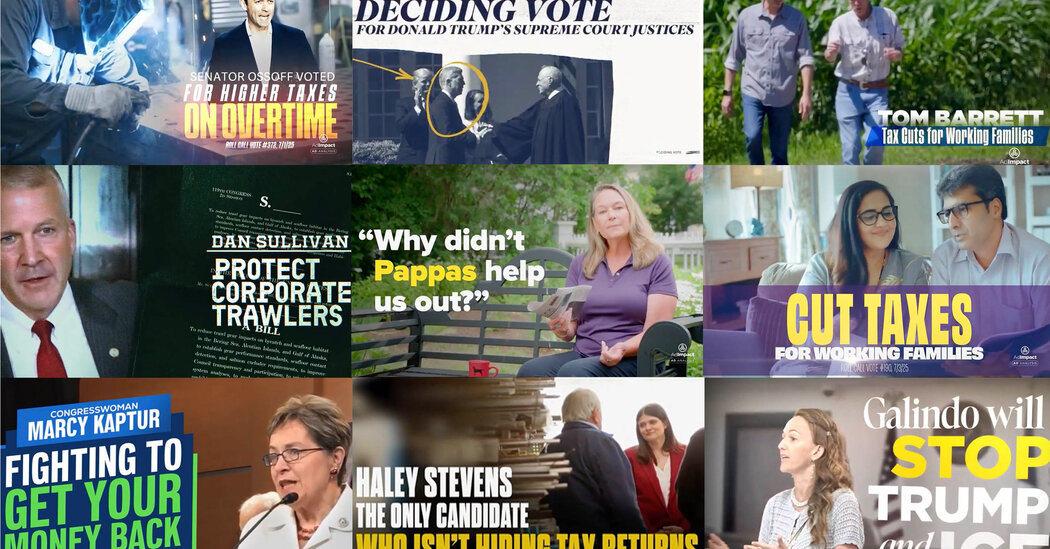
In Michigan and Minnesota, tens of millions of untraceable dollars poured into recent Senate primaries trying to topple progressive Democratic candidates.
In Kansas, the torrent of secret money that boosted an obscure Democratic Senate candidate amounted to 100 times as much as what he had on hand in the final stretch of the primary.
And in Texas, Republicans exploited lax federal disclosure rules to spend secretly and try to nominate a weak Democratic candidate whose own party had denounced her as antisemitic.
All across America, the midterm elections are drowning in dark money.
A New York Times review of advertising data, campaign-finance filings and tax records revealed that about $1 billion in anonymous money is sloshing through the political landscape in 2026, a staggering sum and yet almost certainly a low-end estimate, given how difficult this money is to trace.
Dark money is the term used by the campaign industry to describe political spending by groups that hide the names of their donors. The deluge is upending races from coast to coast, with billionaires, corporations and special interests hiding their agendas and involvement with relative ease.
It is impossible to know the full scale of this spending. The Times’s tally of the $1 billion includes only what is publicly available, primarily television and digital ad purchases and donations to super PACs from nonprofit groups. These groups also fund political activity that is more difficult to track, such as direct mail, hiring influencers to boost favorable content or deploying door-knockers for causes that are not technically campaigns.
Yet the sum is more than “enough money to manipulate a lot of politicians and to put a lot of poison in the blood of the American political system,” said Nick Penniman, the chief executive of Issue One, a group that has sought to reduce the role of money in politics.
Just this month, one Wyoming group with a thin paper trail dating only to this spring, Choose Freedom Inc., sprang into action to reserve about $22 million in ads to boost Republicans in two dozen battleground House and Senate races. The next day, another Republican-linked nonprofit rolled out a $22 million campaign in 41 House districts. On Thursday, a nonprofit called Per Aspera Policy Inc. emerged from obscurity to place a $3.7 million ad buy praising the Republican Senate nominee in Ohio.
All of it involved untraceable cash.
Secret money is not new. But the pervasiveness has reached industrial scale in 2026 — and serves as a preview of its coming prevalence in 2028. Nearly every major primary and battleground race this fall has been or will be shaped by secret funds. The anonymously sourced expenditures are so big that, in some instances, they are outstripping the spending of campaigns themselves, making candidates seem like bystanders of their own elections. The trend is especially true in primaries.
Big money doesn’t always win elections, and in some races, the spending invites significant backlash.
“The power of our many is greater than the power of their money,” Dr. Abdul El-Sayed, the progressive who won the Michigan Democratic Senate primary, declared after his victory. His opponent, Representative Haley Stevens, had benefited from about $62 million in ads from groups funded either entirely or heavily with secret money.
Supporters of undisclosed money argue that allowing anonymity is crucial to free speech.
Each cycle, lawyers look for new loopholes to exploit and old rules to stretch. Democrats and Republicans are locked in something of a partisan arms race, competing for new ways to conceal contributors.
Both are funding more and more types of political activities, such as research and polling, through nonprofit arms. Some are passing tens of millions of dollars through an interwoven network of nonprofits, making the funds even more difficult to track. Others are directly paying for what are called “policy” ads that can be funded with secret donors, even though, for the average voter, they can be virtually indistinguishable from campaign commercials.
“It’s almost like the people inside the Beltway live in a drug den, and this is just the newest drug that’s circulating,” said Mr. Penniman, whose organization formed in the aftermath of the landmark Citizens United decision in 2010, which lifted restrictions on political spending.
The biggest dealers in dark money this cycle are four nonprofit organizations allied with Republicans and Democrats in the House and Senate. Together, they account for more than $460 million from hidden sources being spent shaping this year’s elections, the Times analysis found.
The groups are registered under the federal tax code as social welfare organizations, allowing them to operate as nonprofits. In reality, they each share office space with a sibling super PAC. In all four cases, the nonprofit and PAC are run by the same political strategists, essentially offering donors a one-stop shop to avoid disclosure while spending millions on politics.
The direct spending on ads from these four nonprofits is growing: from $166 million in the 2022 midterms to more than $242 million this cycle so far, according to data from AdImpact, the ad-monitoring service.
”We are on track to have the least transparent midterm at least since Citizens United,” said Dan Weiner, senior director of the Brennan Center’s Elections and Government Program, which advocates for greater transparency rules. “We’re almost at the point where anyone who doesn’t want to be disclosed doesn’t have to be disclosed.”
Maine: A case study
Two elections in Maine illustrate the phenomenon.
In one, Senator Susan Collins, a Republican, is running for re-election in a race that could determine control of the Senate. Voters there are besieged by nearly $75 million in advertising funded by dark money on both sides, according to a Times analysis of donations and data from AdImpact.
That amounts to more than $80 in secret money per registered voter in a state with fewer than 900,000 of them.
It’s not just television ads. Ms. Collins has benefited from at least 10 different mailers from One Nation, a Republican-aligned nonprofit, among them mailers thanking her for working for veterans, firefighters and cancer research, according to Mintt, a mail-tracking firm.
Who secretly gives money matters. Ms. Collins, as an example, serves as the chairwoman of the powerful Senate Appropriations Committee, which helps direct federal spending. That puts her in an elite group of lawmakers with whom special interest groups have a particularly keen interest in currying favor. Ms. Collins also attracts plenty of dark money that works against her.
And while the public remains in the dark, the politicians themselves are often told who their benefactors are. One nonprofit group, Stronger America Inc., has spent more than $11 million on ads helping Ms. Collins — the only candidate it has supported. In July, Ms. Collins attended a dinner hosted by that nonprofit, which was held at the townhouse in Washington owned by the tech company Oracle, according to three people briefed on the event.
A spokesperson for Oracle, whose building regularly hosts fund-raising dinners for politicians, did not respond to a request for comment. Ms. Collins’s campaign also did not respond.
In another race in Maine, the retirement of Representative Jared Golden from the most Republican-leaning House seat held by a Democrat has created a rare opportunity for the G.O.P.
So Republican operatives set out to meddle in the Democratic primary. They spent nearly $500,000 to defeat the Democrat they saw as the strongest candidate, a state senator named Joe Baldacci. Using a new super PAC that did not disclose any donors until after the election and a limited liability company that masked its Republican vendors, the group flooded the airwaves with an ad that labeled Mr. Baldacci “dark money’s choice.”
“It’s the ultimate in deception,” lamented Mr. Baldacci in an interview. His loss by several hundred votes has intensified Democratic concerns about ceding the seat.
In other words, the Republican meddling worked.
Layers upon layers of secrecy
Sixteen years have passed since the Supreme Court decision in Citizens United v. Federal Election Commission helped open the floodgates for super PACs, the independent political committees that, unlike candidates, can raise unlimited money and spend unlimited sums on federal elections. At the time, the Supreme Court reasoned that transparency would prove to be a powerful accountability check on such activities.
“Citizens can see whether elected officials are ‘in the pocket’ of so-called moneyed interests,” Justice Anthony Kennedy wrote in the majority opinion. “This transparency enables the electorate to make informed decisions and give proper weight to different speakers and messages.”
Today, the opposite has proved true. Secrecy has become so widespread it is essentially systematized.
Three distinct strategies help political groups hide their donors.
The first is simply using nonprofit organizations that do not have to disclose their contributors to run ads. Technically, the commercials are supposed to be about issues, but they often attack or praise sitting House members and senators in caustic terms.
The second is for these nonprofit groups to donate to allied super PACs. The super PACs can run explicitly election-focused ads and are required to disclose their donors — but not their donors’ donors — keeping the true origin of the money hidden. There are virtually no limits to the size of these transfers: Some high-profile super PACs are entirely funded by nonprofits.
The third strategy is an increasingly popular option in the midterms: “pop-up” super PACs, which exploit a gap in federal disclosure laws. The final pre-election deadline to reveal donors is three weeks before a federal election, allowing any last-minute group to pop up and spend freely — and secretly — in the final days of a race. The pop-up super PACs must ultimately disclose their donors, but not until the election has passed — too late for voters to weigh that information.
“If you are trying to hide who your donors are, you are probably trying to hide some nasty stuff,” said Representative Chris DeLuzio, Democrat of Pennsylvania, who has sponsored legislation to close this loophole.
Defenders of secret political spending offer a different take. Some Democratic donors privately say such funding can offer shelter at a moment when the Trump administration has explicitly targeted Democratic financiers.
Sean Cooksey, a Republican who is the former chairman of the Federal Election Commission and the former counsel to Vice President JD Vance, said that America was built on anonymous speech, dating back to the Federalist Papers.
“There is important political value in allowing people to associate and speak anonymously,” Mr. Cooksey said. “Especially when they have unpopular opinions.”
The Internal Revenue Service, which oversees nonprofits but has rarely policed political spending, is even less equipped to do so after cuts by the Trump administration. The Federal Election Commission, with only two of six seats currently filled, does not even have enough commissioners for a quorum to hold a formal meeting, let alone enforce campaign finance laws.
“The F.E.C. has never been a cop on the beat,” said Mr. Weiner of the Brennan Center. “But at the moment they can’t even enforce routine traffic violations.”
The commission declined to comment, and the I.R.S. did not return a request for comment.
A growing universe of dark money
Some of the $1 billion in secret money can be traced to ideological interest groups, who disclose their agendas but not their core donors. On the right, the anti-tax Koch family network accounts for over $50 million in spending from undisclosed sources, and on the left, a group of three environmental nonprofits have injected close to $50 million in dark money as well, according to the analysis of AdImpact and donation records. And $30 million has come from the American Israel Public Affairs Committee, which spent heavily against Dr. El-Sayed in Michigan.
One of the biggest new forces in this world is an outfit called the American Prosperity Alliance, which has almost perfected the modern dark-money playbook.
Four years ago, Republican operatives and donors grew frustrated watching Democrats intervene in G.O.P. primaries in 2022 to help elect weaker nominees.
And so this cycle, the American Prosperity Alliance has done the same. The group funneled $37 million to a partner super PAC called Conservative Americans PAC that spawned a network of at least five different “pop-up” committees that used limited liability corporations and postal service boxes to further mask its activities.
Some of these pop-ups adopted Democratic-sounding names like Lead Left PAC or Progressive Champions PAC and intervened in a half-dozen Democratic primaries. This was the network that tried and failed to elevate the Texas Democrat who had been denounced as antisemitic. The network also financed the anti-Baldacci ads.
The American Prosperity Alliance has leveraged all three ways that organizations keep their funders secret. The nonprofit group donates to super PACs. It uses the pop-up loophole. And its three projects also have directly aired tens of millions in policy ads this cycle.
The group does not reveal its contributors. But two people briefed on the group’s finances who spoke anonymously to describe confidential strategy said the nonprofit was funded heavily by corporate interests, including the pharmaceutical industry. The nonprofit declined to comment.
Then there’s Mr. Trump’s own allied nonprofit, Securing American Greatness, which is led by his advisers and also does not disclose its donors. The group so far has spent at least $44 million since early last year, sending nearly $25 million to super PACs and airing about $19 million of ads boosting Mr. Trump and Republicans.
Operatives in both parties privately acknowledge that the system allows them to act nearly with impunity until votes are cast. Lawyers tend to advise nonprofit clients not to file comprehensive disclosures of this cycle’s activity with the Internal Revenue Service until mid-November 2027 — more than a year after the midterm elections.
Kirsten Noyes contributed research.
About the Data
The Times analyzed thousands of Federal Election Commission filings to identify large donations made to super PACs by nonprofit groups that do not disclose their contributors. The list includes three dozen nonprofit groups that transferred more than $525 million to federal accounts in the 2026 election cycle.
The Times also searched for super PACs that formed on the cusp of an election, allowing them to avoid disclosing their donors until after Election Day, and reviewed spending data from AdImpact, an advertising-tracking service, to assess the total amount of political spending by nonprofits on television and digital ads. That included reviewing many of the ads themselves.
The Times also consulted tax records to search for links between organizations and their activities, and to identify leaders of these groups.
