


- The Great African Seaforest is one of the only expanding kelp forests in the world. To better understand this important ecosystem, and why it should be conserved, marine biologist Loyiso Dunga set out to map the entire forest for the first time ever in 2016 using satellite imagery.
- Dunga now works on kelp forest conservation across the globe with both the International Union for Conservation of Nature and the Kelp Forest Alliance.
- As a member of an Indigenous community in South Africa, Dunga is sensitive to how conservation measures were employed during the country’s apartheid-era to expel coastal communities, and makes sure that other scientists include coastal communities in their work.
- “There is so much knowledge that is documented within coastal communities but is outside of science,” Dunga says. “I try to spend a lot of time understanding that, which also enriches my science.”
CAPE TOWN — When scientist Loyiso Dunga began mapping the Great African Seaforest in 2016, he decided to go snorkeling. The South African section of the kelp forest stretches around 800 miles or 1,300 kilometers, straddling two coasts and two oceans.
Dunga grew up in a coastal community, Nqabara, in South Africa’s Wild Coast. As a member of the Xhosa nation, the ocean was kin or family to Dunga, and a sacred place. But that snorkeling trip was the first time he went into the ocean for fun.
“That moment enchanted me,” said Dunga, who lives in Cape Town.
Dunga’s research is now focused on evaluating kelp ecosystems. He works in South Africa as the executive director for the Seas of Good Hope program and globally with the International Union for Conservation of Nature (IUCN) and the Kelp Forest Alliance, a group that is dedicated to protecting over 9 million acres (3.6 million hectares) of kelp forests by 2040.
But, for this conservation work to succeed, Dunga says that Indigenous wisdom, science and policy must be better connected. Dunga founded Asili Blue Renaissance, a nonprofit, to provide diverse, legitimate ocean conservation measures, including working with Indigenous communities.
Dunga is now working on an initiative with the Kelp Forest Alliance to rename global kelp forests by their Indigenous names. Mongabay spoke with Dunga on the phone about his work.
The interview has been edited for length and clarity.
Mongabay: How did you first become acquainted with the Great African Seaforest?
Loyiso Dunga: For my master’s, I mapped South Africa’s kelp forest ecosystem. My background is in terrestrial remote sensing, which uses satellite imagery to measure biodiversity. The water medium makes ocean mapping more difficult. So, to better understand this ecosystem, I went snorkeling in the kelp forest just off Cape Town in 2016. My first time there was an explosion of feelings — you see fish swimming as birds would do in the forest. In my culture, the ocean is a sacred space, not something you play in. After that initiation, I spent a lot of time in the kelp forest.
Mongabay: What was the impetus to map the whole kelp forest?
Loyiso Dunga: I thought if we want to conserve these kelp beds the fundamental question is: Where are they? You can’t protect what you don’t know.
I used satellite cameras to take individual photos of [the] coastline and then used an infrared filter, which helps to show more hues than the human eye can see, to assess chlorophyll content, which shows up as bright red under the filter. Seaweed uses chlorophyll to photosynthesize or absorb light and make food. Using this data, I figured out where the kelp forest was distributed. It was the first time anyone mapped the extent of the ecosystem across South Africa.
The mapping and snorkeling led to a new chapter of my research, looking at the condition of kelp forests. I used the IUCN Red List Ecosystem Assessment, to ask: Is this critically endangered or vulnerable to extinction?
At the time, there was news globally of massive die offs of kelp beds in California, United States and Tasmania, Australia, and we needed more research to advise policy locally.

Mongabay: What are some challenges to conducting marine research in South Africa?
Loyiso Dunga: Globally, it is incredibly difficult to do ocean research — it is expensive and dangerous. You need divers, boats and planes. Humans know more about the surface of the moon than we know about the sea floor.
In South Africa, which is a developing country, it is difficult to allocate resources to marine research rather than other initiatives. Additionally, we are coming out of the difficult apartheid time. Until recently, you had to be a white person to do marine biology, so over 90% of the population could not be a marine biologist. Now, there is a lot of work to open up the field nationally. That being said, South Africa is at the forefront of marine science for all of Africa, and we are proud of our research.

Mongabay: How do you balance your job as a scientist with the IUCN with your understanding of the complicated history of conservation in South Africa?
Loyiso Dunga: That is where my work becomes interesting and difficult. The legacy of apartheid is that most of the people who work in conservation are white people. Most of the people who see the benefit of conservation in South Africa are white people. In contrast, people who are native, Indigenous and local to this land have seen the negative side of conservation.
There was a time in South Africa where if your family or clan stayed in a certain coastline area you would be evicted in the name of the dune stabilization. And then 15 years later, posh hotels would spring up in your motherland. This happened less than 60 years ago — it is still a fresh wound of separation.
I’m in a privileged position — not easy — but privileged. I come from an Indigenous background, from a community that experienced this first hand, and I am a marine biologist. Straddling these two identities, I want to ensure that we can build bridges. Sometimes the bridge means that we need to [set] the targets for protecting our ocean. And sometimes the bridge means we need to repair the pain and dispossession that has been created in the name of conservation.
Mongabay: Could the concept of blue economy help build bridges between communities and science?
Loyiso Dunga: The future of the blue economy cannot only be on scientific research — it needs to include Indigenous wisdom. There is so much knowledge that is documented within coastal communities but is outside of science. I try to spend a lot of time understanding that, which also enriches my science. Also, sometimes blue economy development does not trickle into coastal communities. For many, the ocean is kin. Extracting resources can be quite traumatic.
Mongabay: What is next for you?
Loyiso Dunga: I am scared that more people don’t know what kelp forests are. So, I am focusing my energy on amplifying their beauty and value in one of Asili Blue’s programs called SeaWeave, which combines Indigenous wisdom, science and storytelling, to safeguard kelp forests using Indigenous knowledge. The idea is to foster awareness, community benefit and research, so that all of society safeguards these magnificent marine ecosystems.
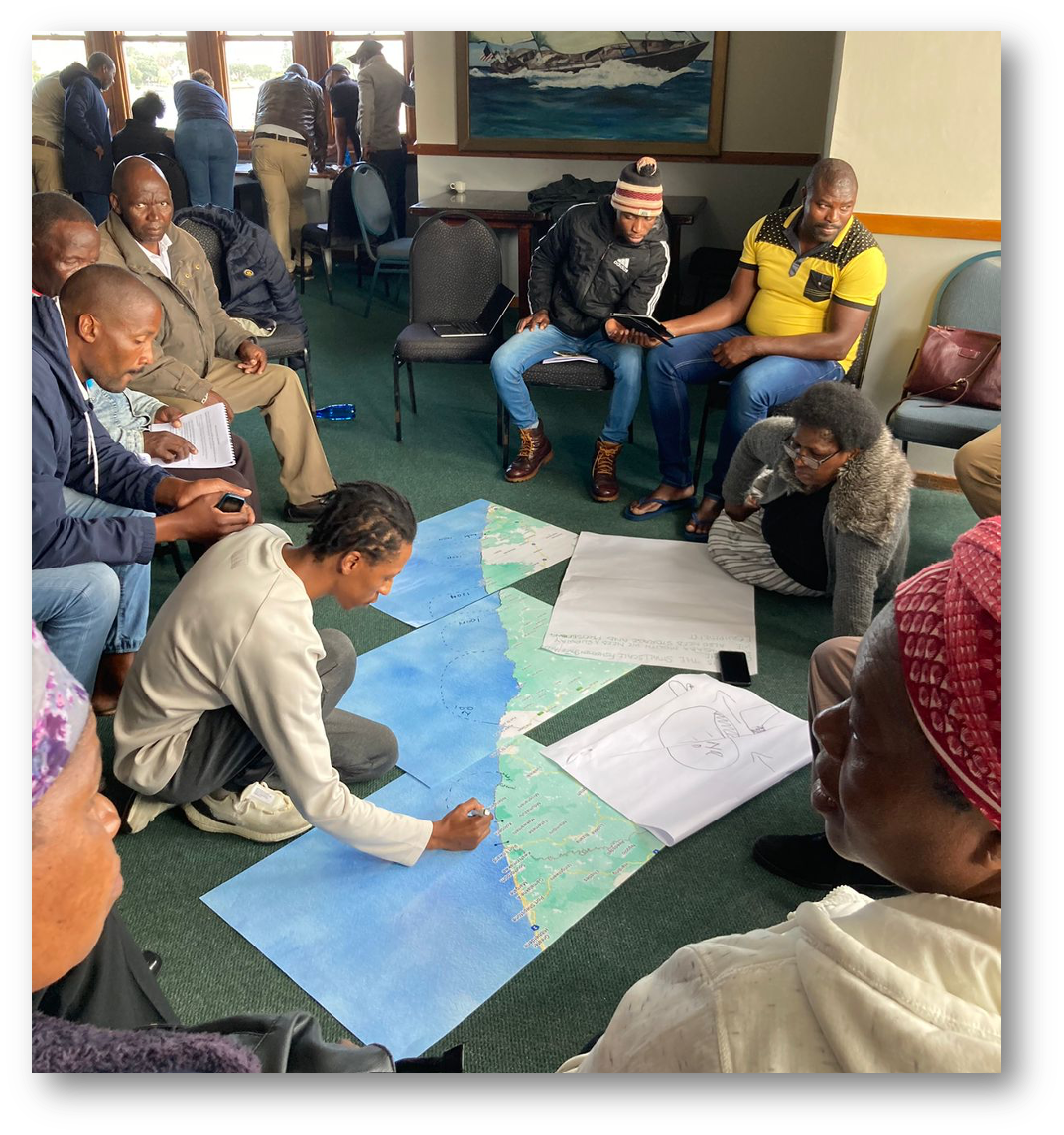
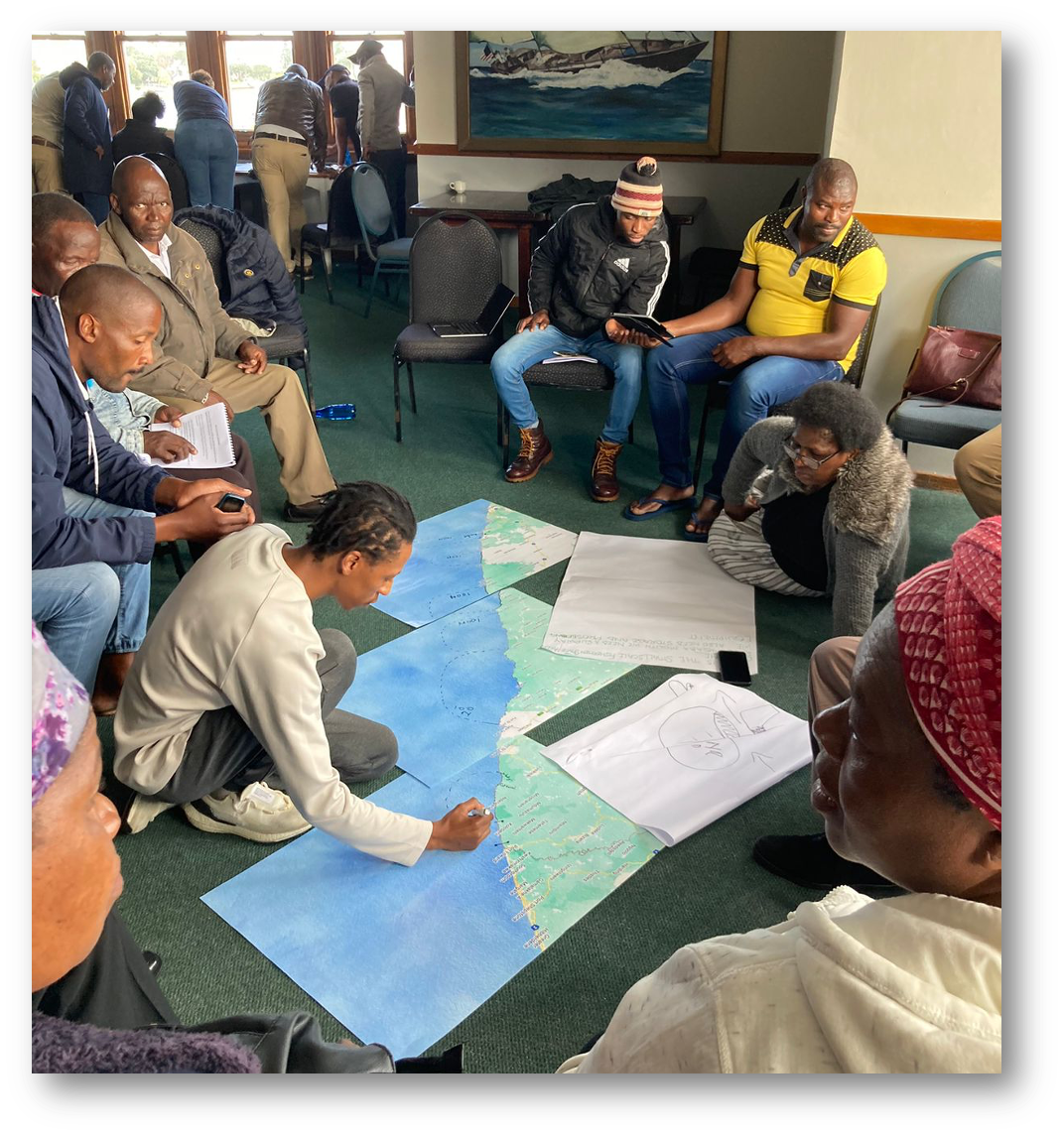
Banner Image: Loyiso Dunga working to map indigenous community cultural connections in the Wild Coast, South Africa. Image courtesy of Loyiso Dunga.
Citations:
Peer, N., Muhl, E. K., Janna, J., Brown, M., Zukulu, S., … Mbatha, P. (2022). Community and marine conservation in South Africa: are we still missing the mark? Frontiers in Marine Science, 9, 884442. doi:10.3389/fmars.2022.884442
Rogerson, J. M. (2017). ‘Kicking Sand in the Face of Apartheid’: Segregated Beaches in South Africa. Bulletin of geography. Socio-economic series, (35), 93-109. doi:10.1515/bog-2017-0007
Feedback: Use this form to send a message to the author of this post. If you want to post a public comment, you can do that at the bottom of the page.
Cite this article
Alexandra Talty (2026). ‘You can’t protect what you don’t know:’ Interview with marine scientist Loyiso Dunga. Mongabay Conservation news. DOI: https://doi.org/10.66709/news-327719

