


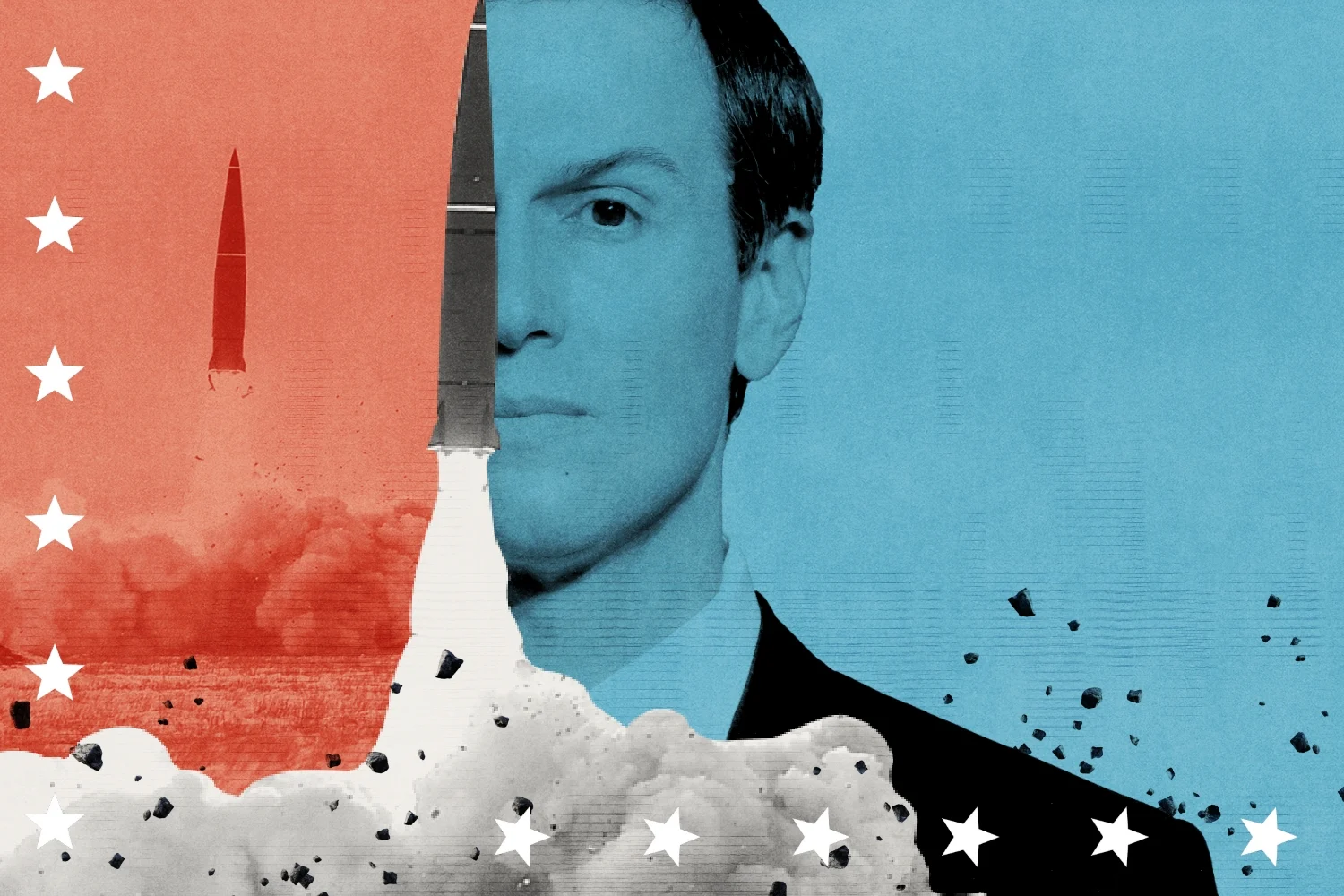
On Nov. 16, 2025, Ukrainian President Volodymyr Zelensky listened on speakerphone to an unfamiliar voice. This new interlocutor, speaking with a reedy U.S. accent, had a plan for Zelensky: a series of bullet points, all approved by the U.S. president, for what Zelensky would have to do to end Ukraine’s war with Russia.
The list of demands ran on and on. There were new limits Ukraine would have to place on its military, preventing Ukraine from ever matching Russia’s battlefield advantages. There was the reality that Ukraine would have to give up any dreams of ever joining NATO. There were the revelations that, even as Ukraine’s ability to defend itself shrank, Russia would see sanctions soon lifted, and that Moscow would once more be welcomed into the geopolitical fold, as if the war had never happened.
On Nov. 16, 2025, Ukrainian President Volodymyr Zelensky listened on speakerphone to an unfamiliar voice. This new interlocutor, speaking with a reedy U.S. accent, had a plan for Zelensky: a series of bullet points, all approved by the U.S. president, for what Zelensky would have to do to end Ukraine’s war with Russia.
This article is adapted from United States of Oligarchy: How America’s Wealthiest Ally with Dictators, Weaken the U.S., and Destroy Democracy by Casey Michel (St. Martin’s Press, 384 pp., $31, August 2026).
The list of demands ran on and on. There were new limits Ukraine would have to place on its military, preventing Ukraine from ever matching Russia’s battlefield advantages. There was the reality that Ukraine would have to give up any dreams of ever joining NATO. There were the revelations that, even as Ukraine’s ability to defend itself shrank, Russia would see sanctions soon lifted, and that Moscow would once more be welcomed into the geopolitical fold, as if the war had never happened.
But that wasn’t all. As this new voice instructed Zelensky, Ukraine would have to finally, formally give up not just Crimea, but all of the Donbas—including territory that Russia hadn’t even occupied. After years of fighting, and after millions of casualties, Ukraine would have to cede territory—and abandon Ukrainian populations—that Russia never conquered.
The proposals were beyond anything Zelensky or his administration had ever heard. They went beyond anything anyone outside Moscow had ever proposed. The demands effectively gelded Ukraine, ensuring that Kyiv would remain forever prone to Russia. Indeed, they read less as a list of negotiated points, and more as a wish list of outcomes straight from the Kremlin.
Which is exactly what they were. Zelensky didn’t know it at the time, but the list of demands had originated not in any Western capital, but in Moscow. And the man unspooling these new demands—Jared Kushner, now emerging from the shadows, taking center stage in the ongoing war between Russia and Ukraine—was there to tell Zelensky that the plan was now Washington’s, and that Kushner was there to make sure the plan was now implemented.
The entire sordid saga of Kushner’s supposed “peace plan” in late 2025 generated immediate headlines and swift backlash. But while many focused on the bungled, haphazard nature of the plan itself—and on how little anyone outside of Kushner and his partner, Steve Witkoff, actually knew about the details ahead of time—there was less attention on the implications of the proposal, or what it meant for the oligarchic takeover of U.S. foreign policy. Because even while Kushner sat there, demanding that Ukraine cede territory Russia had never gained on the battlefield, his surge to the center of the greatest war Europe had seen in nearly a century spoke far more about not just his own future, but about the future of oligarchy in the United States—and what that rise would mean for global stability writ large.

Protesters gather in June in front of the Albanian prime minister’s office in Tirana to demonstrate against the construction of a tourist complex project allegedly linked to Jared Kushner.Adnan Beci/AFP via Getty Images
Take Kushner first. After months of operating largely out of sight, orchestrating hiring and steering policy from the background, the latter half of 2025 saw Kushner step back into the limelight. There were the financial dealings, only growing in scope and import, such as when he partnered with Saudi backers to launch the biggest leveraged buyout the world had ever seen, snapping up the video game company Electronic Arts. There was the government in Albania that fast-tracked Kushner’s latest luxury real estate development, granting him key lands cherished by Albanians—and leading to massive protests in Albania that are ongoing to this day. Most memorably, there was Kushner’s involvement in crafting a so-called ceasefire in Gaza, which granted Israel the right to occupy the majority of the territory—and expedited Israel’s goal of preventing a Palestinian state forevermore.
But all that was a warmup for Kushner’s sudden thrust into leading the United States’ efforts to end fighting in Ukraine. In late October 2025, Kushner and Witkoff huddled in Miami for a multiday meeting with Kirill Dmitriev, a sanctioned Kremlin insider tasked with recruiting Kushner to Moscow’s side. Over a series of “intensive discussions,” Kushner and Witkoff cobbled together a set of supposedly original points to solve the contretemps between Russia and Ukraine.
Read More
-

An illustration shows five fists intermingled with a historical painting of a battle. Behind both, with one eye obscured, is a painting of a man with white hair. An illustration shows five fists intermingled with a historical painting of a battle. Behind both, with one eye obscured, is a painting of a man with white hair. The Deep Roots of Oligarchy
Private contracting is in the DNA of the modern state.
-

A nighttime crowd of cheering people holding up large, flat, light-pink flamingo cutouts mounted on long red poles. In the foreground, a young woman with dark hair and a nose ring smiles widely and shouts with her hand held to her cheek. A nighttime crowd of cheering people holding up large, flat, light-pink flamingo cutouts mounted on long red poles. In the foreground, a young woman with dark hair and a nose ring smiles widely and shouts with her hand held to her cheek. Flamingos Against Autocrats
How a Gen Z-led protest movement in Albania is calling out corruption and global oligarchy.

But as journalists Christo Grozev and Michael Weiss later revealed, Kushner’s supposed peace plan was anything but original. Instead, “many of its most controversial conditions were contained in a document” that circulated out of the Kremlin months earlier. Kushner’s plan, listing all the ways Ukraine would capitulate to Moscow, contained “specific language that appeared almost exactly word-for-word in an earlier text—one drafted solely by Dmitriev,” the journalists wrote.
The two documents in question weren’t precisely identical. Certain clauses were tweaked, while others were expanded or eliminated. But on the whole, as Grozev and Weiss continued, many of the “key concepts” of Kushner’s plan originated not with Kushner, but with the Kremlin. Remarkably, Dmitriev even admitted as much. In a leaked call with another Russian official, Dmitriev reportedly said that he would “informally pass [Moscow’s document] on directly, saying that all this is informal. And they”—that is, Kushner and Witkoff—“can present it as their own.” Which is precisely what happened.

Russian President Vladimir Putin welcomes U.S. special envoy Steve Witkoff (center) and Jared Kushner during a meeting at the Kremlin in Moscow on Jan. 22 in this photo supplied by Russian state media.Alexander Kazakov/APF via Getty Images
If Kushner was merely caught laundering Russian talking points, that would be one thing. But it’s worth pausing on the implications, not just for Ukraine or Russia but for the rest of the globe. Kushner was not only the consummation of the rise of oligarchy in Washington; he was now pushing a plan that threatened to destabilize the world more broadly and ignite a new nuclear age—and a race toward nuclear proliferation unlike anything seen in decades.
It wasn’t just that Kushner, with his father-in-law behind him, was pushing a policy of appeasement, granting an imperialist power the opportunity to garrote a smaller neighbor. It was that, suddenly, there was a new principle of geopolitics staring all of us in the face. With Kushner’s plan, the United States was pledging to recognize a nuclear power’s right to carve up a non-nuclear neighbor. Russia wouldn’t get all of Ukraine, at least not yet. But Moscow would at least get some—some Ukrainian land, some Ukrainian populations—and remain primed to continue its invasion at a later date.
Russia’s nuclear bluffing, in other words, had worked. It was a lesson that wouldn’t be lost on all those non-nuclear powers—Japan and South Korea, Canada and Poland, Kazakhstan and Australia and Germany and many more—staring down nuclear-armed imperialists near their borders. It was a lesson that came straight from the mouth of a U.S. oligarch: an unelected billionaire, subject to no oversight or disclosure requirements, there solely because of his relationship with his father-in-law. There now dominating U.S. policymaking, and much more besides.
There are dozens of other factors that have led to this forthcoming age of nuclear proliferation, from Russia’s imperialism to China’s irredentism to the United States’ strategic myopia and inability to successfully manage alliances. But when the story of this new surge of nuclear powers is written, there will be the rise of a U.S. oligarchy at the center, operating for its own benefit, with little thought for the rest of us or for what its reign may mean for the world—or what remains of it.
Books are independently selected by FP editors. FP earns an affiliate commission on anything purchased through links to Amazon.com on this page.
This post appeared in the FP Weekend newsletter, a weekly showcase of book reviews, deep dives, and features. Sign up here.
