


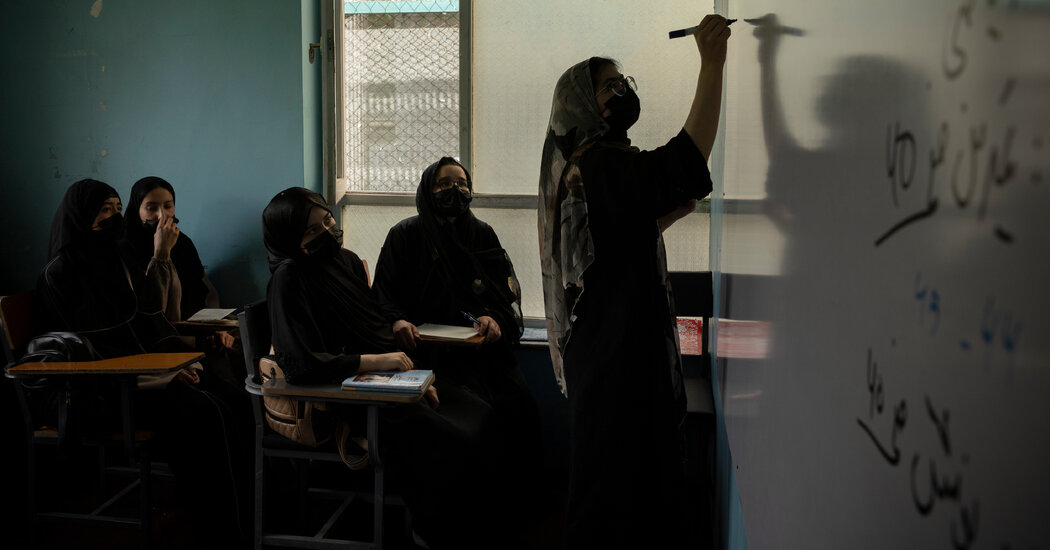
Ayesha goes to a secret school six days a week, mainly to keep seeing people outside her home. It’s the only way to avoid total isolation under Taliban rule, she says. It’s the only way to feel alive.
“Without that connection,” she said, “I don’t know what would happen to me.”
Now 18, Ayesha once dreamed of studying psychology at university. The Taliban ended that dream when they banned formal education for girls beyond sixth grade in 2022.
But Ayesha has been defying the Taliban’s rules for years, sitting in a classroom hidden behind the corridors of a primary school. Thousands of such programs operate across the country under the Taliban’s radar.
Clandestine schools were once seen as a stopgap, a way for girls to keep up with their education until the Taliban were gone. But five years after the Taliban’s return to power, nearly 2.5 million Afghan girls have been locked out of secondary school.
In interviews with more than 50 students, educators, therapists and parents, many said they feared the ban would do permanent damage — to girls and to Afghanistan’s social fabric. All asked to be identified only by their first names, for fear of retaliation.
Even girls who finish their education have few prospects; the Taliban have banned women from most jobs, and opportunities to go abroad are scarce. Reports of suicidal thoughts, self-harm and rates of underage marriage are on the rise, according to teachers and humanitarian organizations.
Nevertheless, some girls refuse to give up their fight for an education.
“We are also part of this society,” Ayesha said. “Just let us be who we want to be.”
The Hidden Passageway
Late one night recently, Ayesha received a text from her friend Zuhal, 17, who said she would not be coming to class the next day. Zuhal’s father had beaten her, saying that there was no point in attending an underground school.
Ayesha recalls crying as she read Zuhal’s message. She has become known among her friends as the one they can confide in, the apprentice therapist. She said she prayed in her bedroom and urged Zuhal to come back. “If you sit at home, it’s finished for you,” Ayesha told her. “Nobody else is going to do anything for you.”
Zuhal returned to school a few days later but said she would be able to come only when her father is away.
Ayesha’s secret classroom is concealed inside an official primary school. The playground is filled with the shouts of younger students, and hundreds of tiny, colorful shoes are lined up at the entrance to the building. But beyond their classrooms, a door leads to a hidden passageway tucked behind a corner, which leads to the secret classroom for older girls.
To avoid detection, the students vary their routes to the school and avoid walking in groups. Still, now and then, the Taliban burst into the school unannounced, as they did one morning in July during Ayesha’s midyear physics exams. The principal locked the students inside, and 14 young women kept scribbling in silence.
The classroom remains undiscovered. On one occasion, when the girls were not at school, the Taliban tore down the artwork on the walls in a common room near the classroom, Ayesha recalled.
“Are they expecting the country to develop by depriving half of the population of education?” said Palwasha, one of Ayesha’s classmates. “We don’t want anything other than the basic rights Islam gave us.”
Only a tiny fraction of girls in Afghanistan can receive a secondary education through secret schools; even fewer, like Ayesha and Palwasha, study an international curriculum and speak English fluently. Palwasha wants to launch her own clothing brand. Ayesha knows she won’t be able to study psychology at a university in Afghanistan when she graduates, so she counsels her classmates.
This is the extent of Ayesha’s social life, and it will vanish in a few months. There is no secret school after Grade 12.
“Girls, you are here now,” Ayesha recalled their teacher saying as they sat down for their midyear exam. “But at this time next year, you will be at home.”
Computer Science and Duolingo
The Taliban have taken credit for one measure of success in education: Primary school enrollment for girls rose from 78 percent in 2021 to 87 percent in 2024, according to UNESCO and UNICEF. That’s mainly because day-to-day security has improved across Afghanistan since the war ended with the U.S. withdrawal in 2021. Schools that had been closed reopened, and crossing a street to reach a classroom no longer presents a daily danger.
But the overall picture is alarming. Nine out of 10 Afghan children age 10 cannot read an age-appropriate piece of writing, according to UNESCO. Only one in four Afghan women is literate. Girls who want to continue their education sometimes face additional obstacles from their families.
Laila, 21, joined a secret school to study computer science and languages two years ago, more than 500 miles from her home in one of Afghanistan’s most conservative provinces. She said she threatened to kill herself if her family did not let her attend.
On a recent morning, she worked on computer science and Duolingo lessons in a clandestine Grade 11 classroom. In the school’s darkened corridors, students walked silently past colorful presentations on the human body and the solar system. Dozens more studied in the basement library.
Laila and hundreds of other girls take in-person classes by day and online by night with volunteer tutors around the world, from the United States to the Netherlands to Hong Kong, most of them high school students in a global network of peer-to-peer support.
Even two years after enrolling, Laila faces surprise visits from her younger brother, who tells her she has dishonored the family by being “so free.” Her father is more open-minded but fears gossip if a relative or neighbor finds out, Laila said.
Laila now speaks four languages fluently, including English, and is learning Korean. If she can leave the country after graduation, she said she will study graphic design in Canada or South Korea.
“I want to share these opportunities with other girls from my province, but I can’t,” Laila said.
During their first rule, between 1996 and 2001, the Taliban banned both primary and secondary education for girls, arguing that secular schools were contrary to their hard-line vision of Islam. They said it was a temporary measure, until they could establish a more compatible education system, but they never did.
After coming back to power in 2021, they made similar claims about the public school system that expanded during the 20-year U.S. occupation, and still maintain that the ban is temporary.
“We hope that one day girls’ schools will reopen,” the Taliban’s spokesman, Zabiullah Mujahid, said in an interview earlier this year. “This situation also deeply affects many officials of the Islamic Emirate who have daughters,” he added, referring to the name the Taliban have given to Afghanistan.
But five years into their second rule, the temporary ban once again appears permanent.
The ban comes directly from Kandahar, the group’s seat of power in the south and home to its secretive leader, Sheikh Haibatullah Akhundzada. Many Taliban officials privately say it should be lifted, but no one challenges their leader’s order.
In practice, many Taliban turn a blind eye to schools operating in secret. The principal at one secret school, where some girls pay fees if their families are able, said he had enrolled the sons of Taliban intelligence officers for free to maintain a cordial relationship.
They know Laila’s school well: Taliban police and intelligence officers visit weekly to ensure that female students wear their hijabs correctly and don’t mix with boys, who attend the same school legally.
But they can order the school shut at any time. All schools in Afghanistan, even religious schools, which are permitted for older girls, face an array of rules and frequent, sometimes surprise, inspections.
When they see the Taliban approach, the guards at Laila’s school warn the teachers and the principal by walkie-talkies and then sound a distinctive bell to alert the students.
Najib, the school principal, said that when he asked some unfamiliar Taliban officers to show him their ID on a recent visit, one shouted, “My ID is my gun.”
“And my gun is my pen,” Najib said he replied. He cited Quranic verses about the imperative to educate all children, and that seemed to satisfy them.
The Taliban left.
Failing in Order to Succeed
Many younger Afghan girls try to delay as long as possible what Ayesha and Laila are going through.
In December, Somaya, 12, took her sixth-grade final exams but skipped the tests in Dari language, social studies and Quran studies, hoping to fail and repeat her final year.
“I love going to school,” she said. “I simply wanted to stay.”
Weeks later, Somaya’s teacher told her she could come back. There was only room for her in Grade 4, so she sometimes helps teach since she already knows the curriculum.
Fatima, 12, a student at another school, tore up her final sixth-grade tests last year, hoping that her teachers would fail her and let her repeat the grade. But they passed Fatima anyway, she said.
As Fatima spoke softly in her family’s living room in Kabul, her father, Azizullah, wept and left the room.
“I cry when I think about how often she says she wants to be a doctor, and how now it’s all over,” Azizullah said.
But Fatima bounced back. Weeks later, she passed an entrance exam for an underground school.
Tasnim, a primary schoolteacher, said she leaves the farewell parties for her Grade 6 students because she can’t bear seeing them cry. She no longer has an answer when they ask her, “What was this all for?”
When her own daughter, Kowsar, completed sixth grade, Tasnim convinced a colleague to take her into her class so she could repeat by taking the spot of an absent student.
Her daughter’s graduation certificate reads “Successfully promoted to Grade 7.”
“We try to make them happy,” Tasnim said. “But there’s no Grade 7.”
Dreaming of the Taliban
The restrictions on women and girls are the primary reason the world has shunned the Taliban, but they have promoted religious schools, or madrassas, as an alternative. The girls in those schools must wear black coverings from head to toe, and they are allowed to study science and English as well as religious subjects.
Zala, a sixth-grade student, plans to enroll in a religious school after leaving primary school. “At least we still have an opportunity to keep studying,” she said.
Ezat, Ayesha’s principal, recently turned the school where her classroom is hidden into a madrassa to ease pressure from the Taliban. He said he hopes teachers can keep providing what he described as a “modern education.”
To what extent and for how long, he does not know.
After the Taliban formalized their ban on education in 2022, many teachers were left without jobs. They kept teaching for free, or for smaller salaries at schools that remained open, or in underground classes across the country.
Many say they feel disillusioned.
At a recent staff meeting, employees in a secret school in Kabul talked about how to keep motivating students. “But who is motivating us?” Kamela, one of the teachers, remembered thinking.
“I see the Taliban in my dreams,” she said. “They’re running after us, beating us and closing the school.”
