


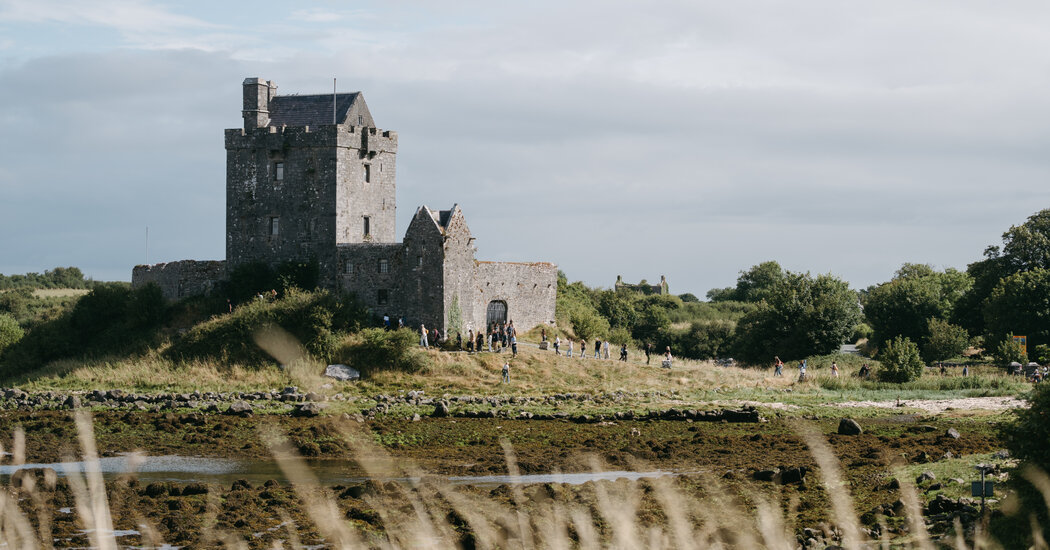
The tourists come by the busload, disgorging from motorized behemoths that seem improbable for many Irish roads. With cellphones at the ready, they head for the photogenic Dunguaire Castle, a majestic 16th-century bastion rising beside a swan-favored corner of Galway Bay.
Overlooking the sea-scented village of Kinvara, Dunguaire (pronounced doon-GWEER-ah) could well be Ireland’s most photographed castle, its image in countless brochures and promotions. But a sign on the entrance gate suggests that Ireland, known as the land of 100,000 welcomes, might have to reduce that number by at least one: “CASTLE & GROUNDS CLOSED TO THE PUBLIC.”
There to say hello instead one recent morning was Fran O’Reilly, a retired researcher wearing a broad-brimmed hat as protection from the day’s Irish rarity of sustained sunshine. In her hand was a document featuring a QR code that, when scanned, opened to a prewritten email of disappointment, already addressed to various government officials, to which visitors could add their own words of dismay.
With the zeal of a seasoned campaigner, Ms. O’Reilly approached clutches of puzzled tourists to explain that not long ago, the castle was open for tours and banquets — until, she said, government officials got in their own way.
“About three years ago, they had a fight about money, and instead of sorting it out, they closed the gate,” she told a family from France. “So people like you, thousands of people every week, come from around the world to see this castle, and can’t.”
One of the French tourists scanned the QR code to join an effort that, at last count, had convinced 2,400 people from more than 50 countries to send missives of disenchantment to the powers that be. A quick perusal showed notes from a tour operator in Denmark, a study-abroad program director in the United States and many, many disgruntled Irish people.
“This place is one of the reasons that tourists come here, and what do they find: Ireland is closed,” one wrote.
When asked about the status of Dunguaire, the Shannon Airport Group, the government entity that owns the castle and closed the site in 2023, forwarded a brief statement that said, in part: “Relevant parties are actively exploring options for the future ownership and stewardship of the site with a view to securing its long-term protection and conservation. As these discussions remain ongoing, it would be inappropriate to comment further at this stage.”
For Ms. O’Reilly, member of a grass-roots group called Save Kinvara Castle, the statement was as vaporous as the exhaust fumes of the idling buses near the tower. “So this petition is a way of trying to say, ‘Enough,’” she said. “‘Get on with it.’”
The castle’s name translates as “fort of Guaire,” a seventh-century king. Technically a tower house, the structure was built around 1510 by the ruling O’Hynes clan as a defensive lookout and residence, but transformed over time into a symbol of permanence as integral to Kinvara’s identity as the sea.
From the outdoor seating at establishments along the quay — Connolly’s pub, perhaps, or the Pier Head restaurant — visitors can sit and, glass in hand, consider how the 75-foot tower has been a stone-silent witness to the evolving Irish story.
It was there, defining the horizon, as a place with a few crude buildings developed into the busy port of Kinvara. As the potatoes were harvested, the seaweed collected and the main street bustled on market days. As tenant farmers chafed under British landlords. As famine struck.
The mid-19th century calamity known as the Great Hunger devastated Kinvara with evictions, emigration and death. In a cow field a short walk from the castle, a modest monument marking the mass graves of hundreds features a prayer in Irish that translates as “May they all have a bed in Heaven.”
A diminished Kinvara took generations to recover, but life continued. In the castle’s shadows, people watered their horses, repaired the red sails of their single-masted Galway hookers and gossiped in forever-pubs like Green’s, where the weight of whiskey still sags the shelves. Some fought in the war of independence early in the 20th century, even tearing down the British police barracks on the main road, then endured the civil war that followed.
After the author and poet Oliver St. John Gogarty took possession of the castle in the 1920s, the building became a gathering place for the literary lights of the Celtic Revival. Then, in the 1960s, the building came into the hands of Lady Ampthill, who had once rocked British society with a divorce centering on an unconsummated marriage and a “virgin birth.”
John Conneely, a retired teacher steeped in local history, recalled seeing her ladyship riding sidesaddle in the fields and driving into the village with her two hounds beside her. Ever aware of her elevated station — she once referred to local residents as “natives” — Lady Ampthill is nevertheless credited with completing a restoration of Dunguaire before selling the castle in the early 1970s to a government entity overseeing regional tourism, a forerunner of the Shannon Airport Group.
“Otherwise, the castle would have fallen down,” Mr. Conneely said.
Dunguaire looked on as ancient pubs closed and chic cafes opened, as the local hotel became a refuge for asylum seekers, as the annual boat festival brightened the bay with red sails. As Granny Brogan kept watch from her candy shop window, and as a white-bearded German fisherman, Rainer Krause, rowed out from the pier every morning, for decades, in search of mackerel.
For most of the last half-century, Dunguaire was open to the public, offering tours, lectures and medieval banquets. It became an obligatory stop for visitors touring the West Coast of Ireland, a way station between the city of Galway and the Cliffs of Moher.
Several years ago, the Shannon Group, later rebranded as the Shannon Airport Group, worked out deals to transfer ownership of various tourist sites under its aegis to local authorities. Clare County Council took over Bunratty Castle. Limerick County Council took over King John’s Castle. But a similar plan to have Galway County Council acquire Dunguaire became mired in a bureaucratic bog, and the castle was closed.
So began years of structural assessments, financial projections and back-and-forth discussions, all rooted in Galway County Council’s refusal to take ownership without significant government funding for a nearly $6 million restoration.
Michael Owens, director of services for Galway County Council, said in an email that while the council did not have the “financial capacity” to reopen the landmark, officials recognized the castle’s historical value and “potential to serve as a critical tourism driver.” He also said that the national Department of Housing, Local Government and Heritage was now “exploring the acquiring of title.”
But the talks have yet to open Dunguaire’s doors, leaving the Galway county councilor Geraldine Donohue to imagine the deterioration being caused by the lack of proper maintenance.
“Here we are, going all over the world promoting Ireland and how wonderful we are,” Ms. Donohue said. “And yet we can’t get together five million to open one of the most iconic, most photographed castles in the world.”
“We’re not asking you to build the castle,” she said. “It’s built!”
Outside Dunguaire, members of Save Kinvara Castle continued their campaign to shame the government into action. At his station near the locked gate, Eamonn Coy, a retiree, worked the economics angle, saying that tourism was essential to Kinvara, which has just 800 residents.
“The idea that we turn our backs on that is utter stupidity,” Mr. Coy said of the potential earnings.
Ms. O’Reilly greeted tourists disembarking from buses and cars in the dusty parking lot. She emphasized the lost opportunity — the missed chance to step back in time — to a pair of Canadian tourists who agreed that a banquet at the castle might have been worth staying the night.
The Canadian visitors walked up to the soaring monument of Ireland’s past, vacant now, save for the ghosts. On the other side of the padlocked gate, overgrown grass lapped against a portal that once led to souvenirs and the 16th century.
Then, like so many before them, they returned to their vehicle and headed on to the more welcoming Cliffs of Moher.
