


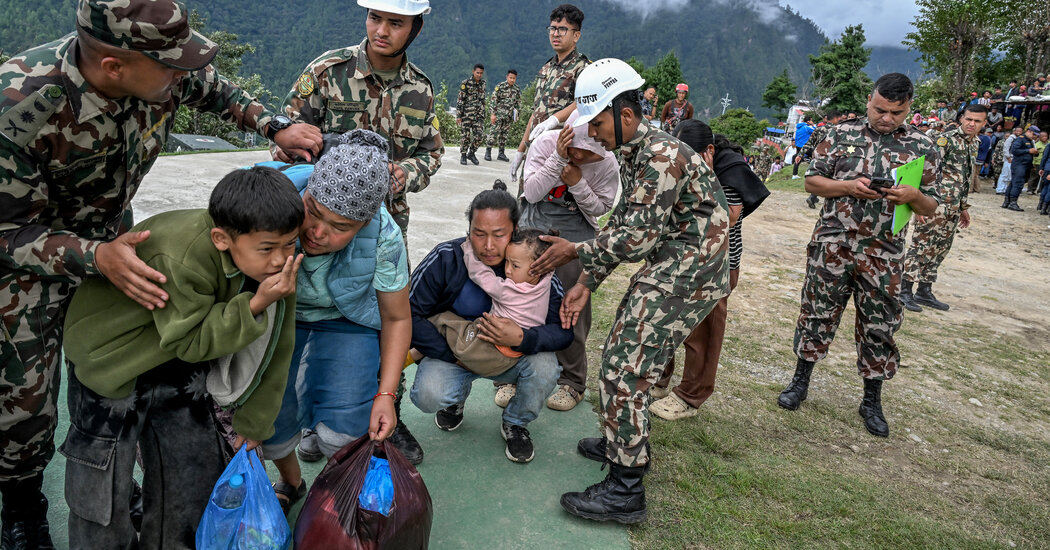
It’s not yet clear how many lives were lost when floodwaters tore through northern Nepal on Wednesday. But the scale of the destruction — at Nepal’s border with the Tibet region of China and along the gorges of the Bhotekoshi and Trishuli Rivers — can already be seen from the air and felt on the ground.
“Thoughts first for human life,” Kanak Mani Dixit, a famous Nepali publisher, wrote on social media, “then infrastructure along the Bhotekoshi-Trishuli.”
Twenty-five miles of roads were erased, according to the Department of Roads, stranding a quarter of a million Nepalis who live in the most affected districts as if they were on a desert island, as an Indian diplomat put it.
The flood transformed winding riverside roads into a bleak mud flat. Bridges were washed away, including 40 suspension crossings. Phone lines and cellular towers are now down, along with electricity for the homes that survived.
The affected region has been the workhorse of Nepal’s hydroelectric industry. On Wednesday, the Ministry of Energy, Water Resources and Irrigation published a memo describing some of the power generation, transmission and distribution resources that were knocked out, including 14 hydropower projects, several still under construction. India’s foreign ministry said it had been unable to locate 63 Indians who were working on the Trishuli-1 project, constructing a hydroelectric plant.
Mr. Dixit said now was not yet the time to assess the catastrophic damage done to Nepal’s economy. Power generation, for example, is of longer-term importance, while people made homeless need aid immediately — and much more than what is now being ferried in by helicopter.
Keshav Sharma, who was Nepal’s secretary for physical infrastructure and transport until March, said helicopters, though essential in the first day or two after a disaster, soon “will be insufficient.”
“Transport is the basis for all rescue,” Mr. Sharma said. “If we need to supply food and grains and fuel, even generators, road transport will be essential.” Heavy machinery will be needed to carve even minimal tracks to population centers along the rivers. Then modular bridges could be installed to cross them.
Last summer, after a smaller flood, Mr. Sharma said he arranged for China to replace one damaged bridge, and India donated 10 modular bridges in the first phase of recovery.
Mr. Dixit noted that Nepal had its own strong experience in relief work and had “effective, elected local governments” that can contribute to emergency operations. He added that “the Nepal Police, Armed Police Force, as well as the Army are geared up for disaster response.”
The provision of energy could prove an urgent challenge.
Liquefied gas became a rarity in Nepal’s villages years ago, even before the U.S. war with Iran created shortages across Asia. In 2015, during a diplomatic spat with India, Nepal found its entire supply of gas held up at the border.
The shortage of gas has been one of the factors that sped up Nepal’s effort to build its giant hydroelectric power projects, many with Chinese backing. Those projects have, in turn, made it possible to export spare energy, especially to Bangladesh, and convinced many Nepalis to buy electric vehicles.
After the disaster in northern Nepal on Wednesday, about 10 percent of the country’s total hydroelectric capacity was taken offline, but power has remained uninterrupted in the area around the capital, Kathmandu.
Nepalis who switched to electric induction stovetops in recent years, like Surajan Pokharel, a licensed tour guide based in the capital, said they are not worried. It is the monsoon season, and they expect there should be enough water in reservoirs to generate sufficient electricity to make up for the losses.
But high in the narrow valleys of the Bhotekoshi and Trishuli Rivers, without gas or electricity, it could be a different story. Mr. Sharma said the coming week would be critical for building roads needed to provide emergency energy supplies.
Mr. Pokharel, who has toured the upper valleys extensively, expects locals will be gathering firewood from the forest until then.
