


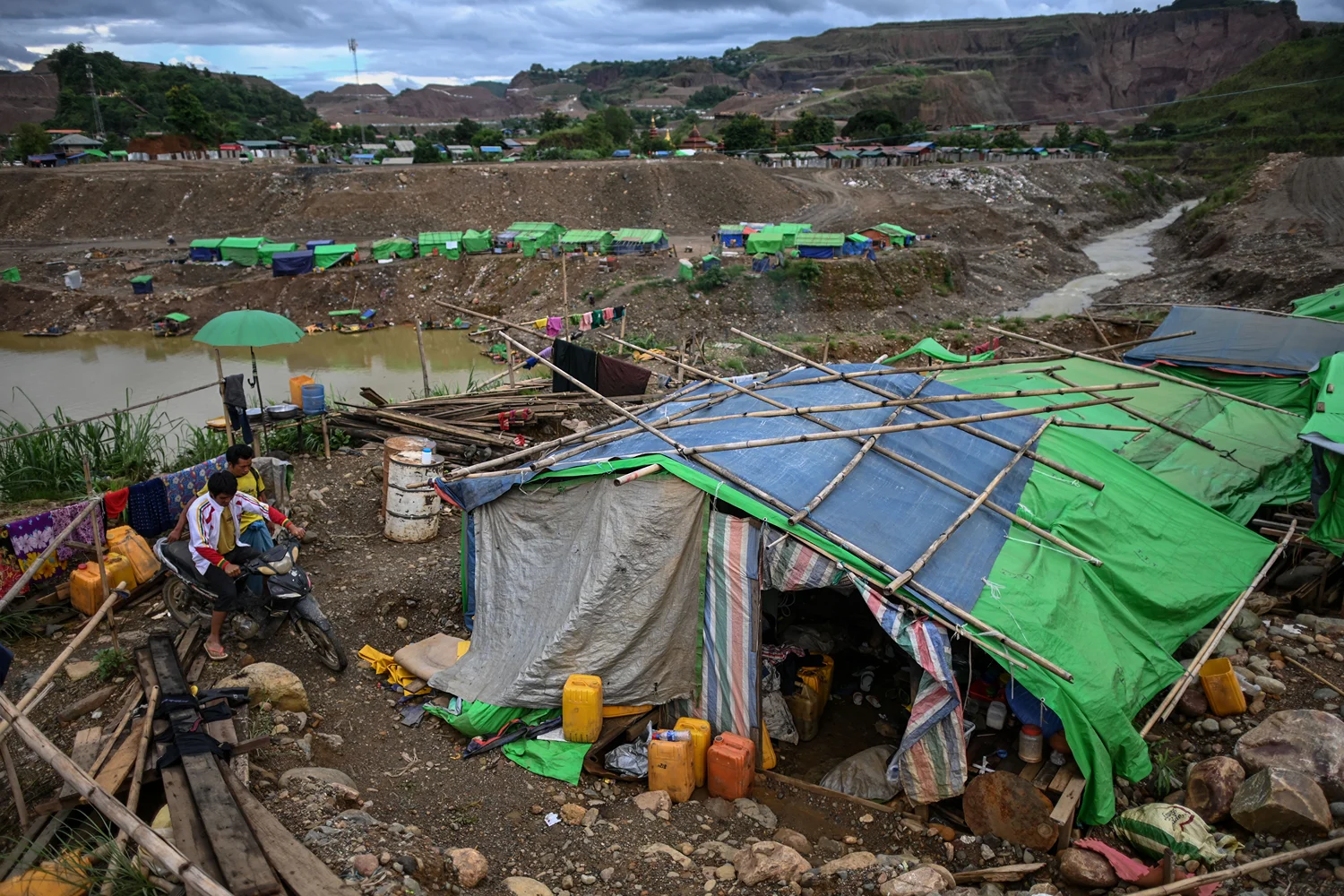
Rare earths help make the world cleaner, smarter, and more connected. But in Myanmar, their extraction leaves behind poisoned rivers, scarred hillsides, dispossessed communities, and rising health risks. Supply chains centered around China are pulling heavy rare earths from Myanmar’s conflict zones, revealing a larger shift: Extraction of strategic resources no longer necessarily depends on stable governments or consolidated state authority. In some places, supply chains can adapt to the fragmented political order that war produces.
The Kachin Independence Army, one of many groups fighting Myanmar’s central government, seized Pangwa, the hub of Kachin state’s rare-earth industry, in 2024. But instead of severing the supply chain, it simply put control of a critical point in new hands. Production has continued almost unimpeded.
Rare earths help make the world cleaner, smarter, and more connected. But in Myanmar, their extraction leaves behind poisoned rivers, scarred hillsides, dispossessed communities, and rising health risks. Supply chains centered around China are pulling heavy rare earths from Myanmar’s conflict zones, revealing a larger shift: Extraction of strategic resources no longer necessarily depends on stable governments or consolidated state authority. In some places, supply chains can adapt to the fragmented political order that war produces.
The Kachin Independence Army, one of many groups fighting Myanmar’s central government, seized Pangwa, the hub of Kachin state’s rare-earth industry, in 2024. But instead of severing the supply chain, it simply put control of a critical point in new hands. Production has continued almost unimpeded.
Myanmar accounts for an estimated 16 percent of global rare-earth mining output, and it may supplies nearly half of global production of heavy rare earths, which are critical for the defense industry and green energy. Most are extracted in Kachin and shipped across the border for processing in China, which dominates downstream refining and manufacturing.
Political instability is generally perceived as a risk to mineral supply. Yet cases such as the conflict-torn eastern Congo show that strategically important minerals continue reaching international markets even during wartime. Myanmar extends this logic to rare earths, confirming that supply chains can adapt to conflict and, in some cases, even take advantage of the fragmented authority it produces.
Beijing does not rely solely on Myanmar’s central government. Chinese actors also engage with military authorities, ethnic armed organizations, local militias, borderland elites, provincial officials, and business intermediaries. Conflict does not stop extraction; it changes who controls it, who profits from it, and who bears its costs.
Heavy rare earths are both strategically indispensable and environmentally destructive to extract. As China tightened environmental regulation at home from the 2010s onward, some of the most damaging mining activity shifted into northern Myanmar, where weak oversight, armed conflict, and proximity to the Chinese border made extraction easier. Once mined, the minerals are mixed with material from other sources during transport, processing, and refining, making it extremely difficult for governments, manufacturers, or consumers to determine the origin of the components used in technologies that are marketed as part of the green transition.
Neither the 2021 military coup nor the ensuing civil war in Myanmar has shifted China’s strategic interests there. Beijing has continued to prioritize access and project security regardless of which actor controls a particular area. Operations at the Letpadaung copper mine and the oil and gas pipelines, for example, resumed or continued under greater military protection after the coup. These projects have generated resentment over land confiscation, environmental damage, militarization, and unequal benefits, but they also demonstrate the resilience of Chinese-linked infrastructure and extraction, which has proved highly adaptable.
That adaptation is most visible in northern Myanmar, where overlapping systems of authority involving ethnic armed organizations, military-linked actors, militias, brokers, local business elites, and Chinese intermediaries oversee the extraction of rare earths. Different groups control mining areas, checkpoints, taxation systems, and transport corridors. Satellite investigations have identified roughly 400 rare-earth mining sites in Kachin state, concentrated particularly in Chipwi and Momauk townships, while reporting from areas controlled by the Kachin Independence Organization (KIO) points to continued expansion.
The KIO now controls Kachin state’s rare-earth industry after its armed wing captured Pangwa from military-affiliated militia and border guard forces. Mining revenues finance both military operations and public services in areas under the organization’s de facto administration, while the KIO also provides support to the broader Spring Revolution. As a result, production costs have increased; Chinese investors are cutting labor costs or moving to other locations in Shan state, including regions controlled by ethnic armed groups like the Ta’ang National Liberation Army (TNLA), United Wa State Army (UWSA), and National Democratic Alliance Army (NDAA), as well as areas near the Thai border and Laos. But mining is still continuing.
This creates a difficult trade-off: The extraction that sustains resistance and local governance also causes environmental damage that may undermine the KIO’s claims of responsible rule. Although the organization said that it has introduced mining, environmental, labor, and occupational-safety regulations, miners have reported that enforcement remains weak.
Rare-earth mining has also expanded into parts of Shan state controlled by the UWSA and NDAA, raising concerns about cross-border pollution in northern Thailand. The threat to rivers, public health, and local livelihoods has prompted growing criticism from Thai communities, civil society groups, and academics, including a recent protest outside the Chinese Consulate in Chiang Mai that Thai police dispersed, which left two protesters injured.
The most common extraction method, in-situ leaching—injecting chemicals directly into the ground to dissolve minerals bearing rare earths—is relatively cheap but carries major environmental risks. Pollution from mining areas has entered tributaries feeding the Mekong, Irrawaddy, and Salween rivers. In northern Thailand, for example, the Kok River was found to contain extremely high levels of arsenic, and communities downstream have reported discolored water, declining fish stocks, sick elephants, and restrictions on using river water for drinking or agriculture.
Communities living near mining areas bear the brunt. They face exposure to contaminated water, polluted soil, and unsafe working conditions. Workers frequently perform hazardous tasks involving toxic chemicals for low wages and with little or no protective equipment, and cases of sexual exploitation involving women workers have also been widely reported. Accountability mechanisms are weak or entirely absent. Local communities bear the long-term environmental costs while Chinese investors capture most of the profits.
These consequences are not unique to rare earths. The Letpadaung copper mine, for example, became associated with violent crackdowns on protesters, forced evictions, and allegations that local communities bore the environmental and social costs while military-linked and foreign actors captured most of the economic gains. However, conflict and fragmented authority can deepen these risks by dispersing the responsibility among multiple actors, making it unclear who is responsible for enforcing standards and compensating affected local communities.
Myanmar exposes one of the central contradictions of the global energy transition. The technologies meant to power a greener and more sustainable future are frequently built on extraction systems embedded within civil war, fragmented governance, environmental destruction, and coercive political economies.
This may represent an emerging model for how strategic extraction increasingly functions in parts of the 21st-century global economy. A similar dynamic is visible in eastern Congo, where M23’s capture of the Rubaya mining area in 2024 did not halt the coltan trade. U.N. experts documented the group monopolizing exports from the area through Rwanda. As in Myanmar, territorial control changed without severing the commodity chain.
Together, Myanmar and eastern Congo illustrate a broader pattern: Conflict does not always interrupt strategic supply chains. In some cases, they adapt to conflict, move through it, and even depend on the forms of fragmented authority that war produces. Western governments increasingly demand “clean” supply chains while remaining structurally dependent on extraction systems that they have little ability, or willingness, to regulate.
Myanmar shows why conflict itself must be treated as part of supply chain governance rather than merely as an external disruption to it. Otherwise, the world risks building a cleaner future on poisoned rivers, militarized borderlands, and communities that are left to absorb the costs of someone else’s sustainability.
