


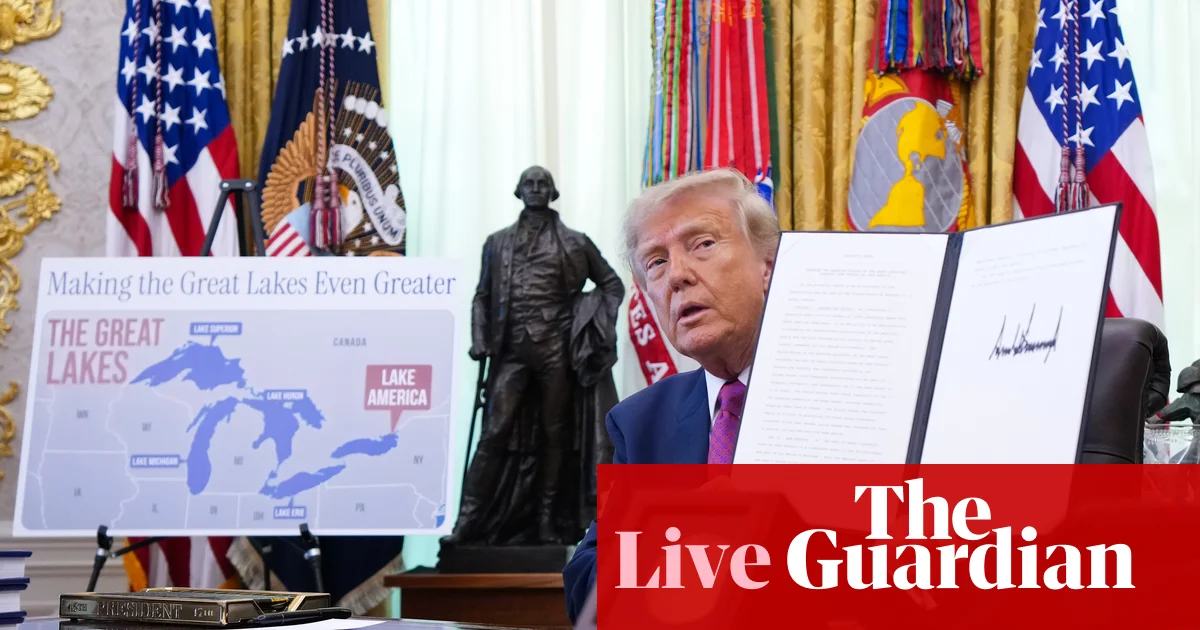
Trump signs order to rename Lake Ontario as ‘Lake America’
Donald Trump summoned the press pool to the Oval Office to witness him signing an executive order that directs the Department of the Interior to rename Lake Ontario as “Lake America”.
This comes after trade talks between Canada collapsed over the weekend and led to a fray of tariffs between Washington and Ottowa.
Trump claimed the name change was something “I’ve been thinking about for a long time”.
“Canada treats us very badly,” the president said. “People oftentimes they’ll ask me who’s the worst to deal with on trade, and I said that’s easy. Canada, they are the worst, and they feel entitled, and just we can’t have that.”
A 50% tariff on several Canadian imports kicked in on Saturday, with Trump threatening another round of 50% duties on Canadian steel, trucks, cars and auto parts to take effect in the new year. Mark Carney, Canada’s prime minister, hit back with 25-50% tariffs on hundreds of US goods.
This, of course, is not the first time the president has made renaming a body of water a priority. At the beginning of his second term in office he issued an executive order to rename the Gulf of Mexico to the “Gulf of America”.
Trump appeared to joke that there could be more to come: “We have a Gulf and we have a Lake – now all we need is an ocean. Maybe we’ll have to change the name of the Atlantic and/or the Pacific. Maybe we’ll change them both.”
Key events
Canada drops US seafood from sweeping tariff list
While the US and Canada continue to escalate a tit-for-tat trade war, Canadian officials have opted to back down from tariffs on a particular American export: seafood.
In a social media post on Thursday, Canada’s Department of Finance said it would remove seafood and fish products from a slate of counter-tariffs prepared against the United States. Canadian officials said the move was intended to “protect against broader economic harms”, even as the nation retaliates against the new US duties.
After a tentative deal between the two nations fell apart last week, US tariffs against Canada took effect, and Canadian authorities responded in kind.
Susan Collins, a Republican Senator from Maine facing a competitive re-election race this year, said in a social media post that she was grateful to the Canadians for pulling back from seafood tariffs. If imposed, she said, such a measure would have been devastating to her state’s lobster industry.
“I urge the US to respond to this show of good faith from our Canadian friends by returning to the negotiating table and working to amicably resolve this trade dispute,” Collins wrote.
Chuck Edwards, the North Carolina Republican facing a censure vote in Congress over allegations that he sexually harassed a pair of staffers, has issued a letter urging his colleagues to reject the disciplinary measure.
A report early this month by the House ethics committee recommended Edwards’ censure on the grounds that he’d engaged in inappropriate conduct toward a pair of young female staffers. That conduct, according to the committee, included sending lavish gifts and affectionate notes to the women, as well as inviting them to “intimate dinners and vacations”.
Edwards, in a letter dated earlier this week, said the committee –which argued the congressman’s actions made the women feel uncomfortable and pressured – overstepped in equating his conduct to misconduct or sexual harassment.
“An affectionate friendship is not a sexual proposition,” Edwards wrote. “A gift is not sexual misconduct. A compliment is not sexual misconduct. Poetry is not sexual misconduct. Socializing with a colleague is not sexual misconduct. Caring deeply about someone with whom you have worked and come to know for years is not sexual misconduct.”
In light of the committee’s findings, Edwards abandoned his campaign for reelection earlier this month. North Carolina Republicans selected Jennifer Balkcom, a member of the state’s House of Representatives, as the party’s replacement nominee for the general election.
Trump insists that Putin will ‘not be attacking a Nato territory’ as speculation circulates after CIA director’s visit to Moscow
Donald Trump told reporters today that he’s had “good talks” with Russian president Vladimir Putin, and insisted that “he’s not going to be attacking a Nato territory”.
This comes after speculation continues to circulate around CIA director John Ratcliffe’s covert visit to Moscow this week, and reports that have emerged that say the spy chief’s trip was expressly to convince Putin to not take action against Nato allies.
Trump signs order to rename Lake Ontario as ‘Lake America’
Donald Trump summoned the press pool to the Oval Office to witness him signing an executive order that directs the Department of the Interior to rename Lake Ontario as “Lake America”.
This comes after trade talks between Canada collapsed over the weekend and led to a fray of tariffs between Washington and Ottowa.
Trump claimed the name change was something “I’ve been thinking about for a long time”.
“Canada treats us very badly,” the president said. “People oftentimes they’ll ask me who’s the worst to deal with on trade, and I said that’s easy. Canada, they are the worst, and they feel entitled, and just we can’t have that.”
A 50% tariff on several Canadian imports kicked in on Saturday, with Trump threatening another round of 50% duties on Canadian steel, trucks, cars and auto parts to take effect in the new year. Mark Carney, Canada’s prime minister, hit back with 25-50% tariffs on hundreds of US goods.
This, of course, is not the first time the president has made renaming a body of water a priority. At the beginning of his second term in office he issued an executive order to rename the Gulf of Mexico to the “Gulf of America”.
Trump appeared to joke that there could be more to come: “We have a Gulf and we have a Lake – now all we need is an ocean. Maybe we’ll have to change the name of the Atlantic and/or the Pacific. Maybe we’ll change them both.”
Trump administration officials are seeking to radically accelerate the deportation of hundreds of thousands of Haitians who were previously living in the US under the aegis of a humanitarian program, according to documents obtained by The New York Times.
The Times reports that the administration is seeking to start deportation flights to Haiti weekly – as opposed to its previous pace of once a month. If put into effect, that could increase the number of Haitians flown out of the country by hundreds of people per month.
The Trump administration has deemed the island nation safe enough for those who fled it to return, even as the country remains mired in anarchy and gang conflict. The violence there has led the administration to reroute deportation flights away from the embattled Haitian capital of Port-au-Prince, to a smaller city 120 miles away.
The more than 300,000 Haitians slated for removal from the country were previously allowed to work and reside in the US under Temporary Protected Status. But President Trump has taken aim at their inclusion in that program since early in his second term, and was able to terminate it for Haitians after a June supreme court ruling cleared the administration’s path.
Trump’s war on Iran is rapidly draining US navy budget, documents and interviews reveal
Aram Roston
Donald Trump’s war on Iran has driven the US military into a severe financial crisis, with the US navy forced to transfer money from its payroll and other sources to cover the costs of combat, according to documents obtained by the Guardian, and interviews with navy officials, contractors and defense analysts.
The US-Israeli operation, which has depleted US munitions stockpiles and prompted retaliatory Iranian strikes that have wrecked strategic bases across the Middle East, is piling pressure on budgets across the military.
One Pentagon memo about navy funding seen by the Guardian warns that there are “shortfalls in payroll” accounts due to the department “raiding” them to fund combat operations.
Experts and former officials say the accounts are running dry. “The piggy bank is broken,” said Harlan Ullman, a retired naval officer. Ullman is a member of the National Commission for the Future of the Navy but he said he is not speaking on the commission’s behalf.
One official and one navy contractor said non-emergency maintenance on shore-based facilities has been deferred because of the cash crunch.
A navy official who was briefed on how the service is planning to address the shortfalls said money is shifted around in imaginative ways. “The money for payroll,” he said, “was robbed to pay for overseas contingencies and is being backfilled by money that hasn’t been spent. They are backfilling payroll so we get enough money in our paycheck.”
Read the full report here:
US facing ‘beyond critical’ shortage of Patriot missile stocks in Europe due to Iran war – report
The US military is experiencing a “beyond critical” shortage of advanced missile interceptors in Europe largely driven by Donald Trump’s war against Iran, a US defense official in Europe and a Nato official have told the Associated Press, raising concerns about vulnerabilities in Nato countries to a potential Russian attack.
The US defense official told the AP the most concerning shortfall involves Patriot missile interceptors, which can shoot down Russia’s high-speed ballistic missiles.
In the event of a Russian ballistic missile assault on, for example, a military headquarters or power plant, Nato could be in a similar position to Patriot-starved Ukraine and be forced “to take punch after punch in the mouth”, they said.
The Nato official confirmed the low inventories of Patriots among US and Nato forces in Europe. The US military “definitely” does not have enough Patriots in Europe to stop any possible sustained ballistic missile attack and would have “very limited” capability to defend against a single ballistic missile strike or a stray Russian missile that goes off course, the US official added.
Though a Russian ballistic missile attack against Nato countries is not imminently expected, this report comes as CIA director John Ratcliffe reportedly went to Moscow this week to dissuade Russia from attacking Nato members amid US intelligence assessments that Moscow could seek to test the alliance.
Trump has played down the significance of the rare and secretive trip, insisting it was “sort of semi-routine”.
European and Nato officials say Russia could be in a position to attack countries in the alliance by 2030. Patriot stockpiles are projected to rebound by then.
In the meantime, Russia’s war in Ukraine could hinder its ability to carry out any missile attack on Europe as it would be a challenge for Moscow to fight an air war on two fronts.
The state department said today that 90 Americans were missing after the devastating flash flooding in Nepal, adding no US deaths had been reported.
“We’re currently tracking 90 Americans who may be impacted by the flood, currently unaccounted for,” a spokesperson told AFP.
The state department said it could confirm three Americans had been rescued and it was not aware of any US deaths.
My colleague Tom Ambrose is covering the disaster:
House Democrats launch investigation into Donald Trump Jr’s venture capital firm
Democrats on the House judiciary committee have launched an investigation into Donald Trump Jr’s venture capital firm.
Trump Jr joined 1798 Capital as a partner just days after his father won a second term in office in November 2024. In a letter by Congressman Jamie Raskin, the panel’s ranking member, has asked the president’s son to detail the firm’s recent success.
The Guardian previously reported that after Trump Jr joined 1789 Capital, its assets under management ballooned, going from a reported $150m in 2024, to $1b last August, to $2.7b at year’s end, to a reported $3.5b by May, according to SEC filings. A significant proportion of that capital came from foreign investors: according to CNN reporting and the Guardian’s review of SEC filings; 40% of assets under management were from overseas investors.
In a letter to the president’s son, and the founders of the firm – Omeed Malik and Christopher Buskirk – judiciary committee Democrats have asked for records that include companies that have receive investments from the firm and any communications with any US elected official or federal government officials by 9 September. However, in the minority, Democrats have little subpoena power without Republican support for their cause.
“Two years ago,” Raskin wrote, 1789 Capital was “a struggling venture capital firm that earned consistently disappointing results by serially investing in total market flops” but has since undergone a “miraculous transformation”.
“With Don Jr’s new leadership role, 1789 Capital has developed an uncanny ability to identify companies that are about to receive massive influxes of cash from the Trump administration or to benefit from significant changes in federal policies and regulations,” the top Democrat wrote. “They say there is no such thing as a sure thing in investing, but this is about as close as you can get.”
Raskin also said “it is now impossible to believe” that the firm’s “astonishing growth and success are due to anything other than insider political influence and thoroughgoing corruption”.
The ranking member outlined a series of reports chronicling recent investments by 1789 Capital that include millions of dollars in Vulcan Elements, a rare earth company, in August 2025. Prior to this, the manufacturer had reportedly touted several government contracts they had secured in the months prior. Raskin then notes that the Pentagon announced a $620m direct loan to Vulcan Elements in November last year. At the same time, Department of Commerce (DOC) provided the company with a $50m grant under the CHIPS and Science Act.
“This was an amazing turn of events when the Trump Administration decided to pump over half a billion dollars into an unproven startup company,” Raskin wrote.
He also pointed to a recent July interview with CNBC in which the president said that his children have “inside information” due to the fact his policies touch nearly every part of the economy.
“I tell my kids, ‘stay away,’” Trump said at the time. “But they also have a life. You know, they were doing business long before I ever thought of running for president.”
In an interview with the New York Times last month, Trump Jr said he only talks to his father, the president, “every few weeks”, and never discusses business with him and – as a private citizen – holds “no policy position and no role within the administration whatsoever”.
Raskin’s letter also cites reporting from the Guardian that Anduril Inudstries, a major military contractor founded by Trump ally and donor Palmer Lucky, has received billions in government contracts over the last year. 1789 Capital, the judiciary Democrats note, has acquired a stake in the company. Anduril says in Trump’s first year in office it doubled its revenue – a growth rate of 100%.
Earlier this month, the Guardian also reported that two appointments to the Defense Policy Board, a key Pentagon advisory body, include two men with ties to 1789 Capital.
Andreessen Horowitz, one of Silicon Valley’s largest venture capital firms, co-invests in three defense contractors alongside Trump Jr’s firm. The other appointee, Blake Masters, also sits on the boards of three ventures tied to 1789 Capital.
Both men now advise the Pentagon on the defense-technology sector those companies operate in.
The US Postal Service (USPS) said today that its new mail-in voting restrictions have gone into force after the supreme court struck down one lower court’s injunction.
The policy is in accordance with a March executive order by President Trump, which barred states from sending mail-in ballots to anybody not included in a database of confirmed citizens, which his administration would compile.
The top court’s ruling on Monday made no final judgment on the legality of the order – it said only that the states’ litigation was premature. A coalition of two dozen states quickly filed a new lawsuit to challenge USPS’s new rule this week.
The states argue that the president is seeking to usurp states’ authority to administer their own elections and sow chaos ahead of the November midterms. Republicans, facing backlash over economic headwinds and the war in Iran, faces a stiff challenge in those elections.
A reminder that a second nationwide injunction barring USPS from enforcing the new rules remains in effect, though the administration argues the high court’s ruling should see that block overturned as well.
An Immigration and Customs Enforcement (ICE) officer charged with shooting a Venezuelan man and lying about it during the Trump administration’s immigration crackdown in Minneapolis was released from a Texas jail on Thursday, after a judge refused to order his return to Minnesota.
On Wednesday, we reported the news that US district judge Fernando Rodriguez Jr – a Trump appointee – declined to order the state to extradite Christian Castro, paving the way for his release.
Castro is charged in Minnesota with assault and falsely reporting a crime by another, in relation to the incident in which he was involved in the wounding of 24-year-old Julio Cesar Sosa-Celis in January.
Minnesota authorities have been seeking to have him extradited since his arrest, but he remained in custody in Texas. Under that state’s law, Castro had to be released after 90 days of detention.
Federal prosecutors are considering bringing charges against Castro, according to CBS News.
Leavitt responded to a question today about the president’s decision to reshare a post on social media this week from a former energy department scientist who said that the GOP doesn’t “fully grasp how badly they are fucking up right now”.
The outgoing press secretary said that Trump is still “wholeheartedly committed to helping Republicans across the board retain the majority” in Congress.
“Tonight he’ll engage in a fundraiser to keep loading up Republicans’ coffers,” she said, telegraphing Trump’s visit to Houston, Texas. “There’s obviously a huge cash advantage on the president’s side, and he’ll continue to go across the country, meet with everyday Americans, and push his message until the very last day.”
Karoline Leavitt describes last day as White House press secretary as ‘bittersweet’
Today is also Karoline Leavitt’s last day as White House press secretary. Earlier this month, she announced her decision to step down from the role to spend more time with her family. She plans to take on a new role at Maga Inc, the pro-Trump Super Pac, after ending her time in the Trump administration.
She gaggled briefly with reporters outside the West Wing today, and said it was a “very bittersweet” moment.
“I’ll miss you guys. I know that’s probably not something anyone would expect me to say,” she said. “I will give my advice to whomever assumes the job. I think it’s most important in this job to understand that President Trump is his own best spokesperson … that he is the true communications director and press secretary here at the White House.”
RFK Jr lied in Senate confirmation hearings, newly revealed documents indicate
Michelle R Smith
Newly obtained documents indicate that the US health secretary, Robert F Kennedy Jr, lied during two congressional hearings last year, telling lawmakers who held the key to his confirmation that a 2019 visit to Samoa had “nothing to do with vaccines”.
Letters obtained by the Guardian and the Associated Press contradict that testimony. In one he wrote to the Samoan prime minister before the trip, Kennedy explicitly said he wanted to study the measles, mumps and rubella vaccine in the Pacific island nation. In it, he used the words vaccine or vaccination eight times.
“I am writing this letter to you in the hope that we might be helpful to the people of your great nation,” he wrote, adding that he believed the deaths of two children there after an MMR vaccine could have resulted from manufacturing issues.
“I would propose my team conduct detailed health informatics assessment in Samoa of what happened with your MMR vaccines,” Kennedy wrote.
Kennedy’s Samoa visit – just months before a measles outbreak swept through the island, killing 83 people – has become one of the most controversial events in his career. At the time, he was leading a nonprofit known for its anti-vaccine activism. The visit was seen by critics as having emboldened anti-vaccine activists in Samoa.
Beyond shedding light on the intent of Kennedy’s visit, the letter raises questions about the health secretary’s integrity and how truthful he was in testimony before Congress. During the confirmation process Kennedy also pledged to maintain vaccine policies that, once in office, he moved to change.
Read the full report:
As we bring you the latest about John Ratcliffe’s covert trip to Moscow this week, it’s worth noting that this is the first time a CIA director has traveled to Russia since November 2021.
Then, William Burns met with Putin to urge him against sending troops into Ukraine. But just months later, Russia launched its invasion.
As we noted earlier, the Wall Street Journal reported, citing people briefed on the visit, that the reason for the CIA director’s trip was to warn Moscow not to attack Nato countries – something that Donald Trump previously dismissed in a radio interview on Wednesday.
“I hate to disappoint people. We would like to see the war with Ukraine end,” Trump added, after being asked by Glenn Beck, a conservative commentator, whether Ratcliffe had travelled in response to fears that Vladimir Putin was planning to “test Nato resolve”, or whether he was attempting to win Moscow’s cooperation for intensified US sanctions on Iran.
“He is not in there for any of the things that you said,” Trump insisted.
