


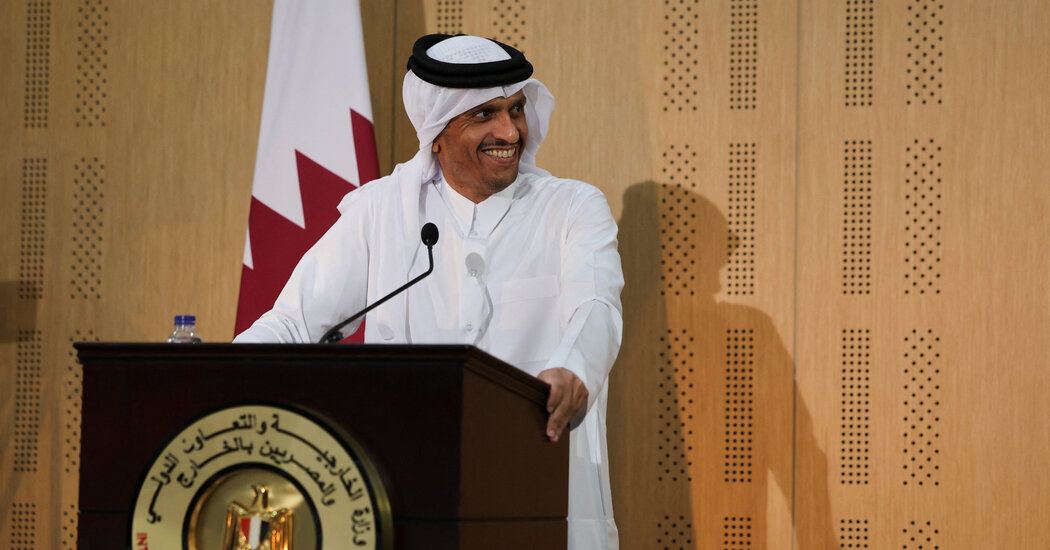
The prime minister of Qatar, a key mediator in the U.S. war with Iran, was in Tehran on Thursday for talks with senior Iranian officials as the conflict nears the six-month mark with no clear end in sight.
The prime minister, Sheikh Mohammed bin Abdulrahman Al Thani, met with the Iranian foreign minister, Abbas Araghchi.
The Qatari Foreign Ministry said that the discussions in Tehran focused on fostering the “conditions conducive to dialogue” and “upholding freedom of navigation” in the Strait of Hormuz.
Sheikh Mohammed’s trip to Tehran comes at a moment of heightened tension between Iran and Qatar. An Iranian general recently accused the Qataris of detaining three pilots who were shot down early in the war, a claim that Qatar denies.
After the U.S. and Israel attacked Iran on Feb. 28, Qatar has faced more than 700 missile and drone attacks that it blamed on Tehran, including strikes on natural gas facilities. Last month, Qatar accused Iran of targeting one of its gas tankers in the Strait of Hormuz.
Qatar, which hosts a major U.S. military base, helped broker a cease-fire between the United States and Iran in June that was intended to pause hostilities and lead to negotiations toward a lasting peace.
That agreement has since unraveled, largely because of disputes over the strait, a crucial waterway for oil and gas that runs along Iran’s southern coast and that both Tehran and Washington have blockaded.
For weeks, Iran and Oman, which also abuts the Strait of Hormuz, have been in talks about introducing a temporary route through the waterway, but no agreement has yet been announced.
The Qatari Foreign Ministry’s statement said that the proposed route in the strait, along with demining efforts in the waterway, were discussed during talks in Tehran on Thursday.
The Iranian Foreign Ministry spokesman, Esmail Baghaei, said that Sheikh Mohammed’s visit would focus on Qatar’s continuing mediation efforts. It was not immediately clear whether the missing Iranian pilots would be discussed.
The general who claimed the Qataris had detained the pilots, Seyed Mohammad Bagherzadeh, said this month that the men were flying Su-24 fighter jets in an operation on March 2, days after the outbreak of the war. He said that their planes had been hit by “enemy defenses” and that the pilots had ejected and had later been captured by the Qatari authorities.
Qatari officials have expressed surprise at the Iranian claim. Mr. al-Ansari, the Foreign Ministry spokesman, said in a news conference last week that Tehran had been invited to send a technical team to Doha, the Qatari capital, to review search operations for the pilots but had not done so. The Iranian Foreign Ministry said on Monday that the fate of the pilots remained unclear.
Despite those tensions, Qatar, alongside Pakistan, has continued to try to mediate in the conflict between the United States and Iran.
Officials from Pakistan were in Tehran on Monday and said they had held “very positive and productive” meetings toward restoring the terms of the cease-fire agreement the country helped broker in June. Oman’s foreign minister was also in Iran this week to discuss shipping through the Strait of Hormuz.
Despite the flurry of diplomacy, efforts to resolve the war remain stalled. The Trump administration announced this week a raft of new economic restrictions against 60 Iranian and Iran-linked entities, calling the measures an “economic D-Day.”
