


Welcome to Foreign Policy’s China Brief.
The highlights this week: An Olympics-style robotics tournament showcases China’s industry dominance, the United States threatens secondary sanctions on China over its support for Iran, and the founder of Evergrande Group is sentenced to life in prison for fraud and bribery.
Welcome to Foreign Policy’s China Brief.
The highlights this week: An Olympics-style robotics tournament showcases China’s industry dominance, the United States threatens secondary sanctions on China over its support for Iran, and the founder of Evergrande Group is sentenced to life in prison for fraud and bribery.
China Showcases Robotics Prowess
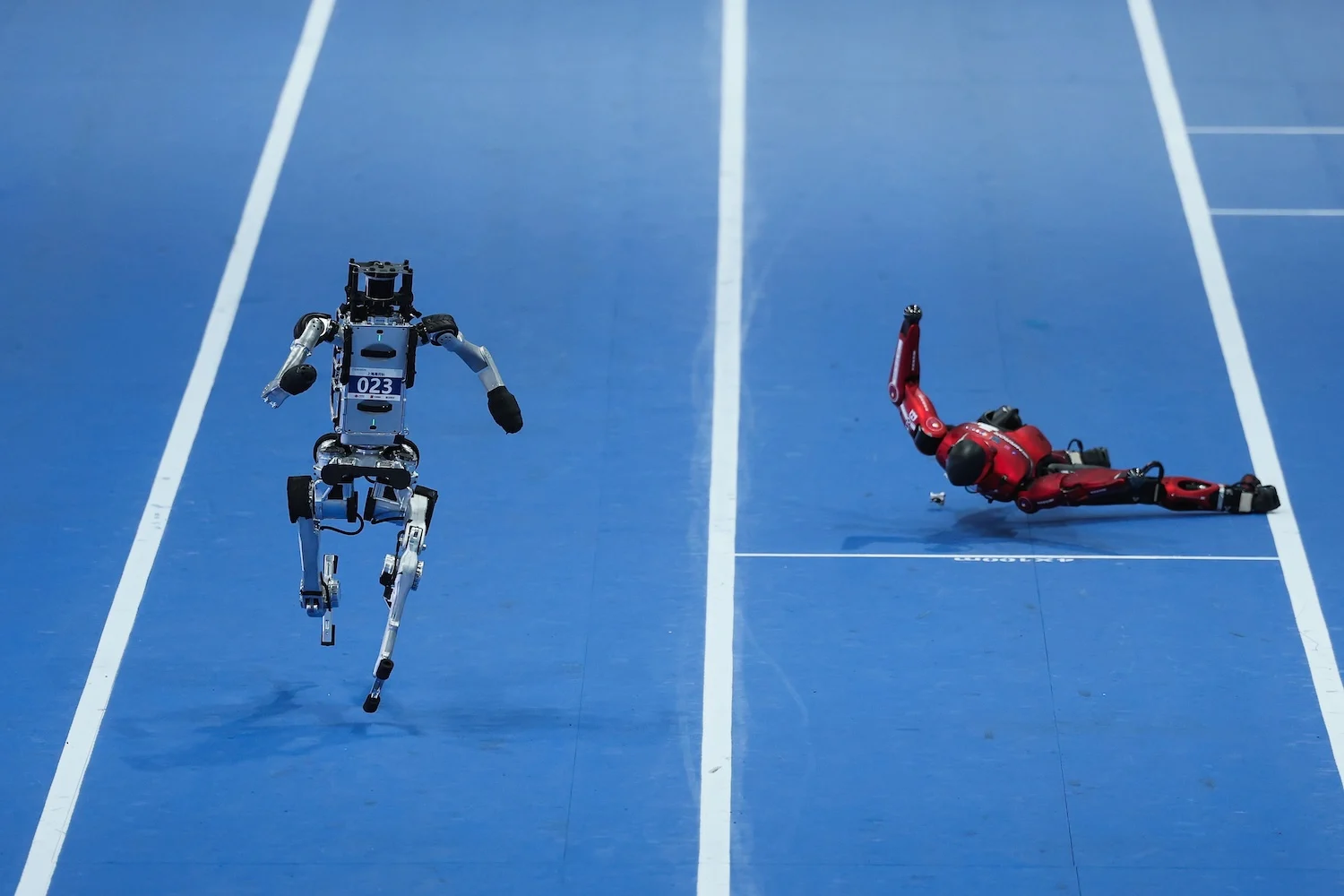
The 2026 World Humanoid Robot Games kicked off in Beijing on Saturday. Now in its second year, the Olympics-style, five-day event pit thousands of robots against each other in jumping, running, dancing, and even horseback riding. (The horses were also robots.)
Though there were some kinks to be worked out, the robots kept breaking records—including Jamaican sprinter Usain Bolt’s 100-meter time—and underscored China’s growing dominance of the global robotics industry.
But don’t expect to see these robots in the United States any time soon: Last month, the Trump administration announced a comprehensive ban on new imports of “advanced robotics devices,” which now must be assembled in the United States and contain at least 65 percent U.S.-made parts. The ban applies to all countries, but it is presumably targeted at China, which dominates robotics manufacturing and was the source of nearly 90 percent of all humanoid robots sold in 2025.
The move is likely to backfire because U.S. manufacturers simply cannot meet the demand for robotics components without massive investment and support. Though there are a few cutting-edge U.S. firms such as Boston Dynamics, the country’s robotics industry is a fraction of the size of China’s.
The ban shows that U.S. President Donald Trump and his officials do not seem to understand that China is genuinely ahead of the United States in certain fields. If Washington wants to catch up, it would be better served by securing access to Chinese technology than by cutting itself off from it.
As a manufacturing country, China has greater incentive to push robotics than the United States, especially given demographic shifts. China is running headlong into the problem of “getting old before it gets rich,” and it hopes that robots can pick up some of the slack. As labor costs rise and China’s working-age population shrinks, factories are automating at extraordinary speed.
Beyond the factory floor, China is concentrating its robotics applications on healthcare and elder care, both sectors that face their own looming labor shortages. In this respect, China is following Japan, which has incorporated robots into elder care for more than a decade—in part as a way to limit the need for immigration.
The scenario that most worries the United States, however, is military use. Humanoid robots are largely impractical for battlefield applications, though some Chinese developers argue that this will change in the next decade. For now, the robots dominating battlefields are drones—which are, as expert Faine Greenwood puts it, “little flying robots” that depend on many of the same technologies.
Unlike the broader robotics industry, where competition is more diffuse, the global civilian drone market is dominated by a single Chinese company, DJI. But other countries have practical battlefield experience that China lacks firsthand knowledge of.
Ukraine, for instance, has held its own against Russia in part by pioneering the manufacture of cheap, practical military drones, often using DJI parts. It has done the same for ground-based battlefield robots—land drones, essentially—where a humanoid form is not particularly useful. Like aerial drones, many of these models combine Chinese hardware with local ingenuity.
For the United States, learning from allies such as Ukraine may be a more effective strategy for catching up with China than simply trying to shut the door to Chinese technologies.
What We’re Following
Beijing faces secondary sanctions. Fresh off declaring a trade war against Canada, the Trump administration is threatening to impose secondary sanctions against China and other “enablers” of Iran’s economy if they do not comply with U.S. requests to sever financial connections with Iran. The announcement was short on certain details, but it did include several Chinese companies on its list of targeted entities.
There is zero chance that China will go along with this. So far, however, Beijing has responded with relative restraint. China seems to be betting that Trump’s rhetoric is hollow talk and that he is unlikely to blow up the bilateral relationship before his summit with Chinese President Xi Jinping next month.
CCP sexual assault scandal. A report that a local Chinese Communist Party (CCP) official and a business executive sexually assaulted and injured a woman in Hangzhou last month has gone viral in China. Public anger, as well as some state media coverage, has focused on China’s sexually tinged corporate drinking culture, which can involve harassment or even group trips to brothels.
Videos of officials and businessmen harassing women and girls began going viral in the 2000s. I’ve written on this culture at length and have watched repeated waves of public outrage over it lead nowhere. China’s business culture is so deeply embedded—and abuse of women by officials so protected—that change is difficult.
FP’s Most Read This Week
Tech and Business
Evergrande Group founder jailed. Hui Ka Yan, who founded property development company Evergrande Group and was once the richest man in Asia, is the latest Chinese billionaire to swap his business suit for a prison uniform. Hui, 67, was sentenced to life in prison on a range of fraud and bribery charges surrounding his work at the company.
Evergrande, once the world’s most valuable real-estate company, was a key player in the Chinese property bubble—but Hui will not be the last culprit. The property crisis has permeated almost every corner of the national economy, implicating everyone from local officials to billionaires such as Hui.
Who ultimately bears criminal responsibility will likely be determined by Xi’s political needs, not actual culpability.
Healthcare, biotech stresses. The recent deaths of at least two patients in Chinese gene-editing trials (and attempted cover-ups) have prompted U.S. lawmakers to call for greater scrutiny of Chinese clinical trial data by the U.S. Food and Drug Administration, which relies on such data when evaluating the safety of new drugs and other medical products.
It’s a long way from the pre-COVID-19 era, when healthcare and biotech once seemed poised to become major areas of U.S.-Chinese investment. Those hopes fell apart as joint accusations over COVID’s origins caused an almost total breakdown of bilateral cooperation on biosecurity and the United States put Chinese biotech firms on its economic hit list.
China’s healthcare market is still dominated by U.S. companies in some areas, such as medical devices. Even as that market grows, likely reaching $1.5 trillion a year by 2029, U.S. firms are increasingly being pushed out by Chinese regulators eager to promote local alternatives.
