


Universal travel adapter or travel-ready charger — which do you need?
Adrian Kingsley-Hughes/ZDNET
Follow ZDNET: Add us as a preferred source on Google.
ZDNET’s key takeaways
- Know what the power is in the country you’re going to.
- Check device voltage needs before you travel.
- Remember, these do not convert voltages!
One fact of life when it comes to travel is dealing with different power outlet styles (called sockets in some countries) around the world. While USB might have come a long way to standardizing the charger-to-device pathway, the wall outlet to charger is something travelers must think about and plan for. The US wall outlet (the NEMA 5-15 for you people who like to know stuff) that outputs 120V/60Hz power isn’t a worldwide standard. Not by a long shot.
Also: The 7 tech travel hacks I swear by – after years of learning the hard way
And this is just the beginning of things getting complicated. Not only will you come across different physical plugs and outlets, but the electricity can also be very different.
Plugs and outlets
First, as you’re probably aware, there are two types of plugs in the US — an ungrounded, two-flat-pin Type-A, and a three-pin grounded Type-B.
You’ll find similar outlets across most of North and Central America, as well as huge swathes of East Asia and Latin America. But this is where things get more complicated.
Just because you’re in a country that uses a compatible outlet doesn’t mean it’s outputting the correct power. In Japan, it’ll be pushing out 100V, while in Paraguay, it’ll be delivering a spicy 230V.
Also: 6 must-have travel gadgets, according to industry experts
And there are a lot more socket/plug types out there. The UK, Ireland, Cyprus, Malta, Malaysia, Singapore, Hong Kong, and countries in the Arabian Peninsula all use the three-prong Type G system featuring a monster of a plug that’s internally fused. (And if you think stepping on a Lego piece is painful, wait until your foot finds one of these lying on the ground prongs-up!)
What happens when you connect a device to an electricity spec it isn’t expecting depends on the device. For travel, we can ignore the frequency (Hz or Hertz) bit, because it’s mostly things like AC synchronous motors found in older clocks and audio turntables, and certain motors or transformers that are affected — and we don’t usually travel with turntables or refrigerators.
Note: If you want a deeper dive into worldwide outlets, WorldStandards.eu has everything you’ll need to know.
Voltage is where things get interesting
Voltage is more of an issue. If something built for 120V in the US gets 100V in Japan, the worst that happens is it won’t work. But turn that around and put 230V through it, and it’s not built for it, and you’ve got the potential for overheating, melting, and fires.
Or, if you’re lucky, it might just stop working in an undramatic fashion. I say this because while the “American hair dryer catches fire in a European hotel” is a common travel blog trope, I can’t find any examples of this happening. And in my professional efforts to deliberately overvolt devices, they usually die rather unspectacularly and don’t try to take people and property with them.
Also: I never leave for vacation without doing these 7 home security checks first
That said, it’s not something you want to be doing, and the best way to avoid this is knowledge. Knowledge is power, and you can usually find information about the power a device needs on the device itself. The print will likely be minute, so you might want to take a photo of it to read it or use the magnifier on your iPhone or Android smartphone.
Everything you need to know, printed on the device (in the tiniest font imaginable).
Adrian Kingsley-Hughes/ZDNET
Rather than a number, you’ll get a range. Increasingly, consumer electronics and tech gadgets are built to operate across a broad range of voltages and frequencies, and most chargers offer worldwide support — 100-250V AC, 50/60Hz — with internal auto-sensing to cover everywhere from Japan to Europe.
Note: Some of you might remember the little switch on the back of PCs that allowed you to change the voltage range. This sort of manual switching is rare because it leaves the door wide open to user error.
When it comes to travel, there aren’t many devices you can buy that reliably convert voltages. You can find them, but they’re pretty big, pretty bulky, and — at least in my experience — pretty unreliable in the long-term. I don’t need hair dryers or straighteners, so my research on this is limited. My advice is that if you need a hair dryer, use the one in the hotel, but if you want to take straighteners or curlers — which are far lower-powered than a hair dryer — devices like this will work.
Plug and socket mismatch
OK, so you’re from the US, and you’re traveling to the UK. How do you get stuff that normally plugs into a Type A to fit into a Type G?
Also: My 7 essential laptop-bag items after decades of working remotely
Back before chargers had infiltrated our lives to such a degree, people used to buy a travel plug adapter compatible with the country they were headed to. These were dumb devices that consisted of a plug from the destination country Frankensteined onto a socket from your country. They cost a few bucks, and before the likes of Amazon, they were widely available in airports and such.
Note: Don’t be tempted to buy the cheap “universal” travel plug adapters that you might see for sale in sketchier, more unregulated parts of the internet. This is because the outlet on the front usually lacks any safety features and allows you to easily touch the live innards with a curious finger or careless metal pen.
There’s a reason why these devices are nicknamed “deathdapters.” If you look into the outlet and you see metal bits, that’s not good, and I recommend avoiding them. You can find decent versions of these converters with safety mechanisms that stop fingers touching electricity, but telling the good from the bad can be tricky. If in doubt, avoid!
Avoid these cheap plug converters… they have no safety mechanism to prevent you touching live bits!
Adrian Kingsley-Hughes/ZDNET
Dumb adapters have given way to two newer devices — the universal travel adapter and the travel-ready charger. Armed with all the information above, you’re now ready to find out which one is right for you.
Universal travel adapter
These solve several problems in one device. Let’s take a look at what a unit like the Ceptics 140W Gallium Nitride (GaN) universal travel adapter can do.
Ceptics 140W Universal Travel Adapter
Adrian Kingsley-Hughes/ZDNET
First, it has the business end to fit into a wide array of outlets. This adapter has output prongs to fit into Type A (US), Type C (Europe and Asia), Type I (Australia, New Zealand, and Chile), and Type G (UK) outlets found in well over 150 countries, and all of these pull into the unit neatly for packing.
It also features a universal input socket — don’t worry, this one has safety mechanisms to prevent fingers and pens getting zapped — that’ll accept pretty much every plug you can throw at it. This means that you can convert a foreign socket to accept your devices when you’re away. For peace of mind, it has a built-in fuse (with a spare) in case anything draws too much power.
Curious fingers are kept away from the zappy-zaps.
Adrian Kingsley-Hughes/ZDNET
Just remember, this is NOT a voltage converter! On top of that, it shouldn’t be used with any devices that need grounding. (Not many of us travel with such devices.)
The other problem this solves is that it also serves as a charger for your gadgets. This 140W unit has three USB-C outputs (two with a maximum output of 140W each and one that maxes out at 18W), plus an 18W-max USB-A port for your legacy stuff.
You can pick up universal travel adapters in a range of USB power outputs, from 35W all the way to 205W. This allows you to cater to the devices that you take with you, and get an adapter that works for you.
Also: This 205W GaN adapter has effectively replaced my other travel chargers
And this can run on any power you plug into, supporting 100-250V AC, 50/60Hz. This gives you a plug converter and a charger, all in one unit. All this for $51. I took the Ceptics with me on my trip to see the solar eclipse in Spain earlier this month, and it performed brilliantly. I’ve also put it through a barrage of tests, pushing it to its limits, and it ticked all the boxes.
Travel-ready charger
A travel-ready charger is a much simpler bit of kit. Think of it as a standard wall charger, but with a selection of interchangeable prongs that fit different outlets. These attachments normally fit over the US prongs.
The BMX GanSTA 140W laptop charger comes woth a lot of bits.
Adrian Kingsley-Hughes/ZDNET
And this is the biggest weakness of these — you can’t lose the attachments. Most come with a little bag to store the ends, but I’ve lost count of the number I’ve misplaced, only to find them when I get rid of the charger itself.
Note: These travel-ready chargers are also handy because they can be sold worldwide and people can attach the appropriate prong for their territory.
Also: You’re charging your phone all wrong: 6 common myths, debunked
I needed a dedicated charger for my iPad Pro when I went to Spain, so I took the BMX GanSTA 140W laptop charger, an advanced, pocket-sized charger with Type C, Type I, and Type G attachments that clip over the US prongs.
This comes with a literal handful of attachments.
Adrian Kingsley-Hughes/ZDNET
BMX has been making some very good semi-solid-state power banks, and this charger has been equally fantastic. It comes loaded with four ports — two 140W maximum USB-C, a 65W maximum USB-C, and a USB-A port that can handle up to 18W — and the whole package is significantly smaller and lighter than my single-port 140W Apple charger.
Also: You’ve been using your power bank wrong, and airline rules make that obvious
It also has a touchscreen display that gives you an overview of what the ports are doing. For $89, it’s a charger that’s definitely worth considering and has you covered both at home and while traveling. (Just don’t lose the adapter bits!)
So, which do you need?
It depends. If I’m packing light and I have to pick one, then I tend to go for a universal travel adapter. I like that there are no bits to lose, and I also like that I’m not blocking up an outlet. In hotel rooms with a shortage of outlets, I don’t have to choose between a lamp and charging my iPhone.
Also, when I was hiking in Spain last year, I found that communal areas were short on outlets, and they were already blocked with chargers. However, having a universal travel adapter meant I could unplug what was already connected, plug in my charger, and then plug the original device into that, keeping everyone happy.
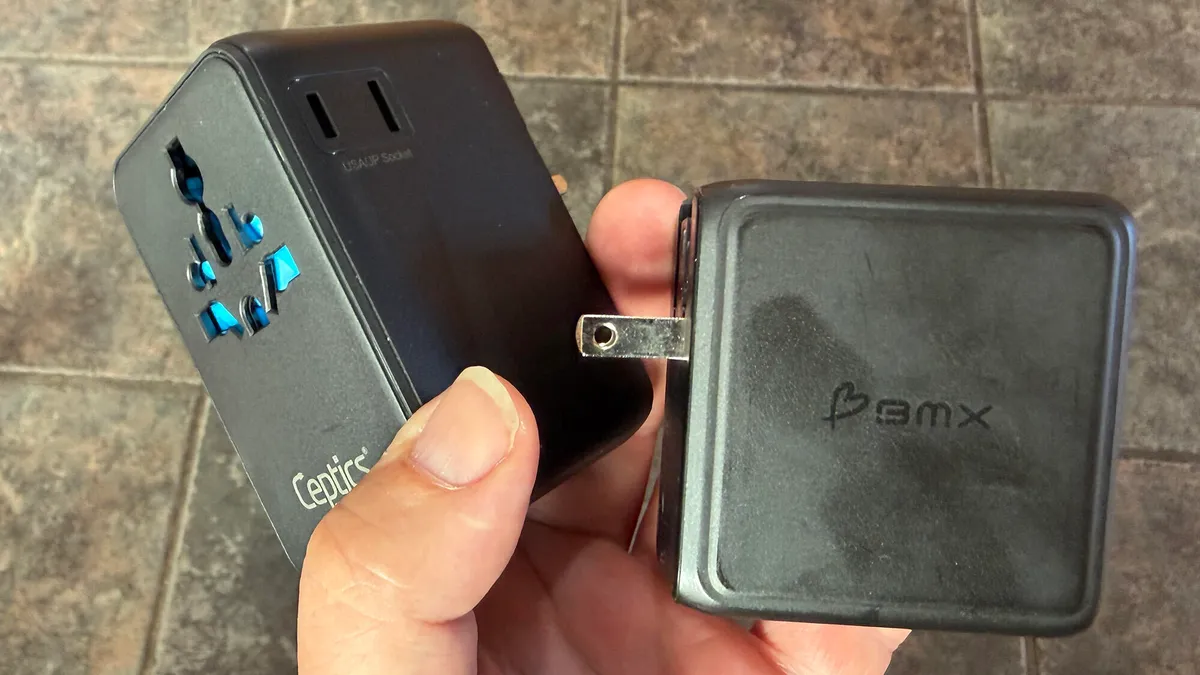
If you have both, you can join them together.
Adrian Kingsley-Hughes/ZDNET
If I have the space (or I’m not carrying everything on my back like an old donkey), I’ll take both because it gives me flexibility, and I can plug my charger into the universal travel adapter for a hybrid charging setup that can charge anything.
